Aesthetic credo
“Made by hands, as if opened by Heaven”
The classical garden is the Chinese art of "re...
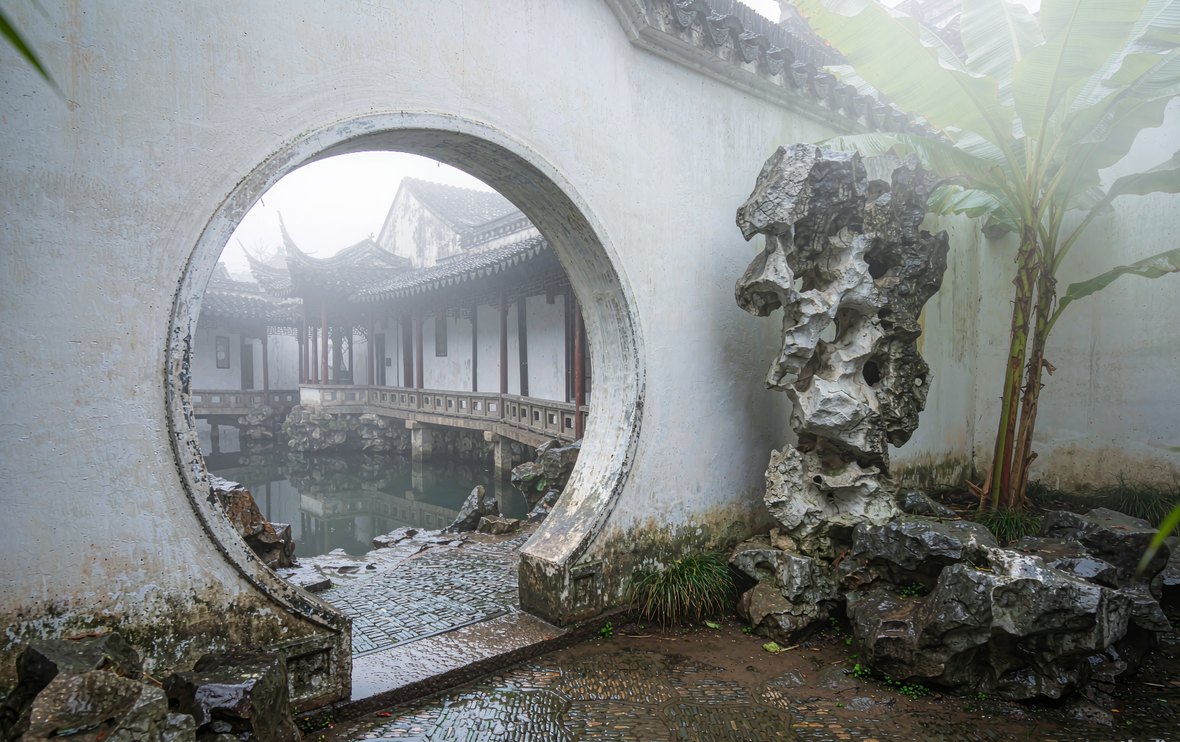
The classical garden is the Chinese art of "rebuilding mountain and forest within the city": piling rocks, channeling water, planting trees, raising pavilions — with a tiny ground, a scholar's landscape to wander in, dwell in and gaze upon — "made by human hands, yet as if opened by Heaven" (Ji Cheng, *Yuanye*). Its lineage spans two millennia: from the "one pool, three isles" of Qin-Han palace parks, through the expressive landscape gardens of Tang and Song, to the supreme private gardens of the Ming and Qing — Suzhou's Humble Administrator's Garden, Lingering Garden, Master-of-Nets Garden and Lion Grove, Yangzhou's Ge Garden, the imperial Summer Palace standing together; in 1997 the Classical Gardens of Suzhou entered the World Heritage List. The garden's aesthetic grammar is unmatched in the world: rockery and water are the skeleton (a fist-sized stone for a peak, a spoonful of water for an ocean); borrowed and framed views are the magic (one window one picture, a new scene at every step); names and couplets are the finishing touch ("With Whom Shall I Sit?" — the pavilion's name is itself a poem) — "one peak holds a thousand fathoms of Huashan, one ladle, ten thousand li of rivers and lakes". The garden is the spiritual courtyard of the Chinese scholar: the disappointed official settled here his longing for mountains and waters, "gaining the delight of the wilds without leaving the city walls" — at the end of the garden lie the Chinese ideas of nature and of life.
Rockery is the garden's first art: Taihu stones (by the four tests — "thin, wrinkled, porous, translucent") and yellow stones are piled into peaks, valleys and caves; the Lion Grove is famed for its rockery maze, and "gaining the wilds without leaving the city" rests wholly on piled stone. Within one peak must live the complete grammar of mountains: the main peak, the flanking hills, the stone steps, the caves; water is its counterpart: the pool at the centre as "field", winding streams as "line", springs and cascades as "point" — "water sends the thoughts afar, stone carries them back to antiquity"; mountain and water are the spiritual base of the Chinese scholar.
The Crown Cloud Peak of the Lingering Garden (6.5 metres, the foremost garden stone of Jiangnan) is the extreme of "stone standing for mountain": one stone in the court, thin, wrinkled, porous, translucent — a connoisseur could sit before it half a day. The depth of the Chinese gaze upon stone is hard for Western garden history to fathom.
The garden's spatial art is a conjuring of "hiding and showing": withhold, then release — a narrow lane at the entrance, then the moon gate opens onto sudden breadth; borrowed views — the pagoda, the hill, the fields outside drawn into the garden (the Humble Administrator's Garden borrows the North Temple Pagoda — "skilful in borrowing, exact in measure"); framed views — doorways and lattice windows cut picture frames, a scene at every step; opposed, screened, divided and veiled views — the Master-of-Nets Garden conjures a vast expanse of misted water from half a mu of court, purely by spatial artifice.
The essence of the art is time: the garden refuses to be seen at one glance and makes you walk — the path is the narrative; touring a garden is reading an essay with its rise, development, turn and close.
The garden is not an ornament but a residence: banquets in the hall, study in the studio, rain listened to under the veranda, heat escaped in the pavilion — of the three states "to wander, to dwell, to gaze" (the terms of the painter Guo Xi on landscape), "to dwell" is the root. The Distant Fragrance Hall of the Humble Administrator's Garden and the Peony Study of the Master-of-Nets Garden were their masters' spiritual salons — "With whom shall I sit? The bright moon, the breeze, and I" (Su Shi's line, borrowed by the Humble Administrator's Garden as a pavilion's name) — the dialogue of the owner with Heaven and earth opens here.
The garden also carried the tradition of the elegant gathering: wine-cups floating down a winding stream, qin music and lotus-gazing, tea and stone connoisseurship — the garden was the site of the literati's sociability and creation; many famous paintings and poems were born in gardens.
The summit of garden theory is Ji Cheng's *Yuanye* (1631), among the world's earliest monographs on garden making, complete with its philosophy ("made by hands, as if opened by Heaven") and its methods (the chapter on borrowed views is the book's essence). Transmission runs on two lines: the restoration and study of Suzhou gardens (garden specialists, World Heritage monitoring) and the contemporary translation of garden aesthetics — I. M. Pei's Suzhou Museum honoured the garden with "Chinese yet new, Suzhou yet new", its "rockery of sliced stones" using the wall as paper and stones as pigment.
The garden keeps travelling abroad: the Astor Court in New York (modelled on the Peony Study) opened the export of Chinese gardens, followed by Chinese gardens in Vancouver, Frankfurt and Singapore — the Eastern spatial wisdom of "mountain and forest within a few paces" is settling into cities around the world.