Region
Qiandongnan, Guizhou (Leishan, Taijiang)
Miao silverwork is the summit of ethnic costum...
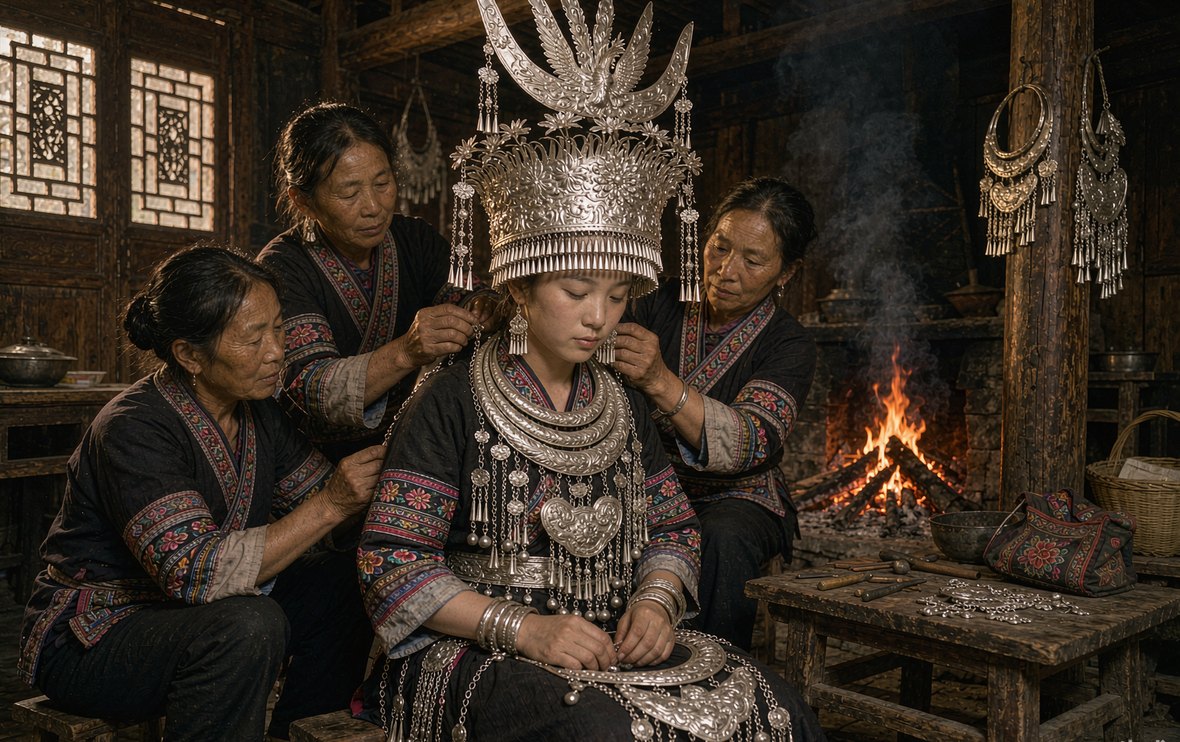
Miao silverwork is the summit of ethnic costume craft in China: horned headdresses, crowns, neck rings, chest locks, bracelets, silver plates for the jacket — a Miao woman in full dress may carry more than ten kilograms of silver, for the aesthetic runs to the large, the heavy and the many. Silver means far more than ornament: the memory of migration is engraved in its patterns, with wave motifs recalling river crossings and buffalo horns honouring the ancestor of farming; silver passed from mother to daughter is family property and a mark of standing, and the saying "no silver, no maiden; no maiden, no market day" measures its weight. The forging craft is a system of its own: melting, hammering, drawing, chasing, plaiting and washing, more than thirty steps, with wire drawn as fine as a hair and a single crown the work of months. In 2006 Miao silverwork entered the first national list of intangible heritage, and the silversmith villages of Leishan and Taijiang in Qiandongnan carry the line on — every hammer blow is a page of an unwritten history of a people.
The Miao attachment to silver has a deep historical logic. A people who moved repeatedly needed wealth that could be carried: silver was both currency and ornament, a form of property that could be worn, so that the family fortune walked with its owners. From Ming and Qing, silver flowed into China in quantity, and trade links made the material available in Miao country; silver is also white and apotropaic, protecting those who travel far. A choice of property was at the same time a choice of faith.
Silverwork is therefore a female line of inheritance: from a daughter's birth her parents add to her set year by year, and at her wedding the full panoply goes on her back. One set records one girl's life and measures one family's glory.
Miao silver patterns are an unwritten history: Mother Butterfly, the creation ancestress; buffalo horns, the cult of farming; wave motifs and galloping horses, the memory of migration; golden pheasant and maple leaf, the totems of the people. The pendants on a crown sway with each step and sound like a waterfall of tiny bells — the Miao recognize a group by ear, for the ringing of silver is a signal of identity. The aesthetic of weight also hides a practical logic: heavier silver means a solider household and finer craft.
The composition does not use perspective but fullness: dragons and phoenixes, fish and birds, sun, moon and stars fill every space — Miao art is fiercely autonomous in its aesthetics, and scholars have called the costume "a Miao encyclopedia worn on the body".
Silverwork is an art of fire and hammer. Melting requires reading the colour of the flame, for the silver must be nearly pure; forging must be done while hot; wire-drawing shows the mastery, a bar of silver drawn repeatedly through dozens of holes in a plate until it is finer than a hair and still unbroken. Chasing is "the picture in the mind": dozens of punches, one blow at a time, the veins of a butterfly's wing worked at the scale of millimetres; then plaiting, soldering and washing away the fire stain — and by the end craftsman and silver have tamed each other.
Transmission works through the silversmith village: in Kongbai of Leishan and Shidong of Taijiang nearly every household has a forge, and apprenticeship is mostly within the family. The smith farms in season and works silver out of season, hammer never leaving the hand, and this living transmission has kept the craft out of the museum.
The silver shines brightest at Miao New Year and the Sister Festival: at Shidong in Taijiang girls in full dress dance on the drum ground and the clash of silver sounds like wind in a forest, the "silver dress contest" the greatest visual event of the Miao hills. Photography and short video have carried the "silver girls" around the world — ethnic full dress has become a top-tier cultural image.
Renewal is happening at the same time: silver design has entered fashion, with silver catwalks and brand collaborations; tourism workshops let visitors chase a pattern themselves; young smiths open studios and take orders from abroad. An epic written with a hammer is being written on by a new generation.