Location
Hulunbuir, Inner Mongolia
The Hulunbuir Grassland covers some 100,000 sq...
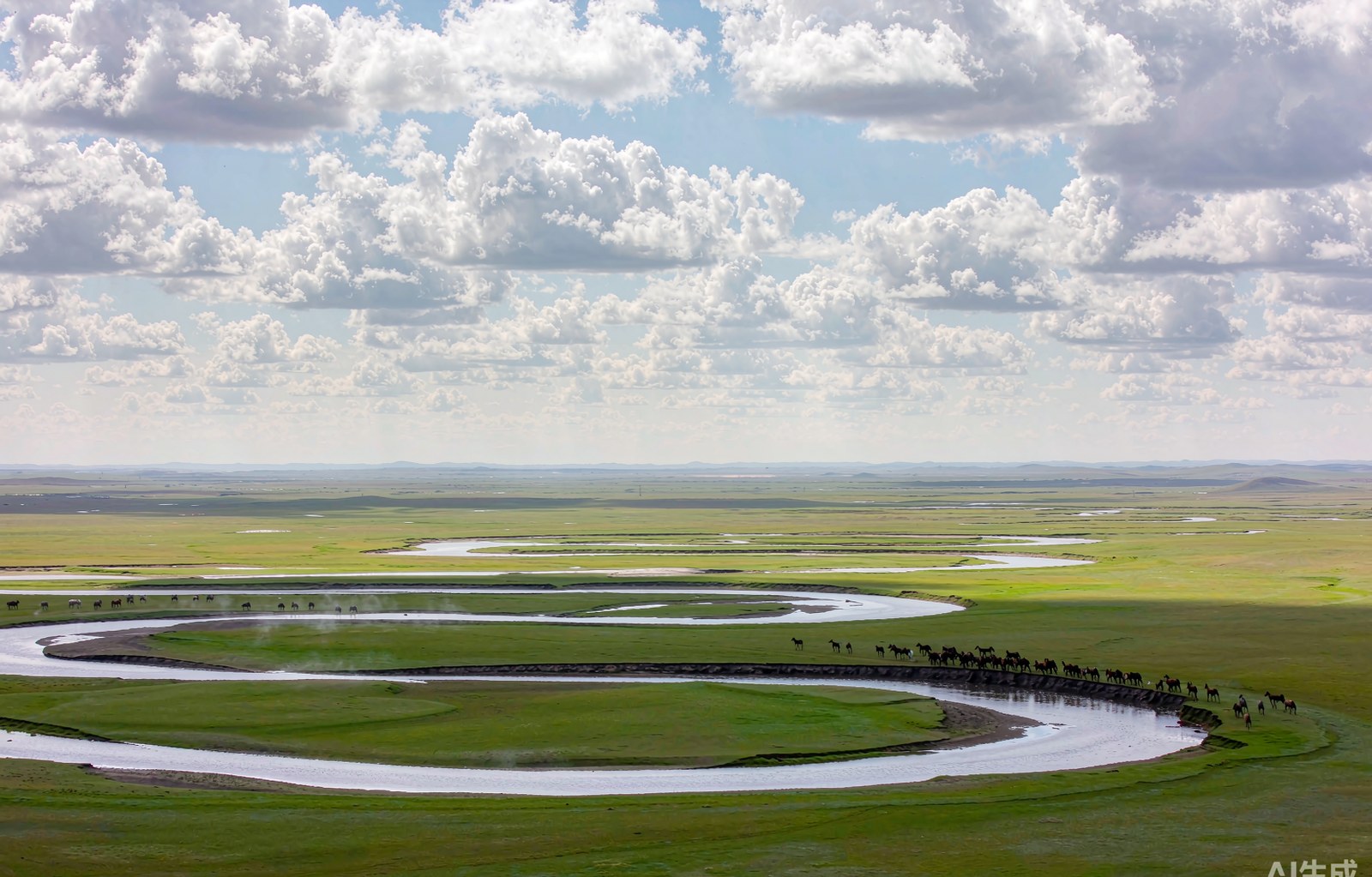
The Hulunbuir Grassland covers some 100,000 square kilometers — a world-famous grassland and China's best-preserved natural pasture, named for Hulun Lake and Buir Lake. The Mergel River winds across it as "the first winding river under heaven," and the nomadic civilization of the Mongols has continued here for a thousand years. This is truly the land of "the sky like a great dome covering the four wilds."
The Mergel River runs 319 kilometers, its channel so contorted it is called "the first winding river under heaven" — from the air, a silver ribbon coiling innumerable S-curves across the green. The writer Lao She visited in 1961 and sang its praises. In summer the herders follow water and grass, and yurts and flocks scatter like pearls along the banks — the living footnote to "the wind bends the grass, and cattle and sheep appear."
Hulunbuir is the birthplace of the Mongol people: the Erguna river basin was the homeland of the Mongol tribes, and Genghis Khan's unification of the steppe began here. The Gaxian Cave inscription of the Tuoba Xianbei proves this grassland was also the cradle of the Northern Wei dynasty. The Golden Khan encampment and the Nadam at Huhenuoer preserve intact the traditions of the ovoo offering, the morin khuur and khoomei throat singing.
敕勒川,阴山下。天似穹庐,笼盖四野。 — The Chile plain lies beneath the Yin Mountains; the sky is like a great dome covering the four wilds.—— Northern Dynasties folk song, "Song of the Chile"
The Greater Khingan range on the grassland's northern rim is the source of the Erguna River, and the Genhe wetlands (Erguna wetlands) rank as Asia's foremost. In the Russian villages of Enhe and Shiwei, log cabins and the scent of leba bread testify to a multiethnic coexistence. Hulun Lake is Inner Mongolia's largest lake, where cranes and swans rise and settle in migration season — grassland, forest, lakes and frontier towns compose the vast mosaic of Hulunbuir.