Location
Burqin, Altay, Xinjiang
Kanas lies deep in the mountains of Burqin Cou...
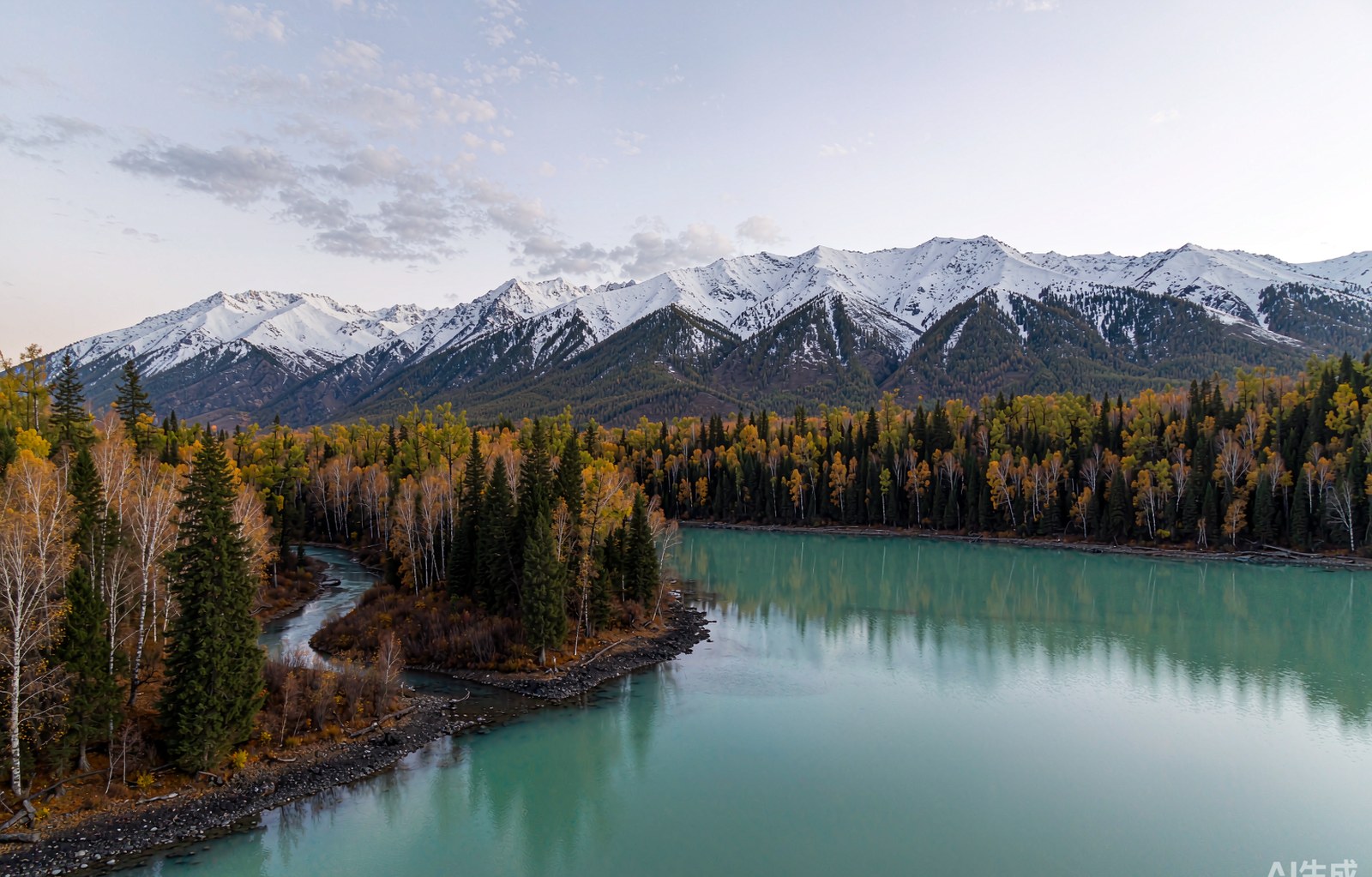
Kanas lies deep in the mountains of Burqin County, Altay, Xinjiang — a glacially dammed lake whose water shifts between blue and green with the mineral silt of the glacier. Birch woods and spruces ring the shore, wood-smoke rises from Tuva cabins, and in autumn, when the forests turn in layers, it is the most stunning fall color in China. The "three bays" — Moon Bay, Sleeping Dragon Bay and Immortal Bay — together with Hemu village compose the fairyland of northern Xinjiang.
Lake Kanas was carved by Quaternary glaciers and dammed by terminal moraines; it runs 24 kilometers long and reaches 188.5 meters deep, among the deepest alpine freshwater lakes in China. Its color changes with season and light — milky white-green in early summer, jade blue at high summer, ink-green in late autumn — caused by the selective scattering of light off the fine mineral particles ground from rock by the upstream glaciers. The legend of the "lake monster" has endured for decades, most often attributed to a giant taimen salmon.
Immortal Bay at dawn is wreathed in mist like a floating isle of immortals; the "footprint" in the S-curve of Moon Bay is said to be left by Genghis Khan in pursuit of a fleeing enemy; the midstream islet of Sleeping Dragon Bay resembles a recumbent dragon. From late September the birches, Siberian larches and firs put on gold in turn, and within two weeks the forests are ablaze — Kanas autumn is widely held to be China's finest, and the morning mist and chimney smoke of Hemu village are its classic still frame.
北疆自古出胜境,桦林深处有人家。 — The northern frontier has bred famed landscapes since olden times; deep in the birch woods, homes of men.—— Modern verse on Kanas
The people of Kanas, Hemu and Baihaba are mainly Tuva — an ancient people skilled in horsemanship, archery and music, whose syr (chuur) flute is regarded as a living fossil of steppe music. Hemu is the best-preserved Tuva village in China, its peaked log cabins scattered among birch woods and snow mountains; after winter snows seal the passes, the Tuva fur-skinned skis reveal a shared ancestry with the very origins of skiing.