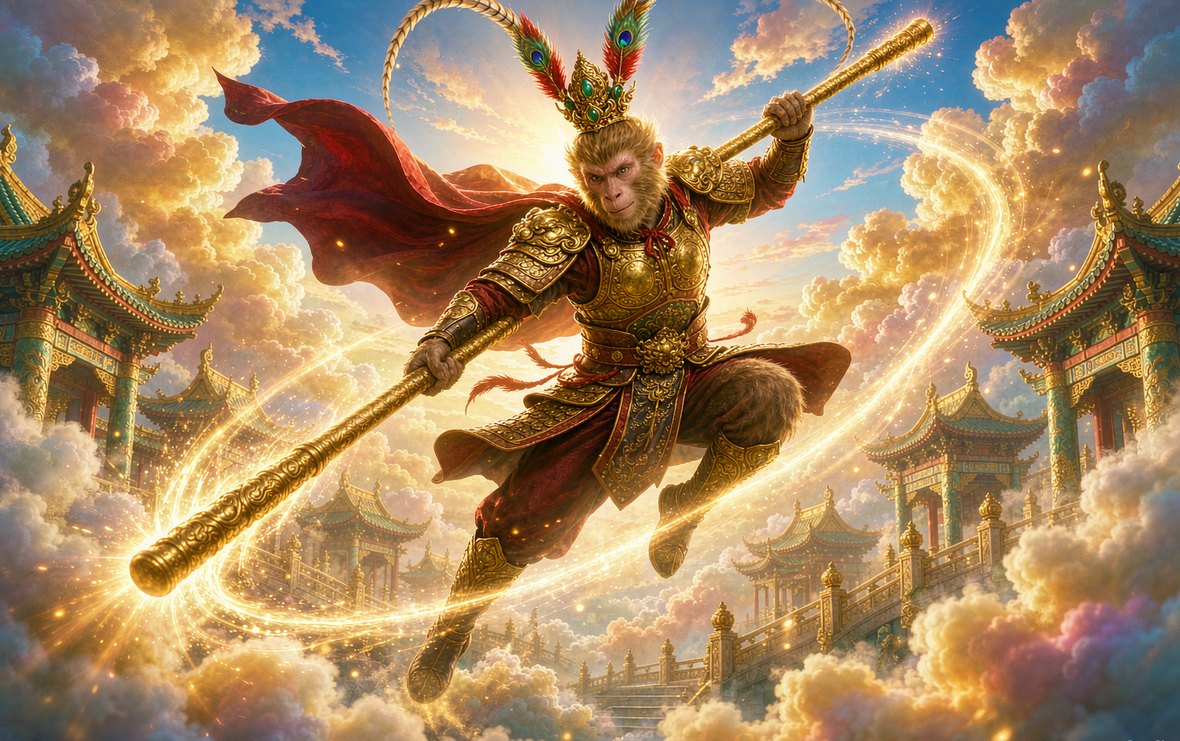
A monkey wrecks the heavenly court — stealing peaches and elixir, beating every squad of celestial troops — yet the Chinese do not call him a rebel; they have loved him for four hundred years. Why? Because he let everyone be gloriously defiant, once.
Fearless of authority, free in spirit. The longing for freedom, unbent by restraint.
Brave to defend freedom.
Why is a monkey born from a stone the best-loved hero in China? Because he dared to turn the Heavenly Palace upside down. He forced the Dragon Palace to yield the sea-pacifying needle, crossed out his own name in the Ledger of Life and Death, stormed off when he learned that Groom of the Heavenly Stables was a post without rank, crowned himself "Great Sage Equal to Heaven," stole the immortal peaches, swiped the elixir of Laozi, fought off a hundred thousand heavenly soldiers, and kicked over the Eight Trigrams Furnace — refining from the flames a pair of fiery golden eyes. The Uproar in Heaven is the most exhilarating stretch of Journey to the West, and the loudest cry in the Chinese heart: fearless of authority, free in spirit. This monkey is the most vivid totem of freedom in Chinese culture.
On the Mountain of Flowers and Fruit in the eastern continent, an immortal stone, "nourished by pure heaven and earth and the essence of sun and moon," burst open to release a stone monkey. He had no father and no mother; he came from no one, and therefore owed no one. Leaping through a waterfall he found the Water Curtain Cave, settled the monkeys there, and was hailed as the Handsome Monkey King — a kingdom won by his own daring.
The manner of his birth shaped his character: having received no favors, he fears no power. He bows to no unicorn's rule, no phoenix's government, no human throne — freedom is the proof of origin the stone monkey was born with.
Seeking a weapon worthy of him, he forced his way into the Dragon Palace of the Eastern Sea and took the Ruyi golden-hooped rod, weighing thirteen thousand five hundred catties; seeking long life, he stormed the Hall of Darkness, made the judge bring out the Ledger of Life and Death, and struck out the name "Sun Wukong" and every monkey's name with one stroke. Even the King of Hell could do nothing.
These are the first declarations of war on the established order: why should weapons belong only to dragons? Why should lifespans be fixed in advance? The monkey answers in the most direct way — my weapon I take myself; my name I cross out myself.
The Jade Emperor made him Groom of the Heavenly Stables; when he learned it was a post without rank, he stormed back to earth in fury. Re-titled "Great Sage Equal to Heaven," he was still not invited to the Peach Banquet. So he stole the peaches, swiped the elixir, wrecked the banquet, beat back a hundred thousand heavenly soldiers, wagered transformations with the god Erlang, was captured and sealed in the Eight Trigrams Furnace — and emerged with fiery golden eyes, kicking the furnace over and fighting his way out through the South Gate of Heaven.
It is an uproar without disguise and without apology. Chinese readers have never worried that he might lose — the joy of it is the point in itself.
"Emperors take turns — next year the throne comes to my house." Spoken by a monkey, that line toppled the last majesty of the Heavenly Court. Five hundred years under the Mountain of the Five Elements, then the golden band upon his head: he escorts the Tang monk on the journey west and wins true attainment at the end. Some lament that he was "tamed," but look closely: he put on the band by his own choice. To bind oneself for a promise is another thing entirely from being broken by power.
What the Uproar in Heaven truly left the Chinese is that daring: to question, to say no, to press impossibility to the ground. Longing for freedom, unbent by restraint — for four hundred years this monkey has lived in the eyes of every Chinese child looking up at the sky.