Functions
Ancestor worship · council · instruction · covenant
The ancestral hall is the ritual building in w...
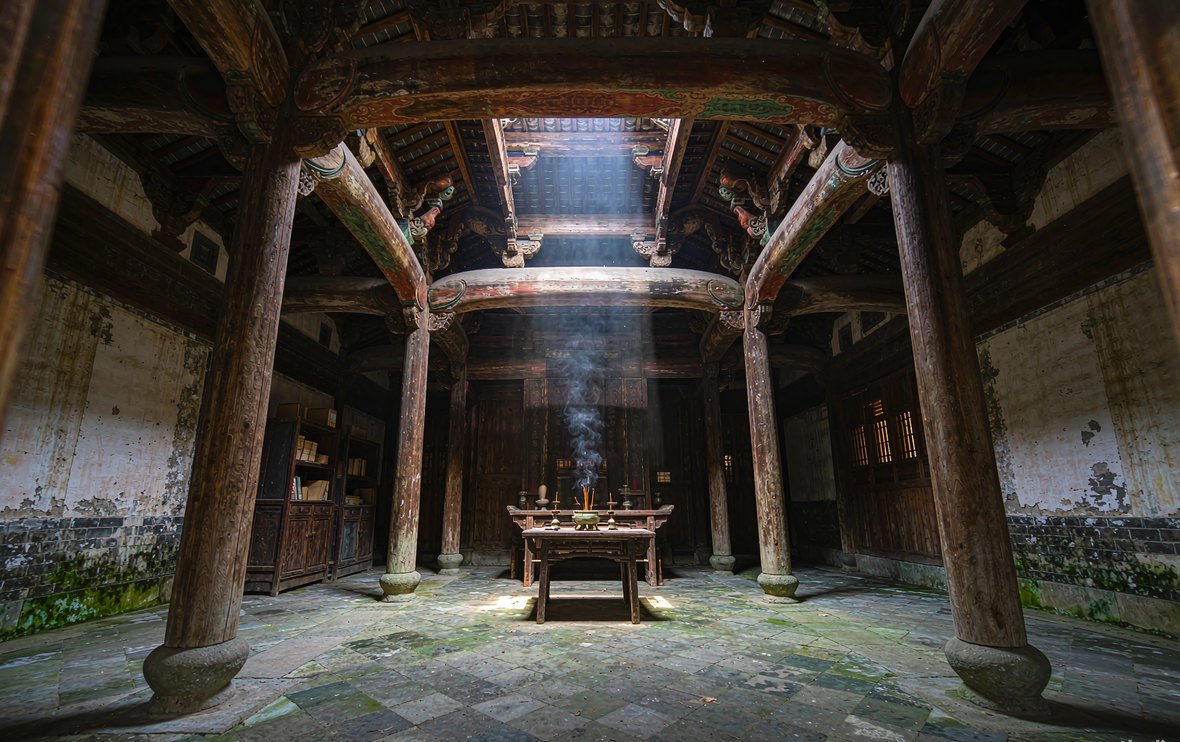
The ancestral hall is the ritual building in which a lineage worships its ancestors and conducts its council and instruction — the spiritual centre of rural society: one great hall to a village (or several), with the entire institution of "living by clan, honouring ancestry, binding the kin" revolving around it. Its lineage is long: tomb-shrines existed by the Han; Song Neo-Confucians advocated clan temples; after the Jiajing reign of the Ming "permitted the people to unite their clans and establish temples", halls sprang up everywhere and peaked in the Ming and Qing — those of Huizhou, Guangdong and Fujian are most renowned: the Luodongshu Ancestral Hall at Chengkan in Huizhou is grand as a palace; the Chen Clan Ancestral Hall in Guangzhou, with its "three carvings and two sculptures" (wood, brick, stone carving plus pottery and lime sculpture), crowns Lingnan. The hall's functions far exceed sacrifice: genealogies compiled here, clan rules proclaimed here, weddings and funerals held here, clan property managed here, sons instructed here — the hall is the "city hall + assembly room + school" of rural antiquity in one. Today the hall's cultural identity is reborn: clan reunions, heritage performances, village museums — the spiritual coordinate of a lineage still sits at its origin.
The ancestral hall is clan institution made space: Song Confucians (Cheng Yi, Zhu Xi) pushed ancestral sacrifice down from the aristocracy, and in the mid-Ming the state allowed the people to unite clans and build temples — the hall then became standard equipment. Within a lineage, the great hall (first ancestor), branch halls (lineages) and family shrines (households) form three tiers; genealogy and hall are two faces of one thing: the register records descent, the hall enshrines the tablets — the ancestral memory of "root and source" thus made institution.
The ritual order of the hall is the power order of the clan: tablets arrayed by generational precedence, worshippers ranked by seniority, elders seated by standing — one glance inside a hall reveals the structure of a lineage.
The typical plan: screen wall (or flag-stone) — gate hall (ceremonial gate) — skywell — sacrificial hall (the great room for worship and council) — sleeping chamber (housing the tablets) — isomorphic to the palace's "state halls before, living halls behind", only at intimate scale. Rank was regulated (a commoner hall must not exceed its measure); Hui halls win with horse-head gables and the three carvings, Lingnan halls vie in lime and pottery ridge sculpture — the Chen Clan hall's ridges carry hundreds of pottery figures, earning it the name "pearl of Lingnan architectural art".
Plaques and couplets are the hall's "text façade": "the ancestors' virtue wafts fragrant", "glorify the past, enrich the future" — the lineage's history and values hang in the most prominent place, where clanspeople pass daily and look up to see them.
The hall's practical function was a rural constitution: income from clan lands and charitable estates was administered here (funding schools, relieving the poor, mending bridges); clan rules were read out and enforced here (punishment included the soft sentence of exclusion); marriages, funerals, divisions of household, adoption and mediation all transacted here; the clan school usually stood within — poor sons were schooled at the clan's expense, and "a hall that produced a provincial graduate" was a family's collective investment.
This commons system made the hall the core infrastructure of traditional village self-rule: half of the order Fei Xiaotong described in *From the Soil* is written in the clan rules of the halls.
Contemporary halls have known decline and rebirth: many served as granaries and schools; after reform and opening, lineage activity revived and the restoration of halls and genealogies swept the southern provinces. The hall's new identities are plural: village museum, heritage workshop, seniors' centre, clan-association seat — halls in Guangdong rehearse lion dances, halls in Fujian host village banquets, halls in Huizhou serve as the living room of a World Heritage site.
Its contemporary value: in a society of high mobility, the hall remains "a fixed origin" — Qingming sacrifice, genealogical reconnection — Chinese identity always has a building to come home to.