Main systems
Buddhist monasteries and pagodas · Daoist abbeys · mosques
Religious architecture is the spatial crystall...
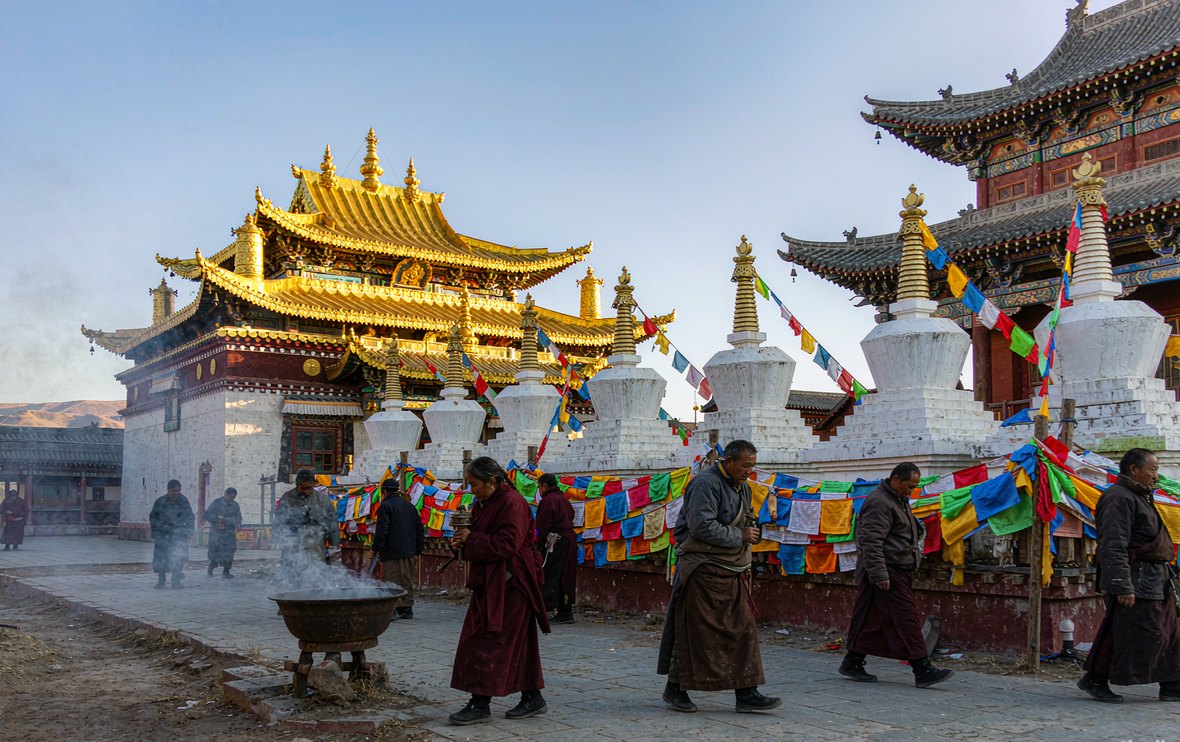
Religious architecture is the spatial crystallization of foreign faiths naturalized in China: Buddhist monasteries, pagodas, cave temples, Daoist abbeys, mosques — all took Chinese timber structure as body and their several faiths as soul, growing into forms distinctively Chinese. The Buddhist monastery evolved most typically: Han and Wei centres on the pagoda (White Horse Temple), Tang-Song conversion to the "seven halls of the monastery" courtyard plan — Buddha Hall at the centre, Mountain Gate and Hall of Heavenly Kings in front, Sutra Library behind — converging with the grammar of palace courtyards. Pagodas transformed the Indian stupa into Chinese pavilion-style towers (Yingxian Wooden Tower, Giant Wild Goose Pagoda), dense-eave towers (Songyue Temple Pagoda) and diamond-throne towers — the formal history of the pagoda is the formal history of the sinicization of Buddhism. Daoist abbeys follow the mountain (the Golden Summit of Wudang, the Green Ram Abbey); mosques blend Chinese and Arabic (the Great Mosque of Huajue Lane in Xi'an, Chinese courtyards beside an Arabic dome); Tibetan monasteries with golden roofs and white walls (the Potala) form a line of their own. The splendour of "four hundred and eighty temples of the Southern Dynasties" is gone, yet the remains of religious architecture are still China's richest ensemble of historic buildings — faiths change, but wood and stone endure.
The layout of the Chinese monastery made a profound "native turn": in the early period (Han to early Tang) the pagoda stood at the centre with the hall behind it, continuing Indian stupa worship; from the Tang and Song came the "seven halls of the monastery" — Mountain Gate, Hall of Heavenly Kings, Great Buddha Hall, Dharma Hall and Sutra Library along the axis, Bell and Drum towers facing each other, monks' quarters and kitchens on the flanks — the grammar of the monastery merged with that of palace and office compounds, and the ideal of "a deep mountain hiding an old temple" took its final form.
The meaning of the turn is a change of dress for faith in space: Buddhism gave up the foreign pagoda-centred plan and accepted the Chinese ritual sequence of courtyards — temples henceforth looked like "home and state", Buddha halls like throne halls, and on this the Chinese sense of intimacy with the Buddha was built.
The formal history of the pagoda is a metamorphosis: the Indian stupa (a hemispherical reliquary mound) on arriving in China married the Chinese multi-storey pavilion and grew into the pavilion-style tower — climbable, with far views; the Giant Wild Goose Pagoda and the Yingxian Wooden Tower (67 metres, the tallest wooden tower in the world) are of this type. Dense-eave towers (Songyue Temple Pagoda, 1,500 years old, twelve-sided — the oldest brick pagoda standing in China), pavilion-and-stupa hybrids, covered-bowl (lamaist) pagodas and diamond-throne pagodas (Zhenjue Temple) each appeared with their sects and ages.
The pagoda also outgrew religion: watchtowers (the Kaiyuan Temple Pagoda of Dingxian), navigation beacons, Wenchang towers praying for literary success — the Chinese turned a foreign memorial type into an all-purpose high landmark. Today "ta" (pagoda) is among the most international words in Chinese.
The spatial philosophy of the Daoist abbey differs from the monastery's: it pursues the metaphor of the "immortal mountain" — the Wudang complex follows the terrain, the golden-roofed halls and the peaks composing a three-dimensional sanctuary of Heaven-and-human unity; the Changdao Abbey on Qingcheng Mountain and the Yongle Palace (a double marvel of Yuan murals and architecture) both take their bearing from mountain and water — the "true meaning" of an abbey is its setting; buildings are but footnotes to the landscape.
Mosques are unique in blending Chinese and Arabic: the Great Mosque of Huajue Lane in Xi'an is wholly Chinese — memorial arches, the Tower for Reflecting on the Heart, a great hall of linked bays — while the Qingjing Mosque of Quanzhou preserves its Arabic stone dome and portals; one faith, two dialects — the Chinese map of mosques is itself a spatial archive of civilizational dialogue.
Religious buildings are the front line of heritage protection: the repair scheme for the Yingxian Wooden Tower has been argued for decades (full dismantling versus preservation in place); the monitoring of the Potala Palace, the wholesale lifting of the Yuzhen Palace at Wudang — each a world-class problem solved.
Samples of adaptive reuse are equally rich: the transmission of temple music (the Jing music of Zhihua Temple), monastery bookshops and meditation retreats, intangible-heritage fairs at Daoist abbeys — beyond their religious function, old buildings have become vessels of public culture. The rhythm of "morning bells and evening drums" still tunes the contemporary city.