Script lineage
Five styles: seal, clerical, cursive, running, regular
Calligraphy is writing raised to art: the brus...
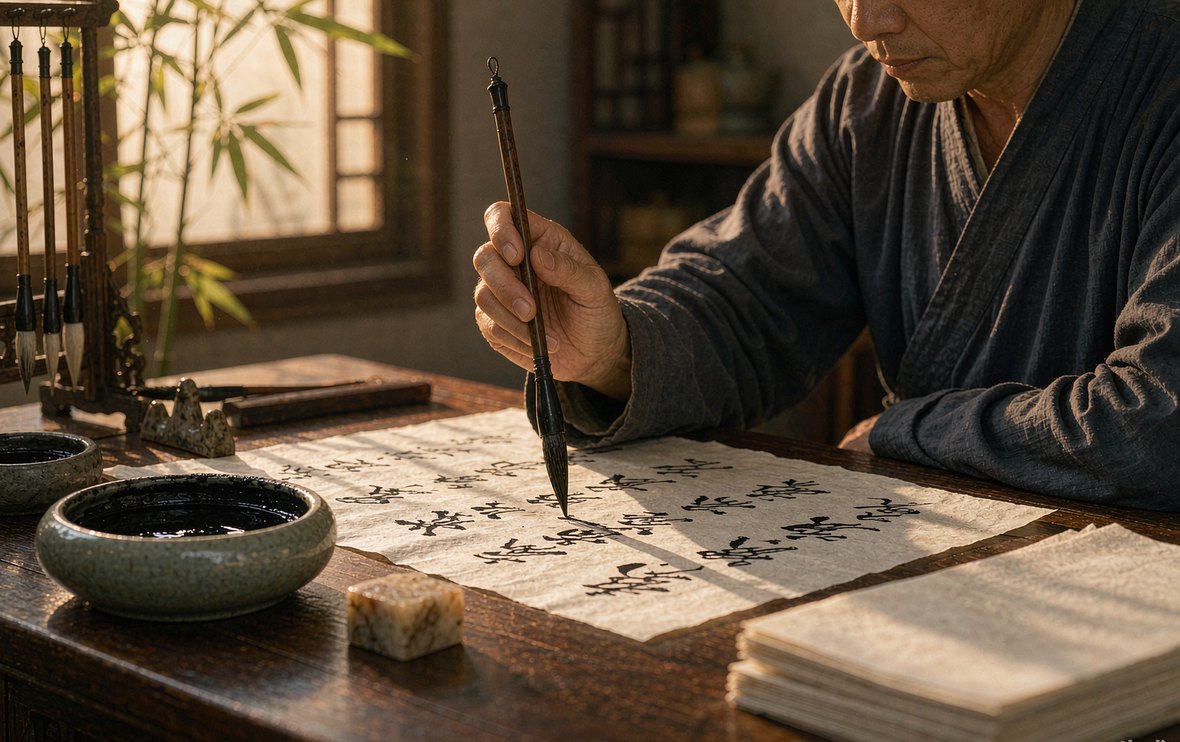
Calligraphy is writing raised to art: the brush as instrument, the ink line as language, black and white as its whole universe — daily record-keeping transformed into an independent art form, something without parallel in the history of the world's scripts. Its lineage is both strict and magnificent: the archaic austerity of oracle bones, the mellow weight of bronze inscriptions, the even composure of seal script, the rippling sweep of clerical script, the abandon of cursive, the fluency of running script, the discipline of regular script — the scripts succeeded one another across three thousand years while the spirit of the line never broke. Wang Xizhi's *Preface to the Orchid Pavilion* "drifts like floating clouds, starts like a startled dragon"; Yan Zhenqing built a moral character out of bone and sinew; Huaisu's wild cursive breaks like sudden rain and whirlwind — every calligrapher signed his name in line. Its depth lies in being at once technique, aesthetics and the training of character: the Eight Principles of the character yong are its technical charter, "the writing is the person" its ethical expectation, "skill advancing into the Way" its ultimate pursuit. In 2009 Chinese calligraphy was inscribed on UNESCO's Representative List of the Intangible Cultural Heritage of Humanity — one brush has traced the cardiogram of Chinese civilisation.
The surface of calligraphic history is the evolution of letterforms: oracle-bone script cut with a knife is lean and taut, bronze script cast from moulds is deep and solemn, Qin seal script "paints like iron and stone, moves like flight"; Han clerical script breaks the round into the square, with silkworm-head and swallow-tail strokes; from Wei and Jin onward regular, running and cursive stand side by side — the efficiency demanded by practical writing and the demands of taste pulling the same cart. Every revolution in script was a revolution in tools and settings: knife, mould, bamboo slip, paper — matter determines the line.
The coexistence of five scripts gave calligraphy a complete ecology of letterforms: seal and clerical sound like echoes out of deep antiquity; regular script legislates, running script takes its ease, cursive converses with the spirits. Calligraphers of every age mastered several at once, finding their own coordinate between law and freedom.
The technical core of calligraphy is brushwork: the shift between centred and slanted tip, the rhythm of lift, press, pause and turn, the way a stroke begins hidden or exposed, with the grain or against it — the Eight Principles of yong abstract the basic strokes of the character into eight models of handling the brush, and have served for a thousand years as the grammar of learning to write. Every line a soft brush leaves on xuan paper has flesh and breath: strength that "penetrates the back of the paper" is force; the leak-mark of a roof and sand cut by a cone are texture; flying white and dry-wet are rhythm.
Mi Fu "brushed" his characters, Su Shi "wrapped the tip", Huang Tingjian "pulled the oar" — calligraphers named their brushwork after bodily gesture, and calligraphy came to be seen as dance on paper: each turn of the line records a breath of the wrist.
The ethical dimension peculiar to Chinese calligraphy is that "the writing is the person": Yan Zhenqing's *Draft of a Requiem for My Nephew*, scored all over with corrections, is honoured as the second finest running-script work in history precisely because the brush was writing not characters but the grief of a family of loyalists; Zhao Mengfu's standing as a calligrapher suffered for serving the Yuan — the judgement of writing has never been separable from the judgement of the person. This tradition made calligraphy a discipline of character for the Chinese scholar: practising the brush is practising the mind, and establishing the person comes before establishing the hand.
Yang Xiong's dictum that "writing is the painting of the mind" opens the argument: calligraphy was read as an X-ray of temperament, a test of steadiness, cultivation and spiritual altitude. It is why calligraphy education has never lapsed in a thousand years: the Chinese have always believed that someone who writes a fine hand cannot be a poor sort of person.
Contemporary calligraphy has turned several corners at once: toward the exhibition (the gallery aesthetics of the National Calligraphy and Seal-carving Exhibition), toward the academy (calligraphy established as a university discipline in its own right), toward the crowd (calligraphy restored to the school curriculum, a hundred thousand viewers in a livestream). Ink abstraction carries the calligraphic gene into contemporary art, and international calligraphers such as Inoue Yuichi proved that the Eastern grammar of the line travels.
In the age of the keyboard calligraphy has acquired a new meaning: it is the last handmade writing, a reason to slow down, an artistic practice within anyone's reach — the moment you pick up the brush, three thousand years of civilisation lie under your wrist.