Artistic elements
Seal script · composition · knife-work
Seal engraving is the craft of cutting a seal ...
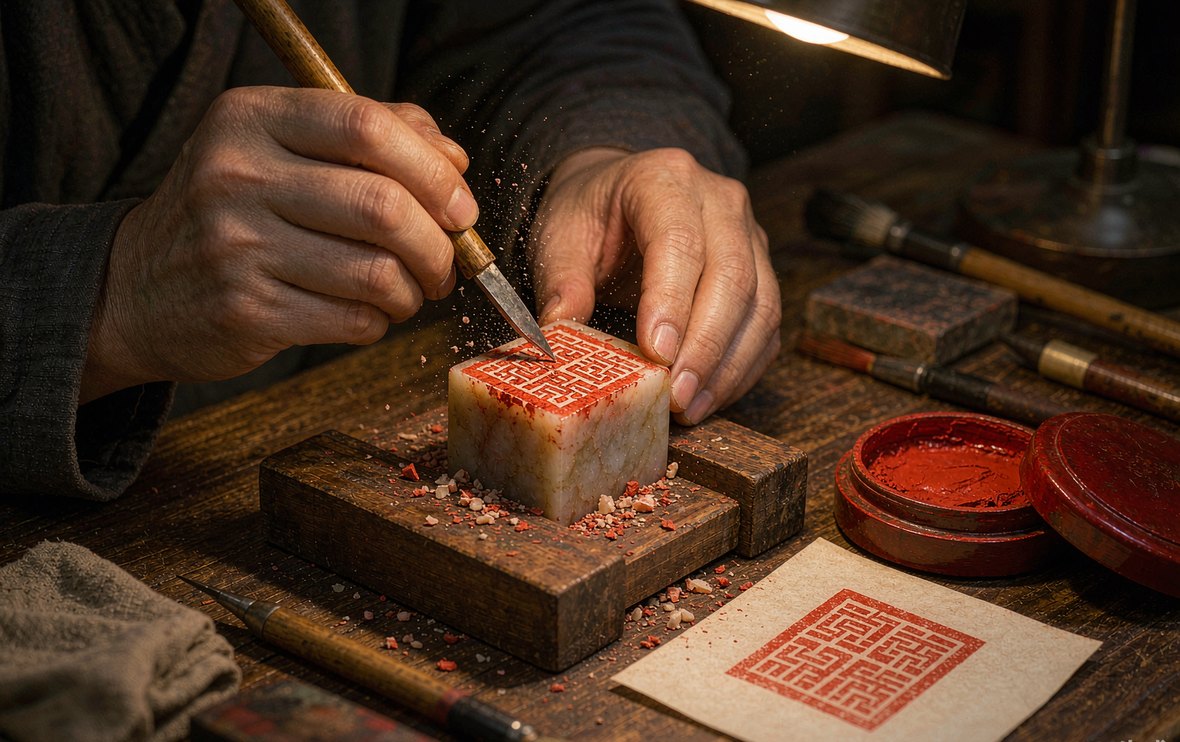
Seal engraving is the craft of cutting a seal in stone with a knife in place of a brush: seal script enters the stone, the movement of the knife carries the intention of the brush, and the three beauties of calligraphy, composition and knife-work meet in a single object — "within a square inch, a universe of atmosphere". Its ancestry is the practical seal: the archaic seals of the pre-Qin states are rugged and various, Qin and Han seals are governed by strict systems (the Han seal became the supreme model for all later carving), and the entry of literati in the Yuan, Ming and Qing turned a craftsman's trade into a scholar's art. Wen Peng and He Zhen opened the way for school styles; in the Qing the Zhe and Wan schools stood as twin peaks; Zhao Zhiqian, Wu Changshuo and Qi Baishi took epigraphy into the seal and made idioms of their own. Literati love stone: Shoushan, Qingtian, Changhua chicken-blood and Balin — the four great seal stones are moist and yield kindly to the knife, "stone cannot speak, yet it is the most delightful of companions". In 2009 Chinese seal engraving was inscribed on UNESCO's Representative List — a seal is at once a credential, a work of art and a signature of the self: to "affix one's seal" is to pledge one's word, entrusting credit to an art practised on the tip of a knife.
The seal began as pure utility: tally of trust, clay sealing, office credential — pre-Qin seals already show a rich repertoire of red and white characters, grids and borders; the Qin "Seal of the Transmission of the Realm" made the jade seal an emblem of imperial power; the even dignity of the Han seal became the aesthetic creed of later carvers, who "take Qin and Han as their ancestors" — structurally identical to calligraphers "taking Jin and Tang as their ancestors". The Chinese seal carver has always innovated by bowing to the ancients.
In the Yuan dynasty Wang Mian began carving huaru ("flower-milk") stone himself, and for the first time a literati artist bypassed the craftsman to complete a seal alone; in the Ming, Wen Peng brought Shoushan and Qingtian stone to the seal, and the age of the stone seal opened. Seal engraving became a scholar's private pleasure and self-declaration: seal texts moved from official titles to studio names, leisure seals and lines of poetry — the seal face became a small reservation of the spirit.
The grammar of seal engraving fuses three methods: seal script (which script to use, how to make the ancient your own), composition (red and white generating each other, density against sparseness, void answering solid — "count the white as red", so that the uncut ground is designed as carefully as the stroke), and knife-work (the crisp rushing cut, the laboured chopping cut, "using the knife as one uses a brush"). In a good seal the script reveals learning, the composition reveals invention, the knife reveals temperament.
Hence the clear genealogy of the schools: Wen Peng (Wumen), He Zhen (Huizhou), Ding Jing (Zhe school of the chopping cut), Deng Shiru (Wan school, "taking calligraphy into the seal"), Wu Changshuo (massive and weather-worn), Qi Baishi (a single thrust of the knife, "unaware that Han ever existed") — a history of seal engraving is a history of scholars testing their inventiveness within a square inch.
The stone itself is an independent object of taste: Shoushan tianhuang, "an ounce of tianhuang for three ounces of gold"; Changhua chicken-blood, red as cinnabar congealed; Qingtian lamp-light stone, translucent as a lantern; Balin fu-huang, warm and inviting. The collecting history of the four great stones is another history of literati sensibility. Appraisal speaks of six virtues of body, colour and texture; collectors hoard, judge and write poems on stones, turning a geological accident into a universe in the palm.
The carved knob — beast knobs, tile knobs, the shallow "thin-intent" relief — adds a further layer of craft: dragons, tigers and hornless chi cut on the crown of a square inch of stone, so that a seal is a trio of epigraphy, sculpture and geological taste.
Contemporary seal engraving continues on three levels: in creation, the national seal exhibitions and the Xiling Seal Society (founded 1904, "the first society under Heaven") sustain a community of scholarship and practice; in education, calligraphy and seal engraving have entered the universities, and youth competitions run year after year; in use, the seal remains indispensable to painting and calligraphy and serves as a credential for institutions and individuals — the craft has never left its post.
The digital age brings new questions and new openings: the visual language of the seal has entered type design, brand marks and experiments in NFT art, and the "Chinese Seal, Dancing Beijing" Olympic emblem gave it a public appearance on a world stage — the oldest of arts, continually set the newest of problems.