Key text
Lu Yu, The Classic of Tea (c. 780)
The Chinese tea art is a complete system that ...
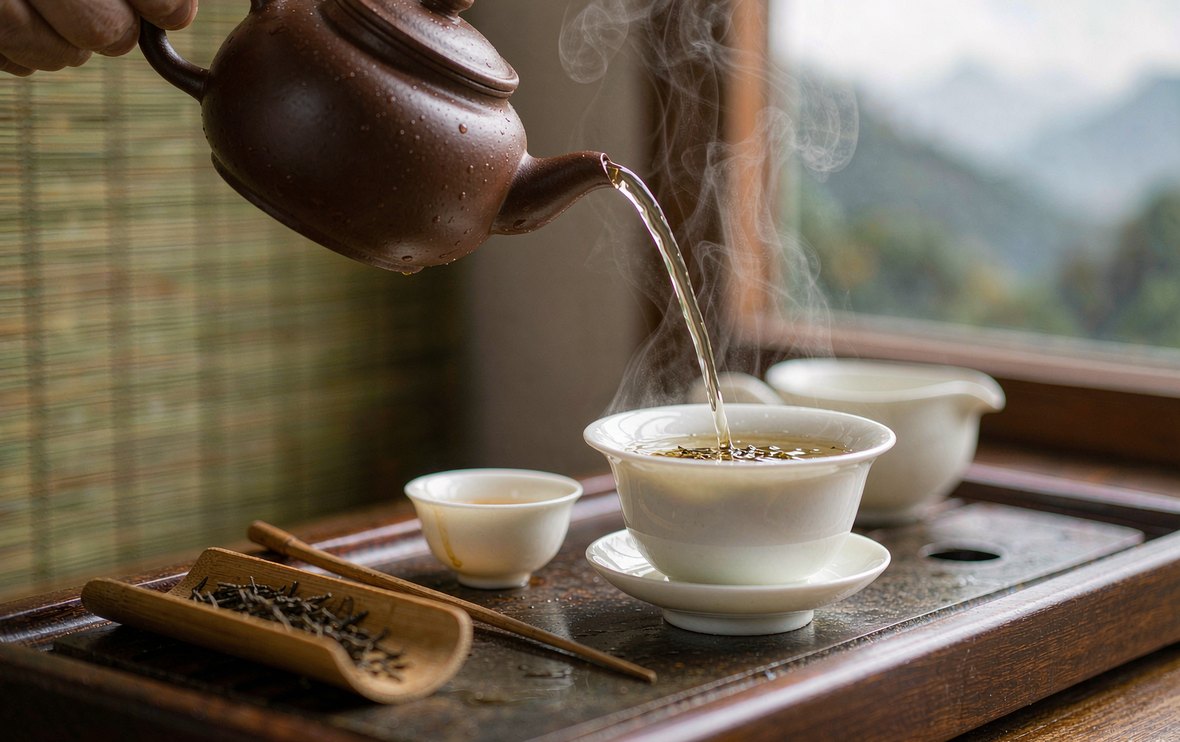
The Chinese tea art is a complete system that lifts a leaf into etiquette, aesthetics and self-cultivation. Counting from the legend of Shennong tasting a hundred herbs, the Chinese have known tea for more than four thousand years; Lu Yu's Classic of Tea in the Tang raised drinking to an art, the Song brought the whisked tea and tea contests to their height of refinement, the Ming abandoned pressed cakes for loose leaf and infusion, and from the Qing the gongfu method became a system of its own — the life of tea is half the life of the Chinese. What makes it precious is that it was never merely technique: choosing water (mountain water best, river water next, well water last), watching the boil (crab-eye bubbles giving way to fish-eye), warming the cups, smelling the fragrance, sipping — each step is a practice of slowing down. The order of serving, the finger-tap of thanks, the rule that a cup filled to the brim insults the guest: these are the grammar of human feeling written into daily life. Today Chinese tea-making skills and related customs are inscribed by UNESCO, and new-style tea drinks have swept the world — a leaf from the East remains the gentlest lingua franca on earth.
The trail of tea is clearly legible: Han records of drinking and the tea markets of Sichuan, the flourishing of pan-boiled tea in the Tang (Lu Yu's Classic of Tea, three volumes and ten chapters, the world's first monograph on the subject, after which "all under Heaven knew better how to drink tea"), the whisked tea and contests of the Song, when tea-slash artists could paint on the foam and Emperor Huizong wrote his own Treatise on Tea, the Ming abolition of cake tea in favour of loose leaf and the infusion method, and the maturing of gongfu tea in Fujian and Guangdong under the Qing. The way of brewing changed four times with the form of the leaf, and each change was a rearrangement of taste.
The material system is just as large: the craft divisions of the six tea types — green, red, blue-green, white, black and yellow — the vessel aesthetics of the Yixing pot and the Jian bowl, the trading network of the Tea Horse Road. One leaf pulls the whole chain of farming, handicraft and commerce behind it.
At the centre is a technique of slowness: warming the cups cleanses the mind, dropping in the leaf and smelling it is to know the thing, pouring and watching the water is patience — "crab-eye has passed and fish-eye is born, a soughing about to become the sound of wind in pines", as Su Shi wrote of waiting for the boil — decanting and dividing is fairness, offering the cup and the tapped finger is courtesy. Go through the sequence and even an impatient person slows. The twenty-one steps of gongfu tea include the division of liquor called "Lord Guan patrols the city" and "Han Xin counts his troops", borrowing the names of military stratagems for the pouring: the sense of ceremony is all there.
Beneath the steps lies "entering the Way through tea": the spirit is summed up as harmony, quiet, ease and truth, or integrity, beauty, harmony and respect. At the tea table, people renegotiate with things, with one another and with themselves. Brewing is therefore a meditation one can practise every day.
Tea carries a heavy social load in Chinese life: offering tea to a guest is basic upbringing — "a guest comes on a cold night and tea serves as wine"; in marriage custom, "receiving tea" means accepting the match, for the tea bush cannot be transplanted, a figure of constancy; when someone pours for you, you tap the table in thanks, a gesture traced to a tale of the Qianlong emperor travelling incognito; tea filled to the brim insults, wine filled to the brim honours — seven parts tea, three parts feeling. The four seats and the order of seniority at a gongfu table are a miniature sand table of etiquette.
Tea also binds literary gatherings: the Orchid Pavilion style tea party, the Zen temple's unity of tea and Zen, the contemporary aesthetics of the tea table — tea gives every cultural occasion its proper tempo: not strong, not fast, good for long talk, good for sitting still.
In 2022 "traditional tea processing techniques and associated social practices in China", covering forty-four national heritage items, was inscribed on the UNESCO Representative List — the world's largest tea system recognized as a whole. Japanese tea ceremony and English afternoon tea both descend from Chinese tea: the monk Eisai brought Song tea home and opened the way to chanoyu, and Wuyi bohea reached Europe through Dutch merchants — the two world pronunciations, "tea" and "cha", preserve the Minnan and Mandarin routes respectively.
Contemporary tea moves on two tracks: traditional tea art with orderly lineages and a revival of heritage tea spaces, and new-style tea drinks carrying tea to young people worldwide through modern commerce. Old and new together are the proof of vitality — tea can sit inside a Song painting and fit inside a milk tea cup.