Also called
Ache Lhamo, "elder sister goddess"
Tibetan opera, called ache lhamo in Tibetan, "...
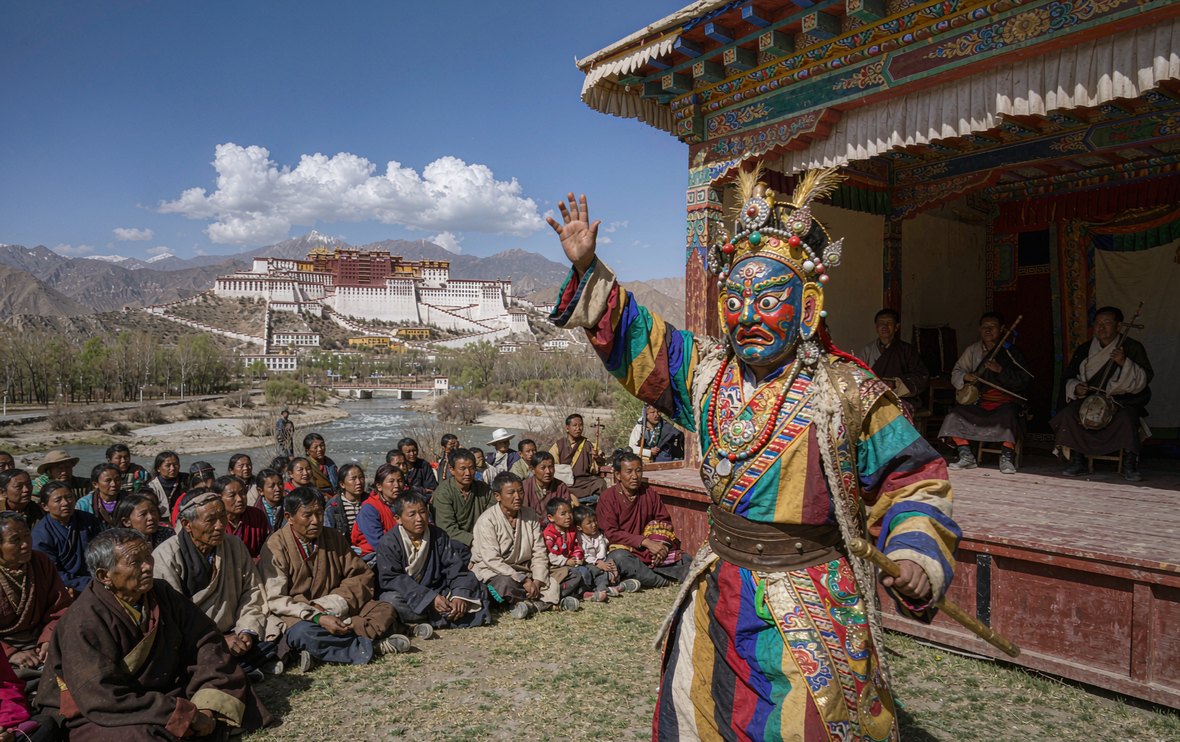
Tibetan opera, called ache lhamo in Tibetan, "elder sister goddess", is the composite theatre art of the Tibetan people: masked, robed, principally sung, and combining song, dance, recitative, speech, acrobatics and craft. It is performed in squares, groves and on grass — not theatre in a picture frame but an open-air poetic drama that moves across the plateau. Tradition credits its founding in the fifteenth century to the Kagyü monk Thangtong Gyalpo, who raised money by putting on plays and built fifty-eight iron-chain bridges over the Yarlung Tsangpo — a legend of "bridges built by opera" that gave the art a compassionate foundation from birth. Its repertoire centres on the eight great plays (Princess Wencheng, Prince Norsang, Drowa Sangmo, Drime Kunden and others), with the blue-mask and white-mask schools each a system of its own; the traditional season at the Shoton, or yogurt, festival continues today. National intangible heritage in 2006 and UNESCO Representative List in 2009 — behind the masks lie six hundred years of Tibetan sorrow, joy and faith.
The founding legend is one of the most moving passages in the history of art. In the fifteenth century the great lama Thangtong Gyalpo saw how dangerous the crossings of the Yarlung Tsangpo were and how many people drowned, and vowed to build bridges. To raise the money for iron chains he recruited seven sisters who could sing and dance, formed them into a troupe and toured to collect alms. Audiences were moved, the bridges were built, and the name ache lhamo, "the goddess-like troupe", was born with the opera itself.
The legend gives Tibetan opera a singular ethical gene: it was not born as court entertainment but as a popular mobilization for the common good — theatre here displays its oldest social function, trading beauty for goods and art for the relief of the world.
The mask is the signature. Blue, with a mirror at its centre, denotes boundless power; white, the kindly elder; yellow, the king; green, the queen; black, the villain; half white and half black, the double-dealer. The mask is the character sheet, and the audience reads good and evil at a glance. The chanting is high and long, one voice leading and the company answering, with a drum and a pair of cymbals the only accompaniment — the sparest of ensembles carrying the fullest of voices.
The performance has its own form: the "don", an opening of sacrificial song and dance; the "tshe", the main play; and the "tashi", a closing blessing. A square performance may run a whole day or several, and this open-air way of watching produced the particular freedom and gusto of the form.
The eight great plays are the classical narrative store of the Tibetan people: Princess Wencheng dramatizes the Tang-Tibet marriage alliance; Prince Norsang is the romance of a prince and a goddess; Drowa Sangmo a fairy tale of good against evil; Drime Kunden the Buddhist birth story of one who gives away all he has; and Sukyi Nyima, Donyo Dondrub, Pema Wobar and Nangsa Wobum complete the set. Love, loyalty, karma and compassion — the whole ethical compass of the culture is written in these plays.
The modern staging of Princess Wencheng in Lhasa shows the classics still being reproduced: a play six hundred years old continues to supply raw material of feeling and identity for the present.
The traditional home of Tibetan opera is the Shoton festival: at the end of the sixth lunar month, after the great thangka is unveiled at Drepung Monastery, troupes from all over converge on the Norbulingka in Lhasa to perform for days — which is why the yogurt festival is also called the opera festival. Protection today is systematic: the regional troupe performs regularly, the eight great plays have been restaged, and village and county troupes are active year-round, with regional schools such as Amdo and Dêgê each holding their own.
Inscribed in 2009, the opera received international recognition and has since appeared at international arts festivals — masks and long chants astonishing audiences abroad. Tibetan opera proves that plateau theatre is universal by nature: so long as the echo of snow mountains remains in the singing, it will always be new.