Origin
An accident of Tang alchemy
Gunpowder is the earliest energetic compound i...
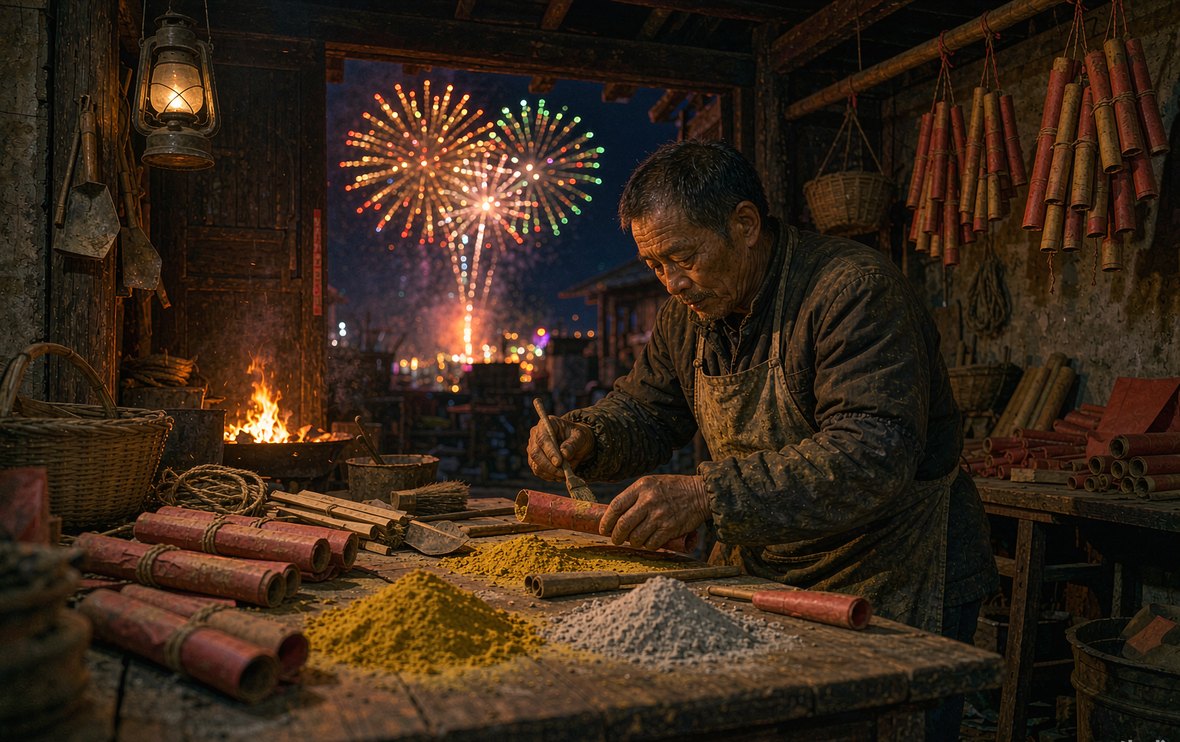
Gunpowder is the earliest energetic compound invented by human beings, and its birth is full of irony: Tang alchemists compounded it by accident while seeking immortality. Sulphur, saltpetre and charcoal explode on contact with fire, and the accidents recorded in their laboratories became precious documents in the history of chemistry. Tang texts already carry warnings about such mixtures; under the Song the military applications unfolded — fire arrows, fireballs, caltrop bombs, the fire lance of bamboo tube firing a pellet, one of the world's earliest barrel weapons, and the thunderclap bomb with an iron casing. In the thirteenth century gunpowder travelled with the Mongol campaigns and the trade routes to the Arab world and Europe, where firearms and cannon rewrote the age of chivalry and the politics of the castle. Bacon ranked gunpowder with printing and the compass as the three inventions that changed the world. Its double fate is telling: in the East it became the firework of celebration, in the West the cannon of the battlefield — one formula, two civilisational uses.
The birth of gunpowder is a magnificent mismatch between intention, the elixir of life, and result, an explosive. Alchemists experimenting with sulphur, saltpetre and charcoal repeatedly suffered flames rising, hands and faces burned, and houses consumed, and their manuals came to warn explicitly that such combinations must be avoided. Those accident reports are the primary documents of gunpowder's evolution, among humanity's first laboratory notebooks on energetic materials.
Chemically, gunpowder is a solid mixture of saltpetre as oxidiser with sulphur and charcoal as fuel, generating great volumes of gas in an instant; the physics of explosion was grasped empirically in the Tang. Chinese alchemy is therefore at once the prehistory of Chinese chemistry and of gunpowder: the furnace of immortality smelted the eve of modern chemistry.
The Song was the first golden age of gunpowder weapons. Kaifeng had dedicated powder workshops, and the *Wujing Zongyao* records several military formulas in full, the world's earliest systematic documentation of gunpowder composition. Battlefield use escalated step by step: fire arrows to burn stockades, fireballs against fortifications, caltrop bombs to hold a line. In the Shaoxing era Chen Gui defended De'an with fireball powder arrows, and in the Kaiqing era the prefecture of Shouchun made fire lances, a great bamboo tube with a pellet inside, the direct ancestor of the barrel weapon.
The Mongol empire carried gunpowder westward: its armies and captured craftsmen brought the thunderbolt bomb to Arab and European notice for the first time. The Arab midfa and the European hand cannon followed, and between the thirteenth and fourteenth centuries gunpowder weapons completed their spread from China to the world.
The chain reaction in Europe rewrote political history. Cannon battered down the walls of noble castles and castle politics gave way to centralised kingdoms; firearms made the knight obsolete and dissolved the aristocracy's monopoly of war; the economics of siege warfare shifted and helped bring the modern nation-state into being. Sociologists call it the gunpowder revolution: an Eastern invention that reshaped Western structures of power.
In the *Novum Organum* Bacon wrote that printing, gunpowder and the lodestone changed the whole face and state of things throughout the world; of the three, gunpowder struck hardest at the political order. From an accidental formula in an alchemical cell to a battlefield force that decided the shape of the world, gunpowder's journey is the most dramatic chapter in the history of technology.
In China, the homeland of gunpowder, its everyday identity is celebration rather than weapon. The Southern Song set off fireworks on a large scale, and by the Ming and Qing firecrackers were part of the New Year: amid the crack of firecrackers, a year departs. The fireworks industry of Liuyang and Liling continues to this day, and Chinese fireworks light up New Year's Eves around the world. In its birthplace, gunpowder was tamed into a vehicle of beauty and joy.
These two fates, weapon and firework, pose a civilisational question: technology itself is neither good nor evil, and its form is shaped by the values of the civilisation that holds it. The double life of gunpowder reminds us that how a civilisation uses its technology matters as much as what it invents. This may be the deepest lesson the Four Great Inventions leave to the modern world.