Early form
Sinan, Warring States lodestone
The compass is the quietest of the Four Great ...
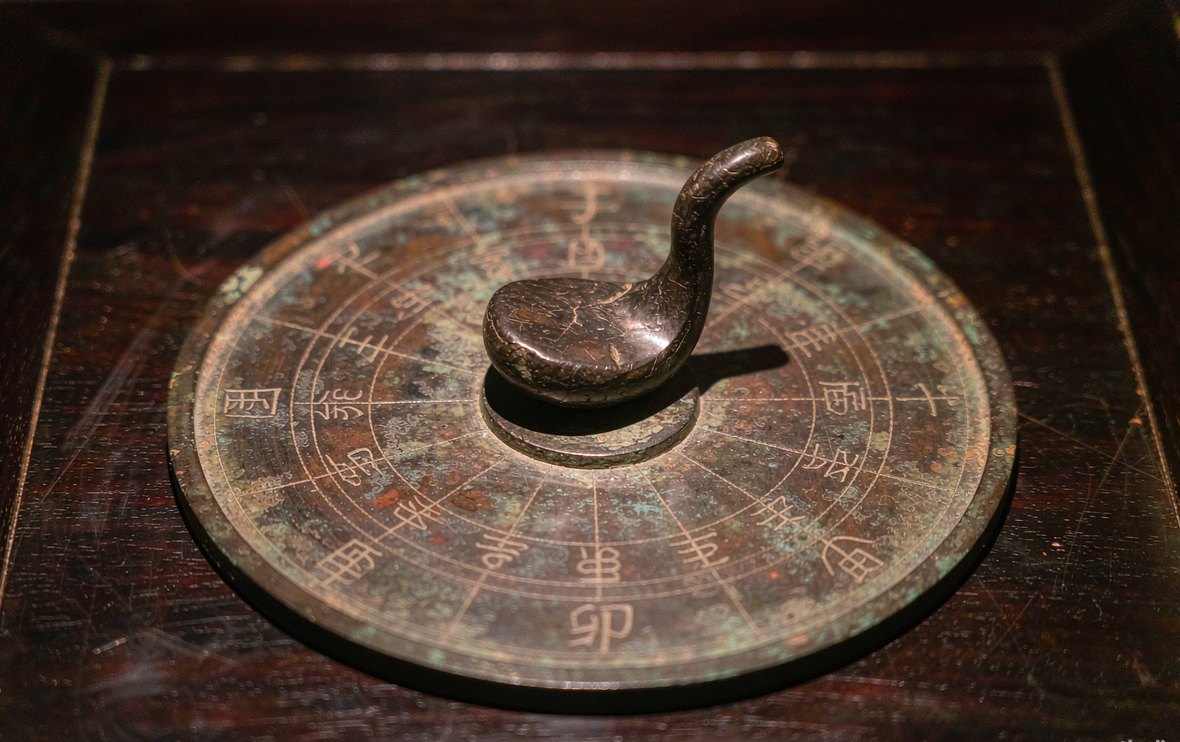
The compass is the quietest of the Four Great Inventions and the one that most deeply redrew the map of the world. Its principle descends from the Warring States sinan, a spoon of natural lodestone turning on a bronze plate, and from the Song technique of magnetising an iron needle with lodestone. The Northern Song *Pingzhou Ketan* gives the first record of the needle at sea — by night they watch the stars, by day the sun, and in thick weather the compass — the first time human beings could hold a course under cloud and on the open ocean. In the twelfth century the compass passed through Arab hands to Europe and became the foundation of the Age of Discovery: every voyage of Columbus, da Gama and Magellan depended on the needle. A Chinese invention freed navigation from the coastline, and the geographical scale of world history was redefined by a small needle.
Chinese records of magnetism go far back. The *Guanzi* notes that loving stone summons iron, and Wang Chong's *Lunheng* of the Eastern Han states plainly that the spoon of the sinan, set on the ground, points with its handle to the south. The Song was the breakthrough: Shen Kuo described magnetising a needle by stroking it with lodestone, four ways of mounting it, including floating on water and suspension from a thread, and observed magnetic declination for the first time — it always inclines slightly east, and does not point due south — four hundred years before Europe.
The compass thus moved from a lodestone instrument to a practical navigational tool. The floating compass became standard at sea, and combined with the twenty-four directions of the geomantic plate it produced the Chinese needle-route system: books of routes that are the earliest navigation databases of East Asian waters.
The Song and Yuan were the golden age of Chinese navigation. The watertight bulkheads of the Fujian ship, the compass and the measurement of stellar altitude allowed Chinese merchantmen to sail directly from Guangzhou and Quanzhou to the Indian Ocean. The record in *Pingzhou Ketan*, of about 1119, is among the earliest eyewitness accounts of the compass at sea. Without it, an ocean voyage on the monsoon routes, walking by the mountains, was a gamble; with it, the sea became for the first time a road that could be planned.
The compass, with watertight bulkheads and the stern rudder, formed the golden combination of Chinese shipbuilding, two hundred years ahead of the world. The merchant fleets of Quanzhou and the cargoes of the wrecked *Nanhai One*: the navigational heart of that maritime achievement was a magnetised iron needle.
In the twelfth century the compass reached the Mediterranean through Arab navigators, and European texts mention the mariner's compass from about 1190. The rest is familiar: every hop of the Portuguese down the African coast, Columbus across the Atlantic, Magellan through the Pacific — the compass lay beneath every route. Bacon ranked printing, gunpowder and the lodestone together as the three inventions that changed the face and state of the whole world.
An intriguing relay was completed: China invented the needle, the Arabs carried it, Europe drew global routes with it, and the world became one. China's early withdrawal from the Age of Discovery is a contrasting reminder of how differently the possessors of a technology and its users may behave: the glory of invention and the dividend of an age do not automatically coincide.
The compass had a second life in China: the geomantic luopan. Diviners oriented houses and graves by its twenty-four mountains, and it became the core instrument of siting, an application that tangled magnetism, astronomy and folk belief together. It is a living fossil of folk culture, and it also lent the compass a partial Western label as a tool for feng shui.
A fair account is this: the same needle served navigation as its dominant use in Song and Yuan China, where maritime trade flourished, and geomancy as a parallel use among the people. In Europe it specialised in oceanic navigation and was combined with celestial positioning. The fate of a tool is decided by the system that uses it, and the global history of the compass is the best footnote to that philosophy of technology.