Location
Huangshan, Anhui
Pines, rocks, clouds and springs — four wonder...
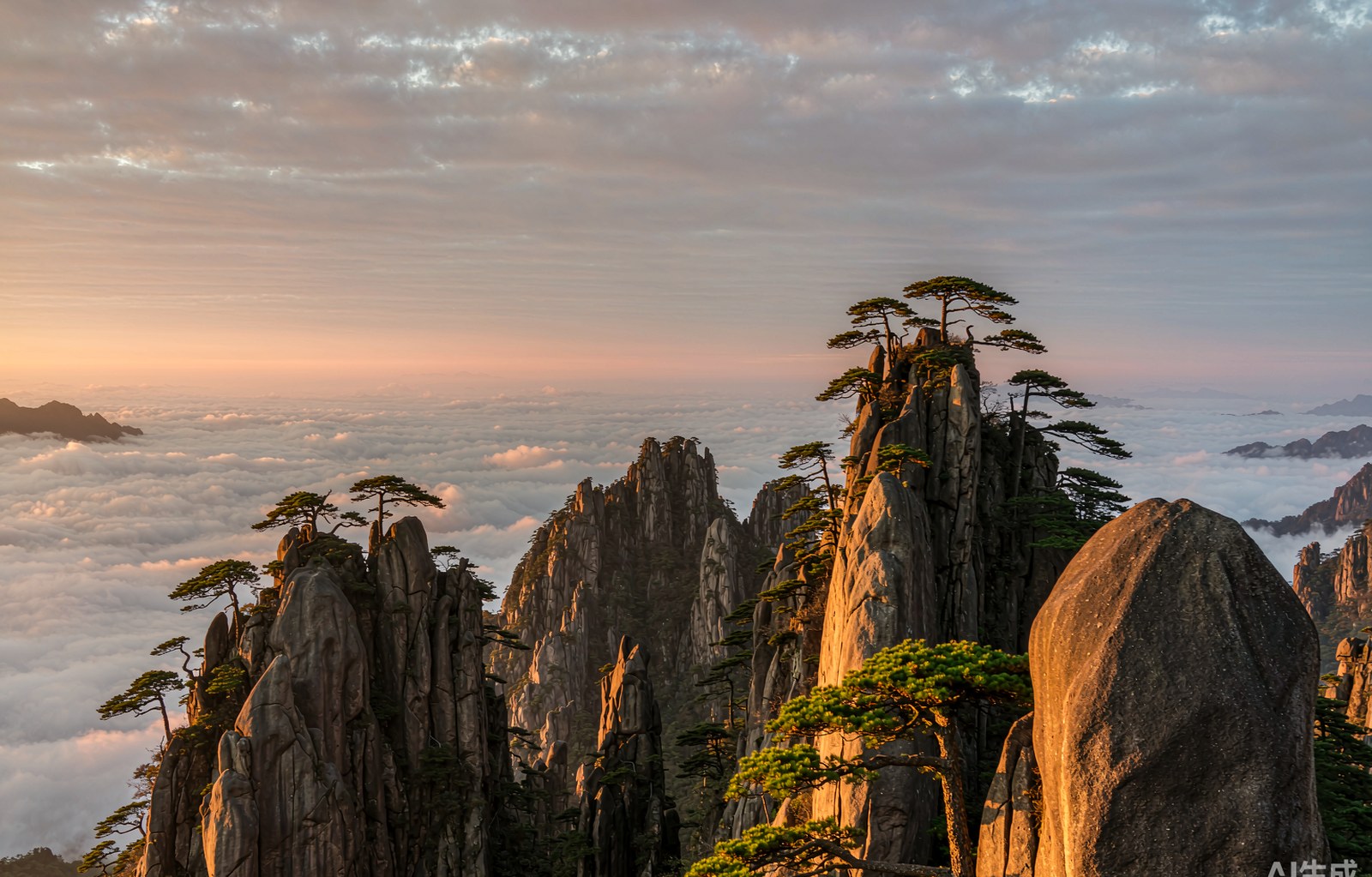
Pines, rocks, clouds and springs — four wonders in symbiosis — have drawn poets and painters for centuries. Huangshan is famed for its granite peaks, its pines breaking from bare rock, and its ever-changing sea of clouds; after climbing it twice, Xu Xiake sighed that "within the seas and beyond there is nothing to match the Huang of Huizhou." It is the prototype of Chinese landscape painting, and a UNESCO World Heritage site of both culture and nature.
Huangshan's massif is Yanshan-stage granite: magma intruded and cooled more than a hundred million years ago, was uplifted by the Himalayan orogeny and sculpted by Quaternary glaciers into a peak-forest dominated by three main summits — Lotus Peak (1,864 m), Bright Summit and Celestial Capital Peak. Joints in the rock carved the strange boulders — "the Immortal Flips the Table," "the Rock Flown from Afar" — abstract sculptures of natural force; legend has it that the Flying Rock inspired the opening stone of the 1987 Dream of the Red Chamber.
The Huangshan pine is a species of its own, distinct from the Japanese black pine and China's masson pine; its seeds fall into granite crevices, its roots exude organic acids that dissolve the rock, and so it breaks out of sheer cliffs. The Welcoming Pine has stood by the Jade Screen Lodge for over a thousand years, an image on the national calling card; the West Sea Grand Canyon and the Clear-Cool Terrace at Beihai are the finest places to watch the sea of clouds — vapor gathers and churns among the peaks and valleys until summits become islands of the immortals at sea, and "the Huangshan cloud sea" ranks among China's four great natural wonders.
薄海内外无如徽之黄山,登黄山天下无山,观止矣! — "Within the seas and beyond there is nothing to match the Huang of Huizhou; climb it and no mountain remains under Heaven — this is the end of seeing!"—— Xu Xiake (Ming dynasty)
In the late Ming and early Qing, monk-painters — Jianjiang, Shitao, Mei Qing — lived as hermits in these mountains and founded the Huangshan school of painting, its dry-brush, spare-ink austerity deeply shaping the Xin'an school. Xu Xiake's rapture — "climb Huangshan and no mountain remains under Heaven; this is the end of seeing" — made it a spiritual landmark of literati China from the Ming onward. At its foot lies old Huizhou — Tunxi Old Street, Chengkan, the memorial arches of Tangyue — and together with the mountain they complete the tale of "fairyland and the human world."