Location
Burang County, Ngari, Tibet
At 6,638 meters, Mount Kailash is revered by T...
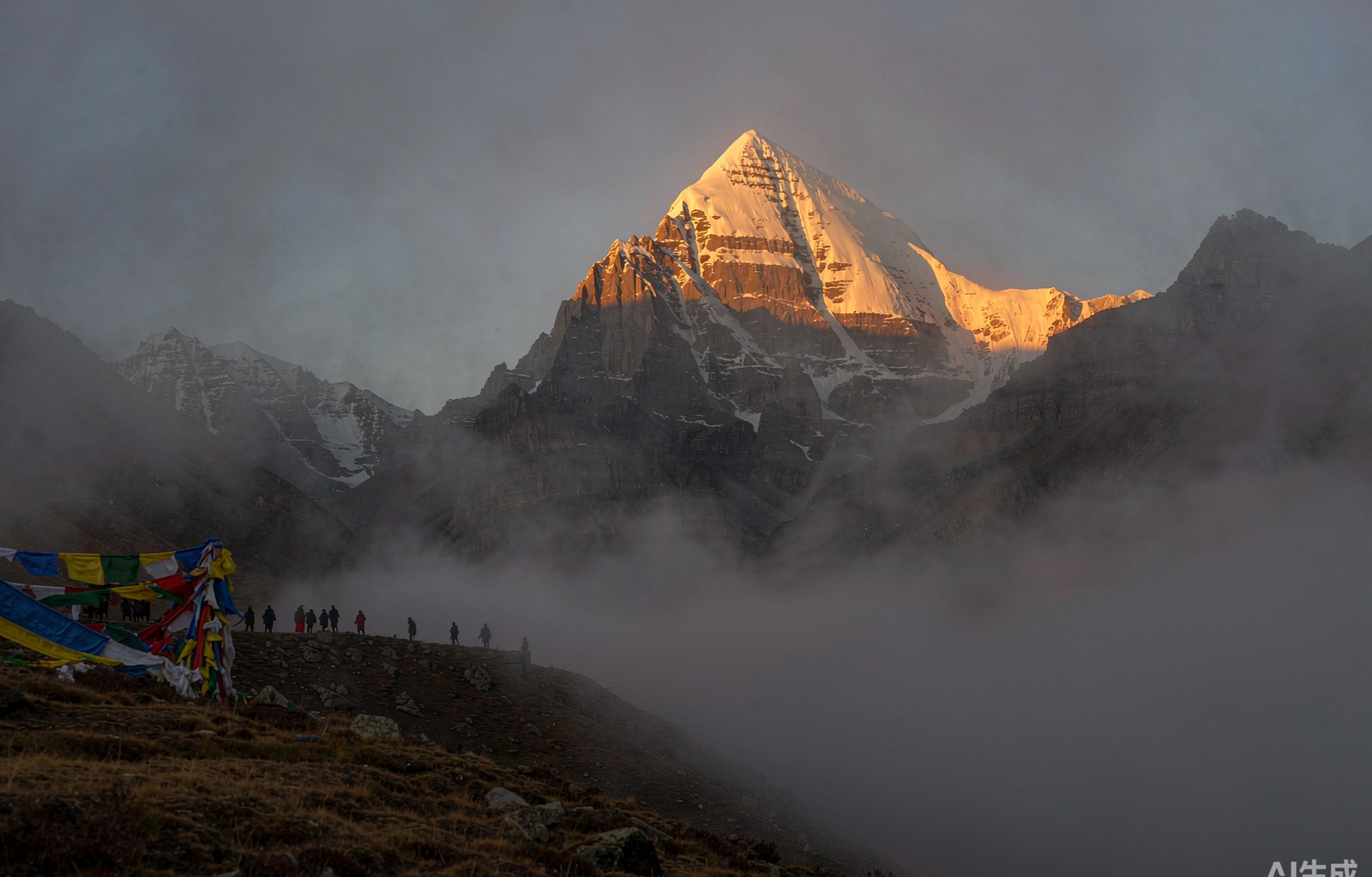
At 6,638 meters, Mount Kailash is revered by Tibetan Buddhism, Hinduism, Jainism and Bon alike — the undisputed "center of the world." Its pyramid of snow is holy year-round, and pilgrims come from thousands of miles to walk the kora: a fifty-two-kilometer circuit, the measure of faith. It has never been climbed — and never should be.
Kailash is built of alternating beds of softer sandstone and harder conglomerate; glacial carving of the horizontal strata has given the mountain its regular stepped profile, and on the sunward face a great vertical ice groove crosses the horizontal strata to form the famous swastika mark — in religious imagination, a symbol written by the hand of the gods. Symmetrical from all four directions, it looks equally solemn from whichever side you gaze up at it.
The circuit of Kailash is about fifty-two kilometers; Tibetan Buddhists and Hindus walk it clockwise, Bon pilgrims counter-clockwise. The Dolma La pass at 5,630 meters is the circuit's highest point — the faithful believe one circuit washes away the sins of a lifetime, and that one circuit in the Year of the Horse counts as thirteen in ordinary years. Prostrators measure the whole line with their bodies, taking months. Below the mountain, the town of Darchen gathers pilgrims from everywhere each year.
须弥藏芥子,芥子纳须弥。 — "Mount Sumeru hides in a mustard seed; a mustard seed holds Mount Sumeru."—— The Vimalakirti Sutra
Tibetan Buddhism sees it as the seat of Chakrasamvara; Hinduism reveres it as Kailasa, the abode of Shiva; the Jains hold that their founder attained liberation here; Bon takes the Gangdise range as the axis of the cosmos. South of the sacred mountain lies Lake Manasarovar, one of the highest freshwater lakes in the world, honored as "king of sacred lakes" — mountain and lake complete a single sanctuary. The Chinese government respects the faith, and Kailash remains closed to climbers — one of the few pure lands humanity has left to belief.