Location
Kashgar, Xinjiang
Kashgar is a Silk Road town of two thousand ye...
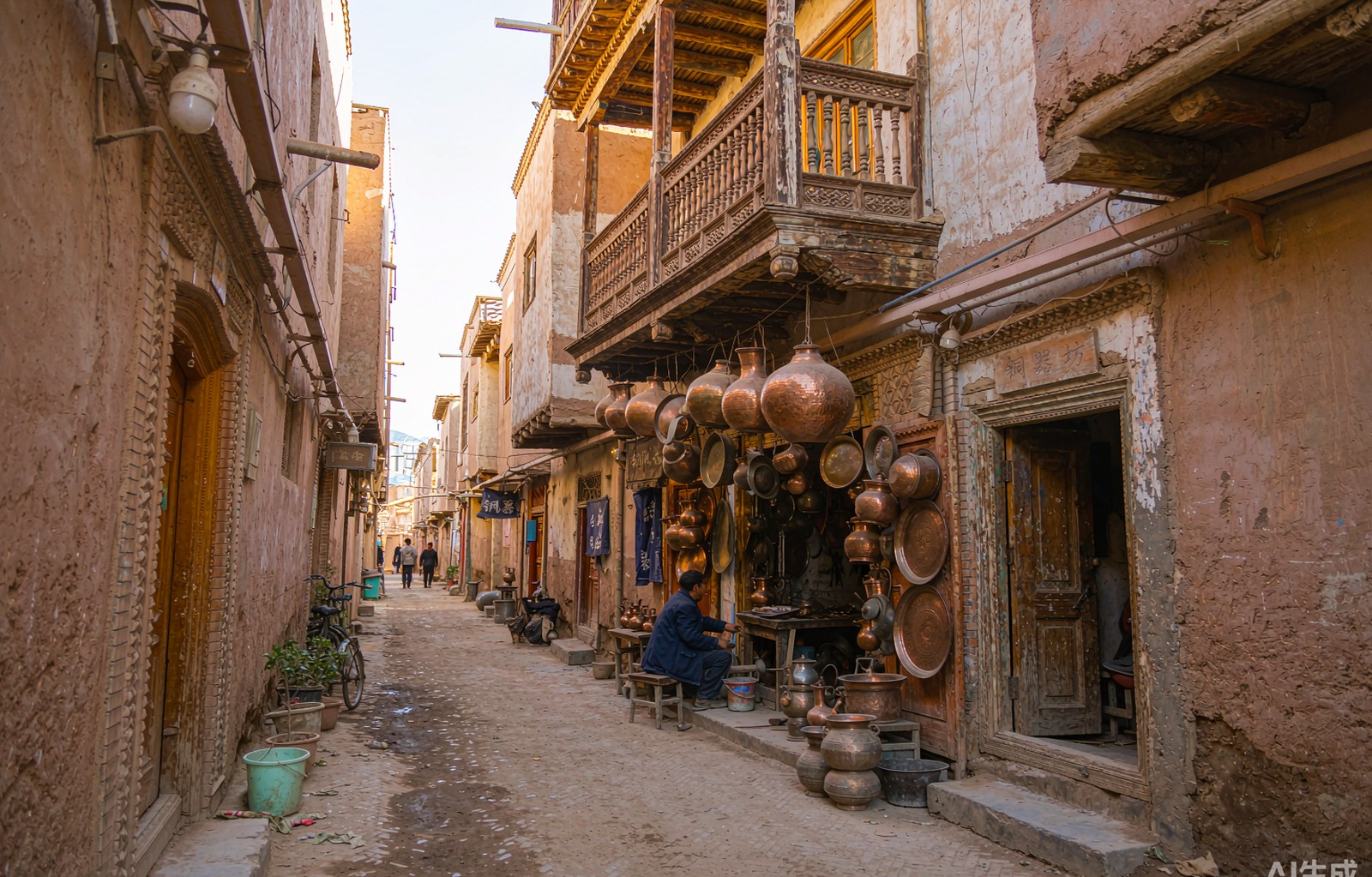
Kashgar is a Silk Road town of two thousand years, the old land of the kingdom of Shule. The high-terrace homes rise tier upon tier; in the maze of lanes potters spin their wheels and coppersmiths hammer out ewers, while pigeons rise over the Id Kah Mosque square. This is a living old town of the Western Regions, where the bustle of the bazaar carries on the memory of the Silk Road's last great markets.
Kashgar sits on the western rim of the Tarim Basin, anciently the Shule garrison of the Four Garrisons of Anxi. Its passes — Khunjerab, Karasu, Torugart and others — radiate toward eight nations of Central and South Asia; the strategic standing of "five ports open to eight nations, one road linking Europe and Asia" has not changed in a thousand years. The itineraries of Zhang Qian, Faxian, Marco Polo and Xuanzang all passed through this oasis city.
The high-terrace homes perch on a loess cliff over forty meters high, houses stacked layer upon layer for six hundred years, with spanning gates and cantilevered rooms forming a wonder of vernacular building; after a wholesale conservation and restoration completed in 2020, they have reopened. Along Wusitangboyi Road the craft street rings with coppersmiths' hammers; Kashgar pottery, prized for its green glaze, turns in the workshops, and the wood shops carve fretted soundboards for dutars and rawaps. "Bazaar" means market, and Kashgar's Sunday Grand Bazaar was once billed as the largest in Asia.
驼铃古道丝绸路,胡马犹闻唐汉风。 — Camel bells on the ancient road of silk; the horses of the frontier still breathe the air of Han and Tang.—— Modern verse on the Silk Road
The Id Kah Mosque, founded in 1442, is among the most influential mosques of Central Asia; on Eid al-Adha the square fills with ten thousand dancers. In century-old teahouses, elders sit cross-legged over brick tea, naan and the strains of muqam; the aromas of gangzi meat, baked samsa and pomegranate juice fill the lanes. At nightfall the old town lights come on, and children play football at the lane mouths — here history is not a backdrop but the everyday.