Location
Yi County, Huangshan, Anhui
Xidi and Hongcun are the exemplars of ancient ...
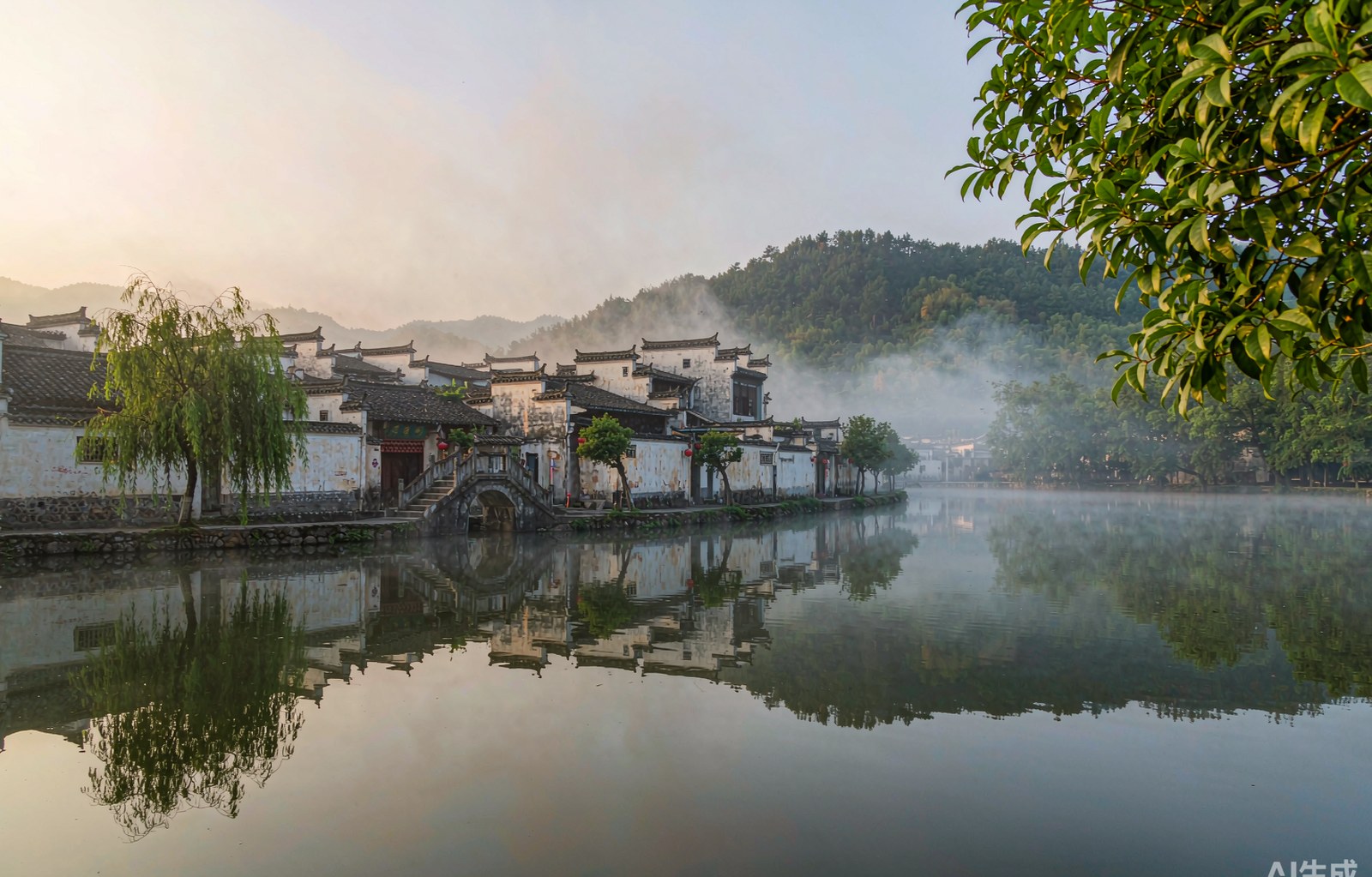
Xidi and Hongcun are the exemplars of ancient Huizhou villages. Xidi is famed for its boat-shaped plan and its complete ensemble of Ming–Qing dwellings; Hongcun is renowned as an "ox-shaped" village with a man-made water system — Leigang Hill the head, ancient trees the horns, Moon Pond the stomach, South Lake the belly, and the water channels threading lane and doorway like the ox's gut. White walls and dark tiles reflected in still water are the very prototype of an ink painting. Both were inscribed as a World Heritage Site in 2000.
Hongcun's water system is a masterpiece of ancient village hydraulic engineering: in the Yongle era of the Ming, clansman Wang Siqi thrice engaged a fengshui master to "survey every hill and stream," dug the Moon Pond and cut the channels; under the Qianlong reign of the Qing, South Lake was added. The channels bend nine times through ten turns, passing every household's door, serving four uses at once — drinking, fire-fighting, temperature regulation and irrigation. The Moon Pond is a deliberate half-circle rather than full, in humility to the saying "when the flower opens it falls; when the moon is full it wanes." This living water system, built six hundred years ago, is still in use.
"Fated badly in a former life, born in Huizhou; at thirteen or fourteen, thrown out to the world" — so the saying goes. Hui merchants dominated the Ming–Qing economy for four centuries, and returning in wealth they built houses and ancestral halls, founded schools and raised memorial arches. Chengzhi Hall in Hongcun, built in 1855, glitters throughout with gilt woodcarvings — "Guo Ziyi offering birthday felicitations" and "a hundred children at the Lantern Festival" — at a cost of 600,000 taels of silver. In Xidi, the memorial archway of Hu Wenguang and the Jing'ai Hall, with their brick-carved gate lintels and stone-carved lattice windows, are the textbooks of Huizhou's "three carvings."
黟县小桃源,烟霞百里间。 — The little peach-blossom spring of Yi County, wrapped in mist and rosy clouds for a hundred li.—— Li Bai (Tang dynasty)
Every misty morning the painted bridge over Hongcun's South Lake draws art students and photographers on pilgrimage; in Xidi the flagstones of the lanes and the horse-head gables compose the classic Huizhou silhouette. "The little peach-blossom spring of Yi County, mist and rosy clouds for a hundred li" — the land Li Bai praised remains a living specimen of Hui culture: exorcism dances, Mulian opera, Hui ink and She inkstones, and the flavors of hairy tofu and Laba tofu all circulate in the villages' daily life.