Location
Northwestern South China Sea · Sansha
The Xisha Islands are scattered across the nor...
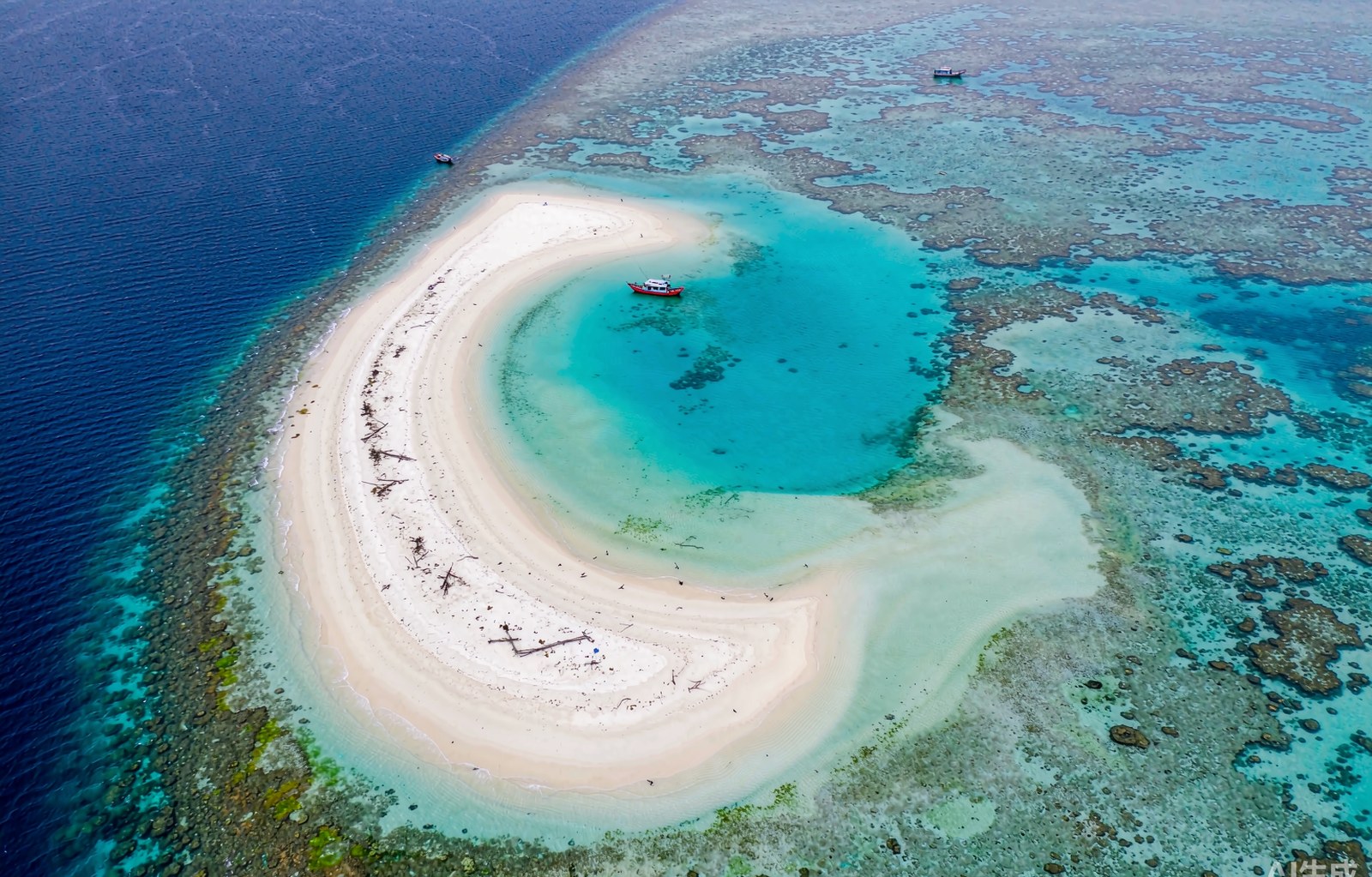
The Xisha Islands are scattered across the northwestern South China Sea, comprising more than twenty islets and reefs in the Xuande and Yongle groups. Crystal-clear blue water, intact coral atolls and pristine white sand cays — pure almost to the point of the primeval. This is the blue territory of China's southern seas, and a hidden travel realm open only to holders of a PRC passport.
Visibility in the Xisha seas often exceeds twenty meters, and the vertically layered reef flats grade from deep blue to Tiffany green. Quanfu Island is an uninhabited sand cay, its white sand as fine as flour, its shape renewed daily by the tide; Yagong Island is piled from shells and coral debris, where islanders dry fish in seawater and build houses of coral stone; on the shallow reef flats of Yinyu, starfish, giant clams and schools of tropical fish are plainly visible. To protect the ecosystem, landings must strictly follow conservation rules.
Fishermen from Tanmen, Hainan, have fished the Xisha for generations. The Ming–Qing era "Genglu Book" (Book of Routes and Distances) records, entry by entry, the headings and distances between the islands — the earliest documentary evidence that Chinese fishermen first developed and worked these waters. Tang–Song era sites and recovered porcelains on Ganquan Island show that settlers already lived and labored here a thousand years ago. Sansha City was established in 2012, making Yongxing Island the administrative center of the South China Sea islands.
海纳百川,有容乃大。 — The sea accepts a hundred rivers; its capacity makes it great.—— Lin Zexu (Qing dynasty), couplet
In 1946 the Chinese government dispatched warships to take over the Xisha Islands, erecting steles and conducting surveys; Yongxing Island takes its name from the receiving ship Yongxing. Today Sansha has schools, a hospital and a library, and the lights of the fishing village on Zhaoshu Island face the lighthouse across the water — every lighthouse among the South China Sea islands keeps watch for passing ships and for this stretch of blue territory.