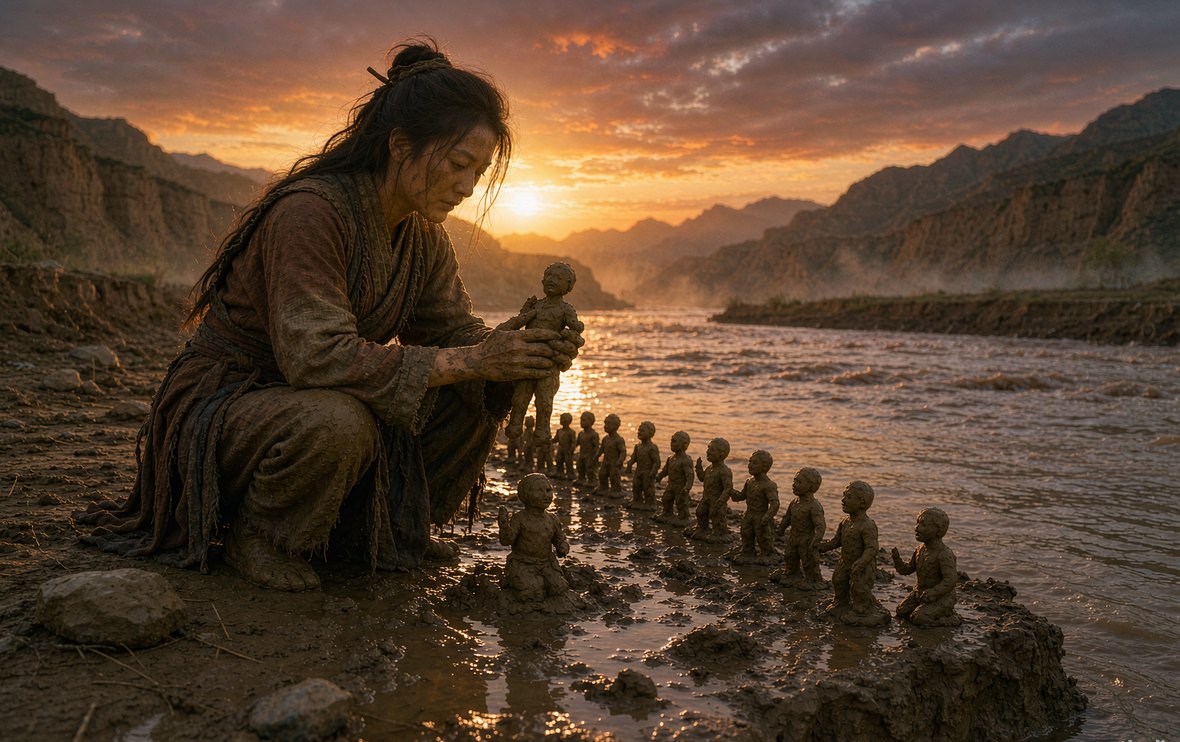
Why does China's creation-of-humans myth knead yellow earth rather than breathe a god's breath? — Because from the very beginning the Chinese believed: we come from the land, and we should live as solid as the land.
She kneads clay into human beings and mothers all life. The origin of life — creation made with tenderness.
She breathes life into mankind.
Among the creation myths of every civilization, China's story of making humanity is the most "down to earth": Nüwa used no divine decree and no material beyond the soil. She simply crouched by the Yellow River, scooped up handfuls of yellow earth, mixed in water, and pinched out little people one by one. Finding it too slow, she dipped a rope in the mud and flicked it — and the falling drops became people too. The myth states plainly what the Chinese believe about themselves: they came from the land, and the earth is on their hands.
The Taiping Yulan, quoting the Fengsu Tong, records: when Heaven and Earth had opened and there were as yet no people, Nüwa kneaded yellow earth into human beings. At first she shaped each one carefully by hand — hence the world has its rich and its clever; later, grown weary, she dragged a rope through the mud and flung it — hence the world has its poor and its dull. The gloss carries the shadow of a class society, but its core is an affirmation: human beings were made with care.
Note the material: not gold, not jade, but the humblest yellow earth. Chinese self-understanding was plebeian from the very source — we all come from the same handful of soil, and no one is born nobler than anyone else.
Gonggong in his rage struck Mount Buzhou: the pillar of heaven snapped, the cables of earth tore, the sky tilted toward the northwest, the land sank in the southeast, and flood, fire and wild beasts raged unchecked. Nüwa smelted five-colored stones to mend the sky, cut the legs of a giant turtle to prop up the four extremities, slew the black dragon to save Jizhou, and piled reed ashes to dam the floods.
This is the most "engineer-minded" scene in Chinese mythology: facing a cosmic catastrophe, Nüwa did not pray — she smelted, cut, filled and channeled. Mend, prop, slay, dam: four verbs, all hands-on work. From Nüwa onward, the Chinese imagination of salvation has been technical.
Legend says that after the flood only Fuxi and Nüwa, brother and sister, remained; the two married and peopled the world again. Nüwa also invented the sheng (mouth organ) and instituted the rites of marriage, ordering the relations of men and women and the bonds of human society. After making people comes ordering them: beyond flesh there must be structure — on this point Chinese myth is strikingly clear-eyed.
From a handful of yellow earth to a system of rites, the Nüwa myth draws a single line from "how humans are born" to "how humans live together." It explains why the Chinese honor Nüwa not only for giving birth to humanity, but for beginning civilization.