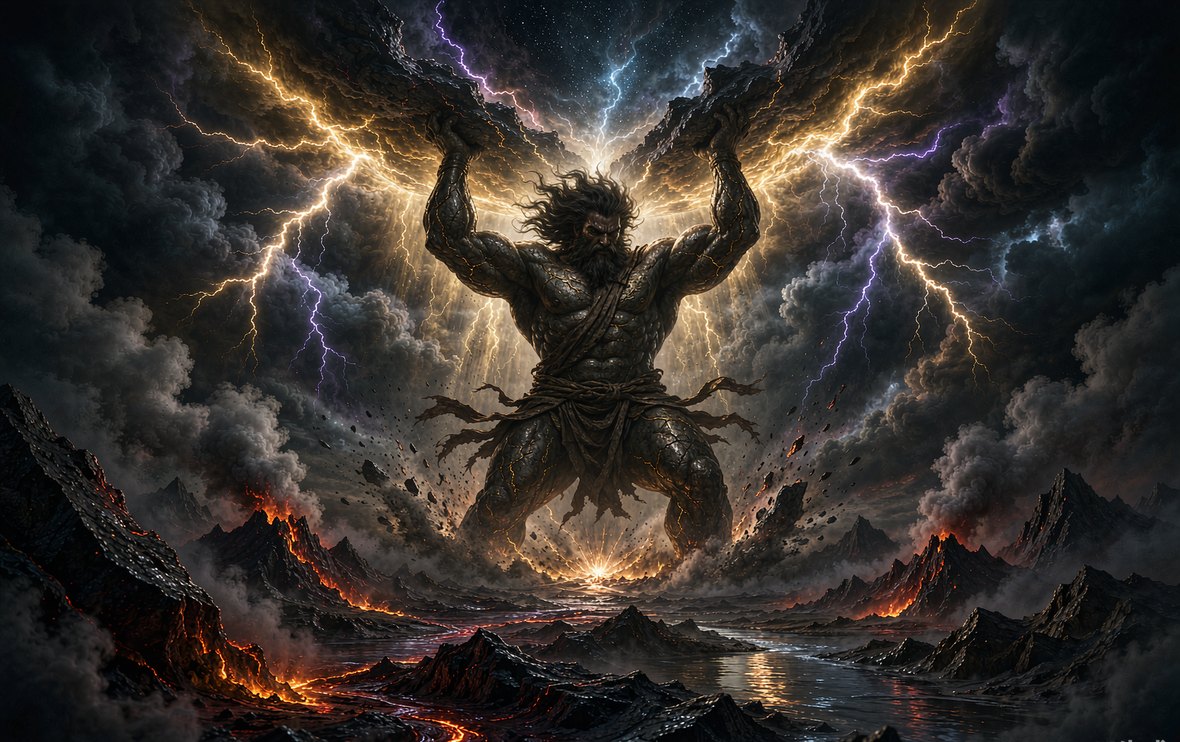
Was the world "spoken" into being, or "worked" into being? — Chinese myth chose the latter: the body of one giant, traded for sun, moon, mountains and rivers.
Chaos parts as Pangu cleaves heaven from earth. Creation of the world — new life, and the origin of all things.
From chaos, a world begins.
The first page of Chinese mythology is not a god creating the world, but a world growing out of a person's body. Pangu is not a sovereign enthroned above the clouds; he is the labor of creation itself — for eighteen thousand years the sky rose a zhang taller each day, the earth thickened a zhang, and he grew a zhang with them. At last he fell, and his breath became wind and cloud, his voice thunder, his eyes sun and moon, his limbs the four extremities and the Five Peaks, his blood the rivers, his hair the grasses and trees. This is not a tale of conquering nature, but the first declaration that man and cosmos are one flesh.
Before Heaven and Earth divided, the universe was a single egg of chaos, and Pangu gestated within. After eighteen thousand years he awoke, seized an axe and split the chaos — the light and pure rose to become the sky, the heavy and turbid sank to become the earth. From then on the sky rose a zhang each day and the earth thickened a zhang, and Pangu grew a zhang taller, for another eighteen thousand years, until Heaven and Earth stood fixed.
The subtlety of this vision: the universe was not "spoken" into being but "worked" into being. Creation is sustained, exhausting labor demanding aeons of persistence — from its very first day, the Chinese origin of the world smells of sweat.
As he lay dying, Pangu was transformed: his breath became wind and clouds, his voice thunder; his left eye the sun, his right eye the moon; his four limbs and five members the four extremities and the Five Peaks; his blood the rivers, his sinews and veins the contours of the land, his flesh the fields, his hair and beard the stars, his skin and body hair the grasses and trees, his teeth and bones metals and stone, his marrow pearls and jade, his sweat the rains that nourish.
This passage is the grandest stroke in Chinese mythology: the world is not an object standing outside of man, but the very substance of a human body transformed. And so when the Chinese look at mountains, rivers, grass and trees, they feel a kinship — the mountain is bone, the river blood, the wind a breath. The unity of Heaven and humanity is not a philosophical deduction; it is a memory kept in myth.
The Pangu myth first appears complete in the Sanwu Liji of Xu Zheng of the Three Kingdoms era, but the idea behind it is far older. It answers a fundamental question: where did the world come from? The answer — from sacrifice and labor. It differs utterly from the tradition of "Let there be light": one creates by command, the other with a body.
To read Pangu today is to read the Chinese attitude toward the world itself: the world deserves reverence, for it was once the whole of a person; and a person deserves respect, for a person can give their all for the world.