Composition
Dou blocks + gong arms + ang levers
Dougong is the most essential and most distinc...
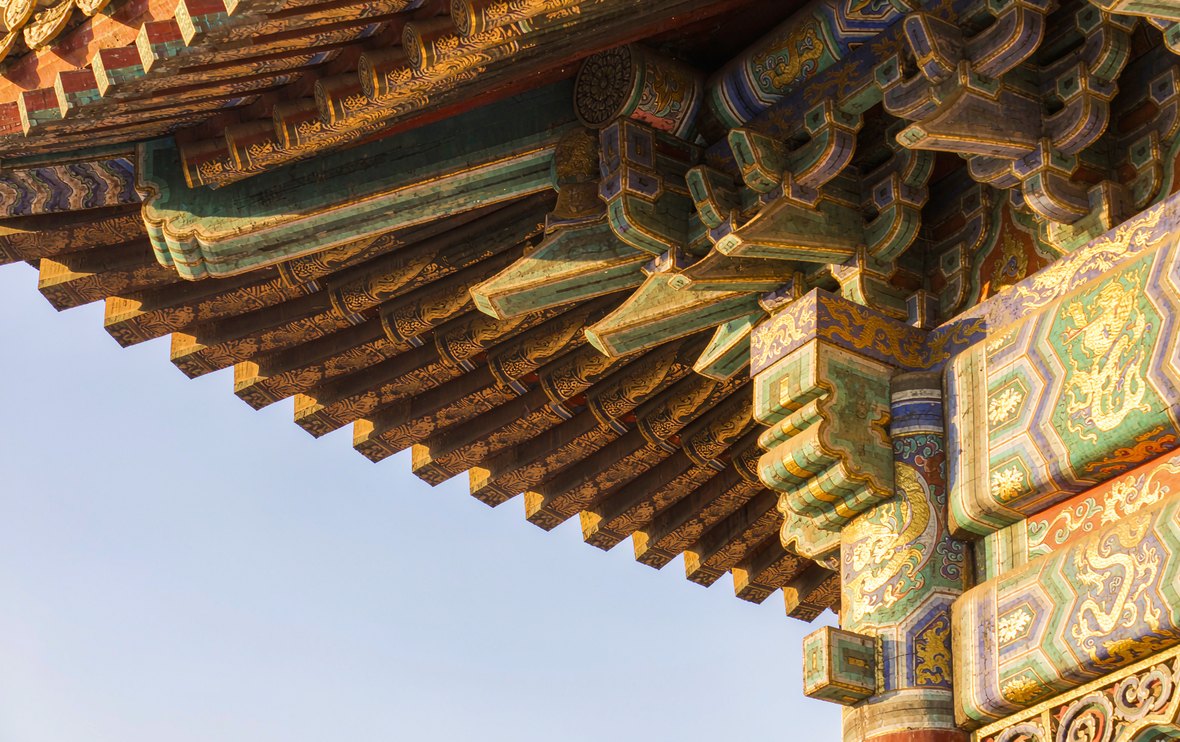
Dougong is the most essential and most distinctive component of classical Chinese architecture: set between the head of a post and the eaves, a "dou" (square block) carries a "gong" (bow-shaped arm), stacked and cantilevered layer upon layer to transfer the weight of the deep overhanging roof back into the post — at once a mechanical joint, a decorative language and a sign of rank. Dougong appears in embryo on Warring States bronzes; the great Tang brackets of Foguang Temple are "massive and the eaves reach far"; the Song *Yingzao Fashi* grades buildings by the number of bracket tiers; in the Ming and Qing the brackets shrank into ornament yet were more strictly regulated — the bracket fields beneath the eaves of the Hall of Supreme Harmony look like a sea of flowers frozen in wood. Their mechanical genius lies in "cantilever plus buffer": eaves project several metres without breaking at the tip, and in an earthquake the layers slide and rub, dissipating energy — dougong has been called "the shock absorber of ancient buildings". To read dougong is to read the grammar of rank and the poetics of force in Chinese architecture: the more solemn the building, the more elaborate its brackets.
The mechanics of dougong are those of a levered cantilever stacked layer upon layer: the bracket set atop a post is like an open wooden hand, its arms reaching outward tier by tier to hold the deep eaves — eaves may project three or four metres, throwing rainwater well clear of the wall base. The ang is a slanted lever whose shorter tail balances its longer head — the whole system uses not a single nail, relying entirely on the geometric interlock of its members.
Its performance in earthquakes is equally remarkable: when seismic waves arrive, the bracket tiers slip and rub like hundreds of small springs, absorbing and dissipating energy — more than sixty kinds of dougong together form the "damping skeleton" of the Yingxian Wooden Tower. Engineers have studied dougong for half a century and still marvel at its structural efficiency.
Dougong was the yardstick of rank in ancient building: the *Yingzao Fashi* fixed a building's grade by the number of bracket tiers ("puzu") — nine tiers being the highest, reserved for the main halls of palaces. After the Ming, as brackets shrank, the "doukou" measure took over the ranking function; commoner buildings had no dougong or only the simplest single block — one glance at the brackets told you a building's identity. The rule that "commoners may not dwell under dougong" turned it into ritual made three-dimensional.
The density of the brackets also dates a building: Tang and Song brackets are massive and chiefly structural; Ming and Qing brackets are fine and chiefly decorative — a single bracket set is an architectural dating stamp.
The beauty of dougong makes it the visual signature of Chinese architecture: the brackets beneath the eaves bloom like wooden flowers, shadow flowing through their layered projections. In any photographer's frame of an old Chinese building, the dougong is always the protagonist. It is the support of the "flying eaves", the technical base of the roof curve — without dougong there would be no Chinese skyline.
Its image long ago rose to the level of cultural symbol: the Expo China Pavilion "Oriental Crown" was modelled on dougong, and national-style logos, cultural products and game architecture borrow it again and again — dougong is among the few ancient components to complete a modern symbolic career.
The study of dougong is a central discipline of architectural history: the surveys of the Society for the Study of Chinese Architecture led by Liang Sicheng and Liu Dunzhen (Foguang Temple was identified as Tang by its brackets) founded Chinese architectural archaeology. The bracket lineages of the *Yingzao Fashi* have been reconstructed one by one, and 3D printing and structural testing have put the thousand-year-old members under load once more.
The other face of transmission is the workshop: master carpenters of the "great woodworking" tradition can make a complete set of brackets to the treatise, and the official-style techniques for restoring the Forbidden City pass down in unbroken order — the transmission of dougong is a long-distance relay joining craft, texts and standing buildings.