Technical essence
Convex tenon + concave mortise, joined without nails
Mortise and tenon is the core joining techniqu...
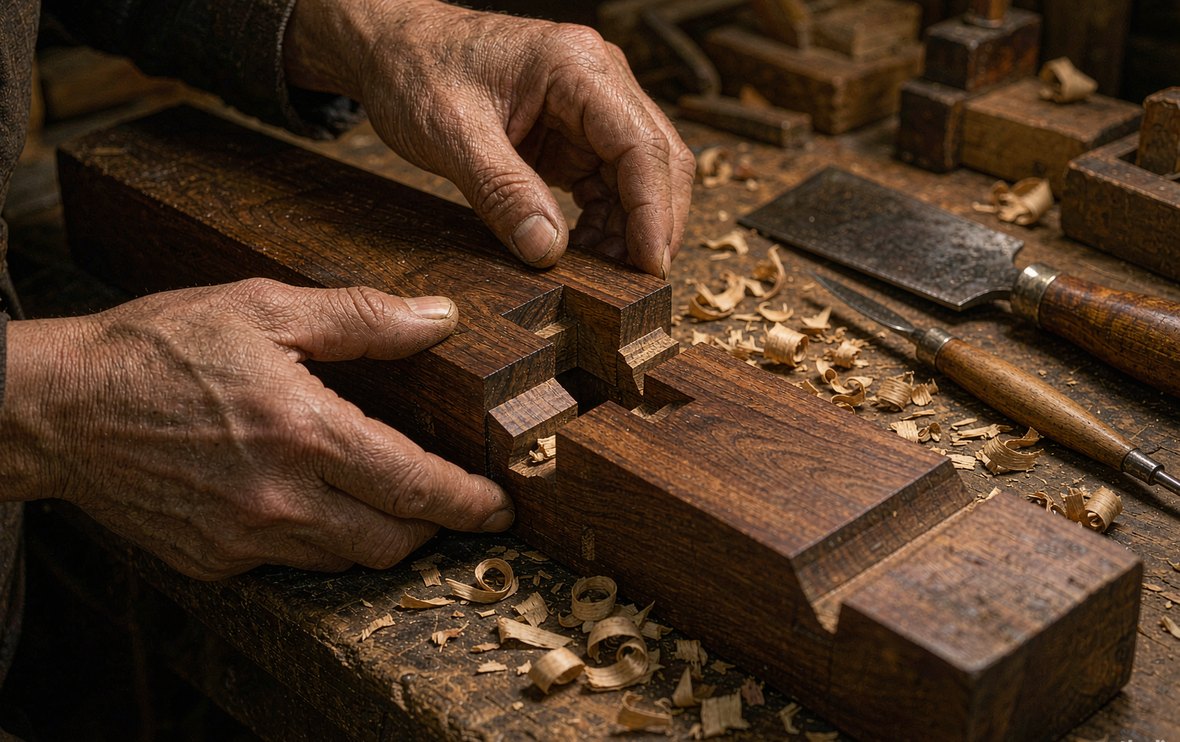
Mortise and tenon is the core joining technique of timber architecture and furniture: the projecting "tenon" enters the hollowed "mortise" and the two interlock, binding millions of members into a whole without a single nail — from the seven-thousand-year-old joints of Hemudu, through the Yingxian Wooden Tower and the Forbidden City, to Ming-style furniture, joinery is the universal grammar of Chinese woodwork. Its variety is vast: mitred shoulder joints, dovetails, "zongjiao" corner joints, wrapped shoulders, "zoumaxiao" self-locking pins... Ming-style furniture employs dozens of joints, each with its office; architectural joinery prizes the "movable connection": joints that are half rigid, half yielding, able to shift under load without coming apart — the ultimate secret of the seismic resilience of ancient Chinese buildings. The philosophy runs deep: convex and concave complete each other as yin and yang; no external force (nails, glue) compels them — the structure itself lets each fulfil the other. "Sunmao" is therefore often cited as a metaphor for Eastern ideas of relationship. Today joinery has entered design education and the vocabulary of cultural products, becoming a world Calling card for "the Chinese way of joining".
Joinery is older than writing: the stilt-house timbers excavated at Hemudu already include dovetails and tongued-and-grooved planks — ancestors without metal tools were treating wood as precision building blocks. Warring States coffins, Han tomb structures, Tang and Song pagodas, Ming and Qing furniture: the craft advanced all the way, and Ming-style furniture raised it to its summit — the graceful arc of a horseshoe-back armrest is joined with wedged "pintle" joints, seamless to the eye.
Furniture joinery and architectural joinery divide the labour: furniture joints aim to be "tight" — pieces handed down four hundred years still do not loosen; building joints aim to be "alive" — able to move in an earthquake and settle back after. One principle, optimized on two different timescales.
The mechanical advantages are three. First, a nail driven along the grain splits the wood, while joinery loads the wood along its natural strength. Second, iron nails rust and loosen as humidity changes, whereas the wood-to-wood faces of a joint "bed in" with use. Third — and decisive — the joint is semi-rigid: it permits slight rotation and slip, deforming to absorb energy in a quake and recovering afterwards — a resilience rigid connection cannot offer.
The brackets and joints of the Yingxian Wooden Tower form a vast energy-dissipating network that modern structural biomimetics studies in earnest. The ancients knew no finite-element analysis, yet seven thousand years of trial and error arrived at the same answer.
Joinery is often read as Eastern philosophy made tangible: the tenon is yang, the mortise yin — one proud, one hollow, entering and uniting. No outside compulsion (nails, glue) holds them; each fulfils the other through its own shape. The character he (合, "to join") originally meant vessels fitting together — sunmao is the Chinese model of relationship: a good union is one in which each side pare away a part of itself to complete a whole.
The metaphor is widely cited today: teamwork, exchange between civilizations, the meeting of tradition and modernity — "joinery thinking" has become a frequent image in cultural discussion. For a technical term to be elevated into philosophy is a distinction unique to sunmao.
Joinery today advances on two tracks. The traditional track: Ming-style furniture making is on the national intangible-heritage list, and the craftsman lineages of Suzhou, Beijing and Guangzhou styles continue. The innovative track: joinery has entered contemporary design — nail-free furniture brands, joinery building-block toys (Chinese alternatives to LEGO), experiments in jointed contemporary timber architecture; the Forbidden City's joinery puzzle boxes made it a phenomenon of popular science.
Joinery has even entered programming education: parametric design of joint models, 3D-printed mortises and tenons — a seven-thousand-year-old wisdom of connection is being translated into a language every generation can read.