Two branches
Paper-cutting (cut paper) · New Year prints (woodblock)
Paper-cutting and New Year prints are the two ...
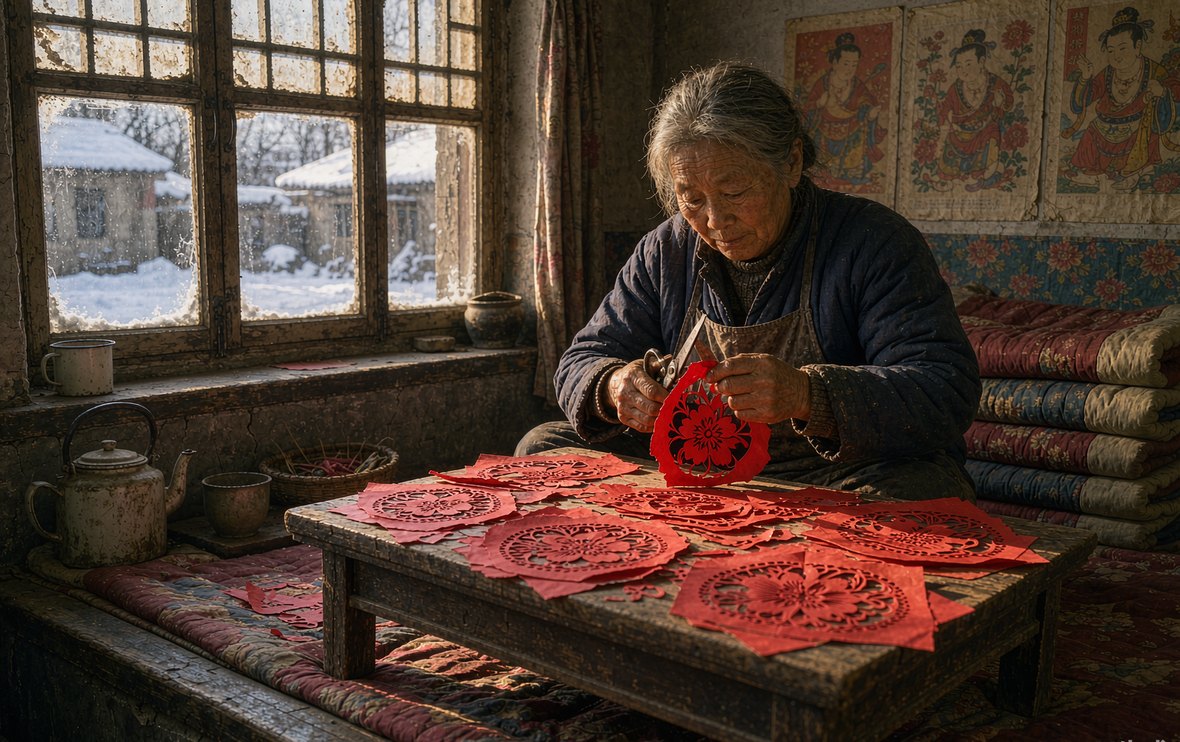
Paper-cutting and New Year prints are the two great branches of Chinese folk art, both a vernacular art of pictures that pray for blessing: the one cuts holes in paper with scissors and knives and pastes the result on window lattices and door lintels, the other prints colour from woodblocks on paper for the doorways of the house. Paper-cutting is a system unto itself: the northern manner is blunt and plain (window flowers of northern Shaanxi, the dyed cut-outs of Yu County), the southern manner fine and lovely (Yangzhou cutting, the copper-chiselled work of Foshan), and in 2009 Chinese paper-cutting was inscribed on UNESCO's Representative List. The New Year print grew up with the printing arts: Yangliuqing's "half printed, half painted" sheets are as fine as fine-line painting, Taohuawu's are as elegant as a sketch, Yangjiabu's as strong as sorghum spirit, Zhuxianzhen's as archaic as bronze — four great centres, four schools, several hundred years deep. The grammar of subject matter is shared: door gods to guard the house, chubby babies to draw blessings, fish and lotus for many sons, opera scenes for delight — the whole secret of folk art is that it paints and pastes up the wishes of ordinary life.
The history of paper-cutting reaches back at least to the Northern Dynasties (the rosette cuts excavated at Turpan in Xinjiang are already fully mature): window flowers, wedding flowers, gift flowers, shoe patterns — cutting permeates every crevice of life in the north. Scissors and knife work side by side, monochrome and piece-dyed both practised; Yu County work, "three parts cutting to seven parts dyeing", forms a school of saturated colour, while northern Shaanxi cutting, "one pair of scissors and the whole world", startled the modern art world with its raw force — a Picasso-like freedom of form had long been living on the papered windows of loess caves.
The aesthetic core of the cut is thinking in holes: negative shape is positive shape, the broken place is the joined place, and infinity is made within the limits of paper. Inscribed by UNESCO in 2009, the work of the bearer Ku Shulan, "the flower-cutting woman", is regarded abroad as that of a master; the modern canonisation of folk art was completed here.
The New Year print is as old as woodblock printing itself: the door god (Shenshu and Yulü, Qin Qiong and Jingde) is its oldest motif; a print market is recorded as early as the Song; the four great centres flourished in the Ming and Qing. Yangliuqing in Tianjin had literati painters taking part, and its half-printed, half-painted sheets are fine and elegant; Taohuawu in Suzhou, shaped by the engraving tradition, composes and colours like Jiangnan itself; Yangjiabu in Weifang is full-bodied and strong; Zhuxianzhen in Kaifeng is archaic and vigorous, a living fossil of the craft.
Their subjects make an encyclopaedia of custom: door gods and stove lords (belief), chubby babies and beauties (blessing), opera scenes (entertainment), farming and the solar terms (knowledge) — the print wall of a household was at once its wish list and its library.
The universal grammar of folk art is homophone and symbol: lotus and fish for "surplus year after year", plum blossom for "joy up to the eyebrows", a vase for "peace as you wish", three rams for "the opening of the year" — the picture is a phonetic code, understood at a glance and answered with a smile. This system in which every picture has a meaning and every meaning is auspicious let villagers who could not read read wishes and pass on blessings: Chinese folk art is at heart a visual dialectology.
The print baby clasping a fish, the paper-cut pomegranate with its many seeds — the fertility of the image is one with the cult of fertility: the deepest motif of folk art is an eternal prayer for life and abundance.
The two crafts have fared differently and both well: paper-cutting has entered art schools and contemporary art (Lü Shengzhong's installations of little red figures), and cut-paper installations appear in international exhibitions; the New Year print has completed an IP transformation — Yangliuqing elements enter national-trend design, animation and merchandise, Yangjiabu painters livestream at their blocks, and the new door gods now include astronauts and delivery riders.
The logic of transmission has been rewritten: from "used only at New Year" to "visible every day" — as paper-cuts go up in coffee shops and prints appear on phone cases, these two old crafts have seeped back into the texture of contemporary life.