Theoretical basis
Xie He's Six Principles (Southern Dynasties)
Chinese painting (guohua) is a pictorial syste...
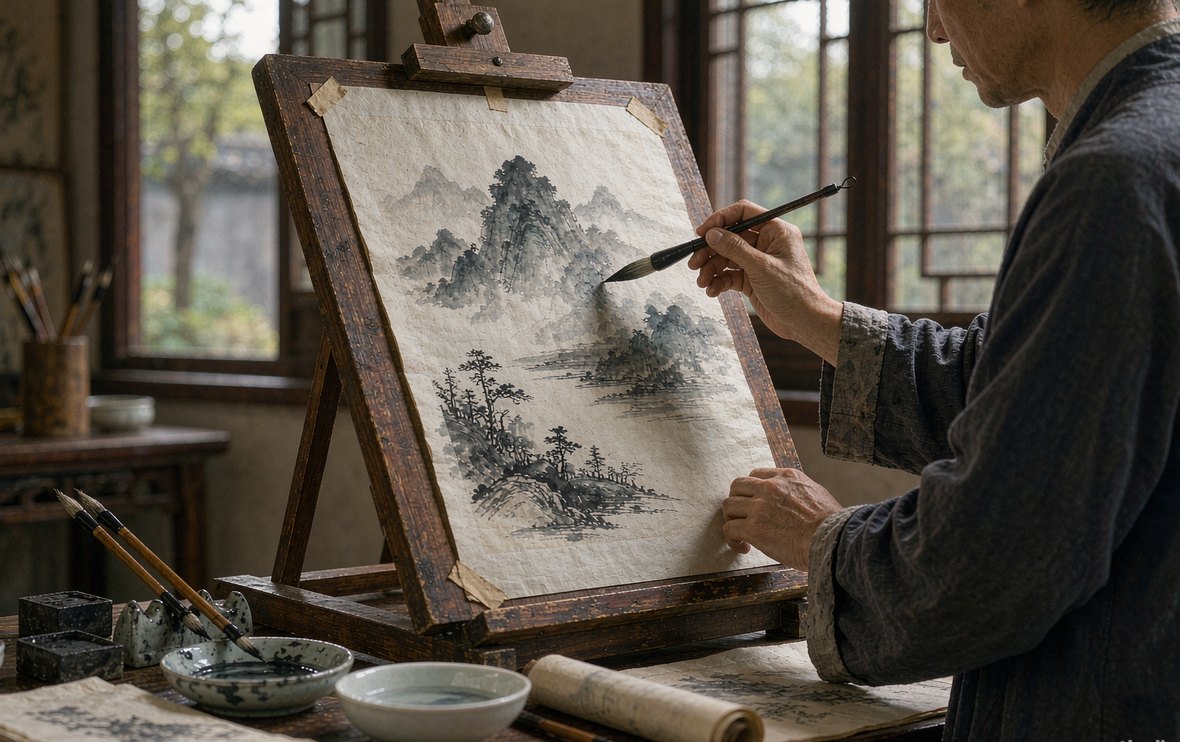
Chinese painting (guohua) is a pictorial system that stands on its own beside the Western tradition: brush, ink, xuan paper and silk as its materials; the line as bone, ink tone as soul, blank space as breath; and qi yun sheng dong — spiritual resonance, life in motion — as its aim rather than visual verisimilitude: "to judge a painting by likeness is the view of a child" (Su Shi). The system is self-sufficient and immense. Figure painting prizes spirit (Wu Daozi's sashes, filled with wind); landscape prizes mood (Jing Hao and Guan Tong, Dong Yuan and Juran, Fan Kuan and Guo Xi — their texture strokes are a graphology of mountains); bird-and-flower painting prizes vitality (Xu Xi's wildness against the Huang family's richness; the lonely birds of Bada Shanren staring coldly at the world). Literati painting rose in the Song and Yuan and bound poetry, calligraphy, painting and seal into one body, with Ni Zan's "a careless brush, no wish for likeness" as its highest creed. Xie He's Six Principles, formulated in the Southern Dynasties, remain the theoretical bedrock of the art. To read a Chinese painting you must read its peculiar way of seeing: shifting perspective, imagined blankness, inscriptions that answer back — a painting is a whole world you can walk into.
Xie He's *Record of the Classification of Old Painters* set out the Six Principles: spiritual resonance in motion (the highest law — the picture must live), bone-method in brushwork (the sinew of the line), correspondence to the object in form, appropriateness of colour to kind, management of position (composition), and transmission by copying (the lineage of study). For fifteen hundred years these have been the constitution by which Chinese painting is judged, taught and made.
What is profound is the order: likeness ranks only third or fourth, while resonance is the final standard — from the very origin of its theory, Chinese painting chose expression over reproduction. That choice set it on a road entirely different from the Western realist tradition.
Landscape is the crown of Chinese painting: the panoramic landscapes of the Five Dynasties and Northern Song (the towering mountain of Fan Kuan's *Travellers among Mountains and Streams*; Guo Xi's three distances — high, deep, level), the corner views of the Southern Song (Ma Yuan and Xia Gui, "one corner, half a side"), the studio landscapes of the Four Masters of the Yuan (Huang Gongwang's *Dwelling in the Fuchun Mountains*, a whole life painted into one river), the archaism and individualism of the Ming and Qing — the history of landscape is the history of where the Chinese spirit has lived.
Guo Xi's *Lofty Message of Forests and Streams* gives the game away: landscape painting is made for those who "never leave the hall and yet would sit out the ravines" — a spiritual stand-in that can be dwelt in and wandered through. The Chinese need not actually retreat to the mountains: hang a landscape, and the springs are already in the heart.
The material philosophy of Chinese painting is brush and ink: ink divides into five tones — scorched, dense, heavy, pale, clear — and a single colour of ink can render every light and shadow; brushwork and inkwork generate one another, "ink within the brush, brush within the ink", so that the limit pushed on the tool produces the limit of richness in the language. The bleeding of raw xuan paper brings chance into the aesthetic: one stroke laid down, the tones settle as they will, nothing can be corrected — Chinese painting is an art completed in a single pass, closer to performance than to sculpture.
Blank space is its other marvel: in Ma Yuan's *Angler on a Wintry Lake* the sheet is all water, with one boat and one old man — the emptiness is the river, the sky, the imagination. "Count the white as black": the untouched ground is not absence but the largest vessel of presence. This aesthetic shaped calligraphy, garden design and, beyond them, a whole Chinese attitude to life.
The great synthesis of literati painting is the union of four arts: a poem inscribed on the picture (calligraphy and literature entering painting), a signature sealed in red (seal engraving entering painting) — four arts annotating and completing one another on a single surface. The tradition of inscriptions made the painting a site of conversation across centuries: collectors and connoisseurs left their remarks on the silk, so that an old painting travels through a thousand years trailing a long ribbon of commentary.
The foresight of this synthesis is astonishing: it precedes Western mixed-media art by nearly a millennium, and it is not technical collage but aesthetic intertextuality — painting writes the idea in form, poetry speaks the intent, calligraphy frees the spirit, the seal pledges the word. Only when one reads the union of the four does one understand why Chinese painting is the Eastern archetype of the total work of art.