Four skills, five methods
Song, speech, movement, combat · hand, eye, body, method, step
Chinese opera (xiqu) is a total theatre of son...
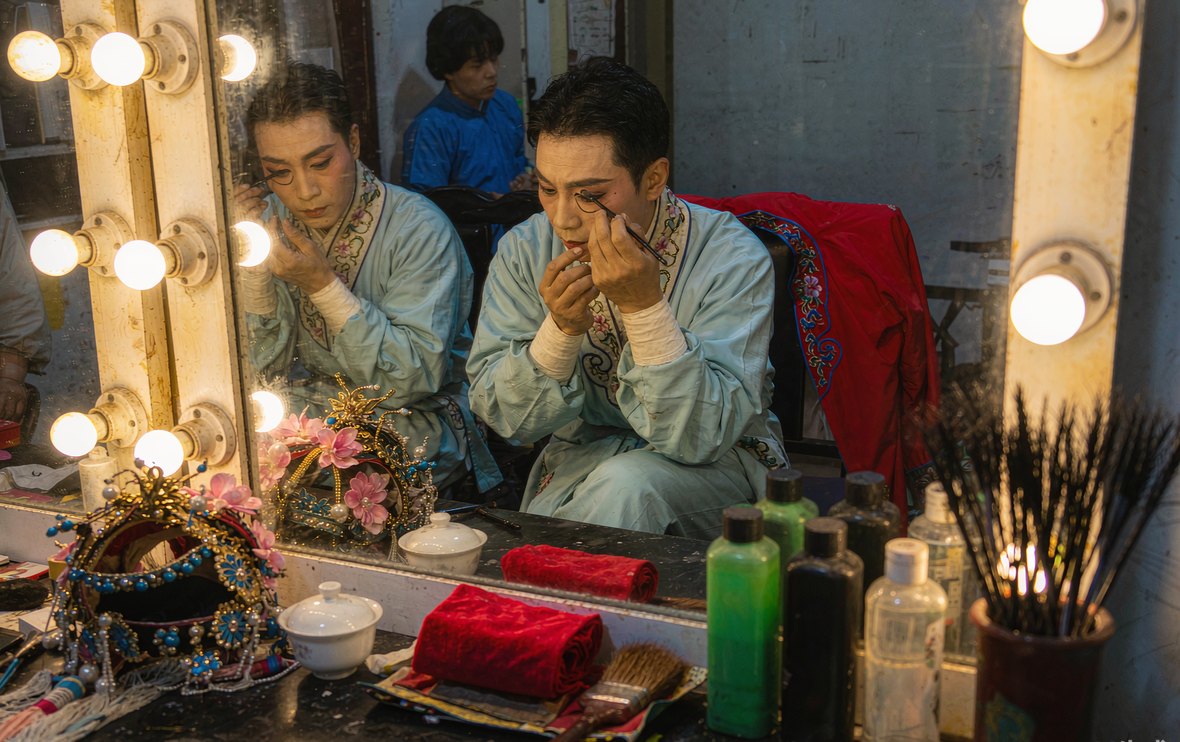
Chinese opera (xiqu) is a total theatre of song, speech, movement and combat — chang, nian, zuo and da — uniting literature, music, dance and design on a single stage. With the tragic and comic theatre of ancient Greece and the Sanskrit drama of India it forms the world's three ancient theatrical traditions, and it is the only one still alive. Its lineage is immense: the nanxi of Song and Yuan, Yuan zaju (Guan Hanqing's *Snow in Midsummer*, Wang Shifu's *Romance of the Western Chamber*), the chuanqi of the Ming and Qing (Tang Xianzu's *Peony Pavilion*), the refinement of kunqu, "ancestor of a hundred operas", the maturity of Peking opera (the Anhui troupes entering the capital, the Thirteen Masters of the Tongzhi and Guangxu reigns) — more than 360 regional forms, each with its own dialect and accent: the grandeur of Peking opera, the elegance of kunqu, the tenderness of Yue opera, the high pitch of Yu opera, the splendour of Cantonese opera, the freshness of Huangmei. Its aesthetic stands apart: stylised performance (every mounting of a horse and every circle of the stage has its fixed form), virtual space (a single riding crop is a thousand li of country), expressive design (a painted face is a map of character) — "three or five steps cross the world; six or seven men make an army of a hundred thousand". Kunqu was inscribed by UNESCO in 2001 and Peking opera in 2010 — the joys and sorrows on the Chinese stage are the most complete living form of Chinese aesthetics.
The bloodline of opera flows down from ancient song, dance and sacrifice: the hundred entertainments of the Han, the adjutant plays of the Tang, the zaju of the Song and the courtyard plays of the Jin all prepared it, and Yuan zaju announced its maturity with the four masters Guan Hanqing, Ma Zhiyuan, Bai Pu and Zheng Guangzu — the midsummer snow of *Snow in Midsummer*, the lovers of *The Western Chamber*: literature and stage met perfectly for the first time. The chuanqi of the Ming and Qing carried the form on, and Tang Xianzu's *Peony Pavilion* — "love, one knows not where it begins, deepening the further it goes" — lifted opera to the summit of literature. Kunqu held sole sway as the refined style for two hundred years; Peking opera, after the Anhui troupes entered the capital in 1790, fused Anhui, Hubei, Kunqu and clapper idioms and took shape as the national opera under the Daoguang emperor.
Thereafter the regional theatres flowered everywhere: the high pitch of the clapper systems, the smooth flow of the xipi and erhuang systems, the modern rise of Yue, Ping and Huangmei opera — more than three hundred forms running like parallel rivers into the vast estuary of Chinese opera.
The grammar of the operatic stage is convention and suggestion: convention distils the movements of life into beautiful fixed forms — the general's self-presentation, the ride on a horse, the sleeve that speaks, the pheasant feathers that signal — everything has its score; suggestion summons the most with the least — one oar and you are on the water, one crop and you are mounted, four extras and you face an army, one circle of the stage and you have walked a hundred li. Actor and audience hold to an unspoken contract: not truth to life, but beauty and true meaning.
This expressive aesthetic shares an origin with the blank space of painting: the stage is the paper, the convention is the brushstroke. Chinese opera has been called dramatic poetry, and its essence is poetry performed with the body. Western theatre recognised the modernity of this aesthetic only with Brecht; Chinese opera had been walking the expressive road for eight hundred years.
Operatic characters are sorted by role type: sheng, dan, jing and chou each have their province — the sheng (older, young, martial), the dan (quiet, lively, old, armed), the jing with his heavy painted face, the chou with his white-powdered nose and comic patter. The painted face is a colour science reserved for jing and chou: red for loyalty (Guan Yu), white for treachery (Cao Cao), black for rectitude (Bao Zheng), blue for ferocity (Dou Erdun), gold and silver for gods and demons — character written directly on the face, so that the audience knows good from evil without a line of text.
This colour code is a highly compressed semiotics of ethics: it assumes public standards of loyalty and villainy and makes the opera the most effective moral theatre of traditional society — villagers could not read, but they knew a red face from a white one.
The repertoire is a national storehouse of feeling: *The Peony Pavilion*, *Farewell My Concubine*, *The Drunken Beauty*, *The Butterfly Lovers*, *The Orphan of Zhao* — each a shared memory of generations. Mei Lanfang and the four great dan players carried Peking opera to the world (Mei's tours of America and the Soviet Union were events in theatre history), and Pai Hsien-yung's youthful *Peony Pavilion* won a new generation for kunqu.
Challenge and opportunity arrive together: audiences are ageing while short video breaks the circle; opera in schools, newly written works and crossovers (opera with rock, opera with animation) keep experimenting. The 360 forms are not equally healthy, but the aesthetics of the stage are being seen again by a younger China — in the national-style revival, opera is an inexhaustible mother lode.