Planning blueprint
The capital model of the Rites of Zhou · Kaogongji
Palaces and ritual buildings form the highest-...
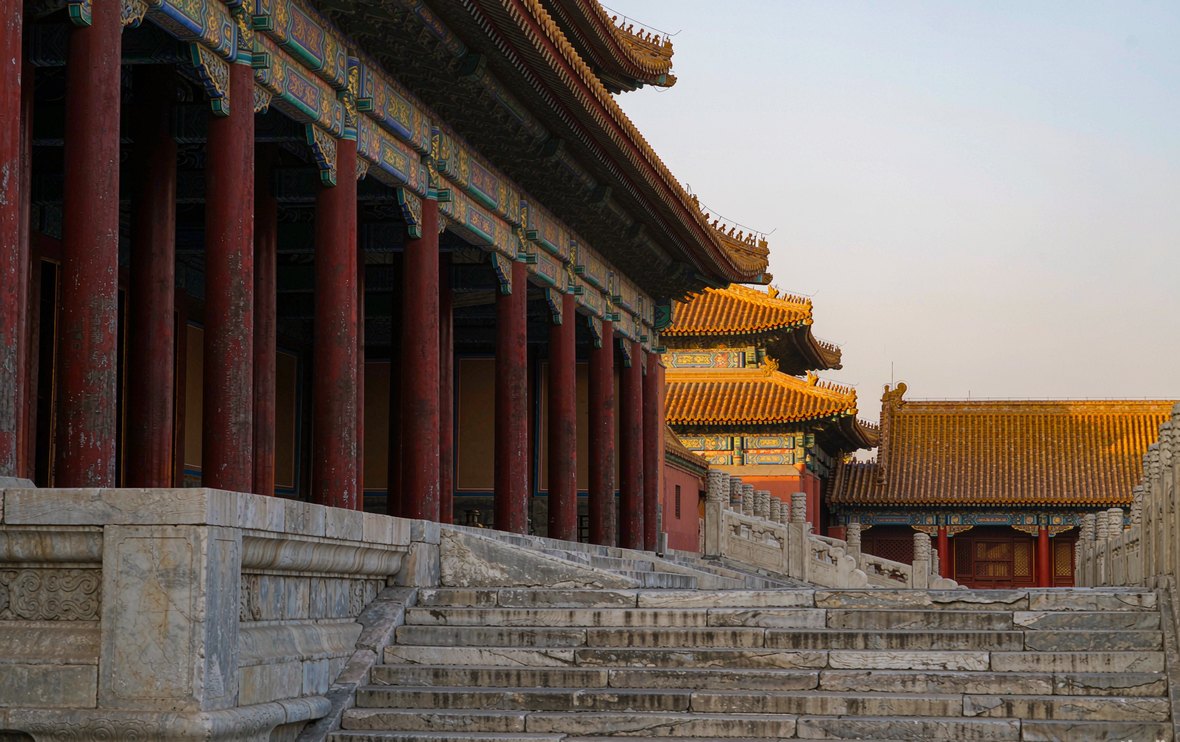
Palaces and ritual buildings form the highest-ranked architectural system of ancient China: palaces housed imperial power (government and residence), altars and temples carried ritual (worship of Heaven, ancestors, soil and grain), and together they built the spatial expression of "family and state as one". The planning grammar comes from the *Rites of Zhou · Records of Artificers*: "ancestral temple to the left, altars to the right, court in front, market behind" — the Forbidden City is the perfect realization of this ideal: the Hall of Supreme Harmony for state affairs in front, the Palace of Heavenly Purity for residence behind, the Imperial Ancestral Temple to the east, the Altar of Land and Grain to the west; the Round Mound of the Temple of Heaven worships Heaven, the Square Water Terrace of the Temple of Earth worships Earth — the round and square plans answering "round Heaven, square Earth". The hierarchy is written into every detail: the hipped roof supreme, the hip-and-gable next; bays in nines and fives; yellow glazed tiles reserved to the throne; the highest polychrome painting for the greatest halls — every brick and tile speaks status. The Forbidden City and Temple of Heaven are World Heritage, and the Beijing Central Axis was inscribed as a whole in 2024 — the grand order of palaces and altars is the most vivid textbook for understanding traditional Chinese politics.
The essence of a palace is to translate power into space: the three great halls of the Forbidden City (Supreme Harmony, Central Harmony, Preserving Harmony) stand on a three-tiered white marble terrace; the Hall of Supreme Harmony with eleven bays, double-eaved hipped roof and ten ridge beasts — a configuration unique in the realm. Below the steps the officials ranked in order; the imperial way belonged to the emperor alone — every detail of "the Most Exalted of the Nine-Five" and the "Golden Chime Hall" staged the performance of power in every glance upward and bow downward.
The scale is itself politics: the Forbidden City covers 720,000 square metres with more than 8,700 rooms, yet the emperor's sleeping quarters run only a dozen-odd metres deep — the grandeur of power coexists with restraint in living; the division of "outer court, inner court" is precisely the institutional carving of public from private.
Ritual buildings split into two branches: altars (open-air platforms speaking to Heaven, Earth and nature) and temples (roofed halls enshrining ancestors and sages). The Round Mound of the Temple of Heaven stands open to the sky in three tiers of white marble, its numbers all nines and fives (the extreme of yang); at the sacrifice, nothing stands between the worshipper and the vault of Heaven. The Square Water Terrace of Earth, the altars of Sun and Moon, the five-coloured earth of Soil and Grain — "the great affairs of state are sacrifice and war"; the altar was the dynasty's first public instrument.
The Imperial Ancestral Temple (today the Working People's Cultural Palace) and the Temple of Confucius represent the worship of ancestors and sages: the front hall of the Ancestral Temple held the tablets of emperors and empresses; the Hall of Great Achievement at the Confucius Temple has a double-eaved hip-and-gable roof and ten dragon columns — the two spiritual lines of ancestor and sage, each housed in its own architecture.
Palaces and ritual buildings speak a rigorous language of rank: roof types (double-eaved hipped > double-eaved hip-and-gable > single-eaved hipped > single-eaved hip-and-gable > overhanging gable > flush gable); bays (nine by five the honourable, eleven exceeding the rule and requiring special dispensation); glazed tiles (yellow reserved to the throne, green for princely mansions, grey for commoners); painting (hexi > xuanzi > su-style); terrace tiers (the number of sumeru steps) — each item alone reads out a building's identity card.
The function of this language is legibility: without a word of text, the building itself proclaims order — enter any ancient complex and the hierarchy is known at a glance. The spatialization of ritual is the most distinctive contribution of Chinese architecture.
The Palace Museum is the most visited museum in the world (well over ten million a year); the Temple of Heaven, the Imperial Ancestral Temple and the Altar of Land and Grain form the ritual core of Beijing; in 2024 the "Beijing Central Axis" joined the World Heritage List — palaces and altars, as the skeleton of the axis, received recognition as an ensemble.
The contemporary reading of this architecture keeps deepening: the "Digital Palace Museum", the acoustic demonstrations at the Temple of Heaven (the Echo Wall, the Three-Tone Stones), archaeology probing the Ming foundations of the Forbidden City — palaces and altars still offer a triple text of political history, architectural history and ritual history.