Compiled
Eastern Han · Edited in the Northern Song
The Jingui Yaolue (Essential Prescriptions fro...
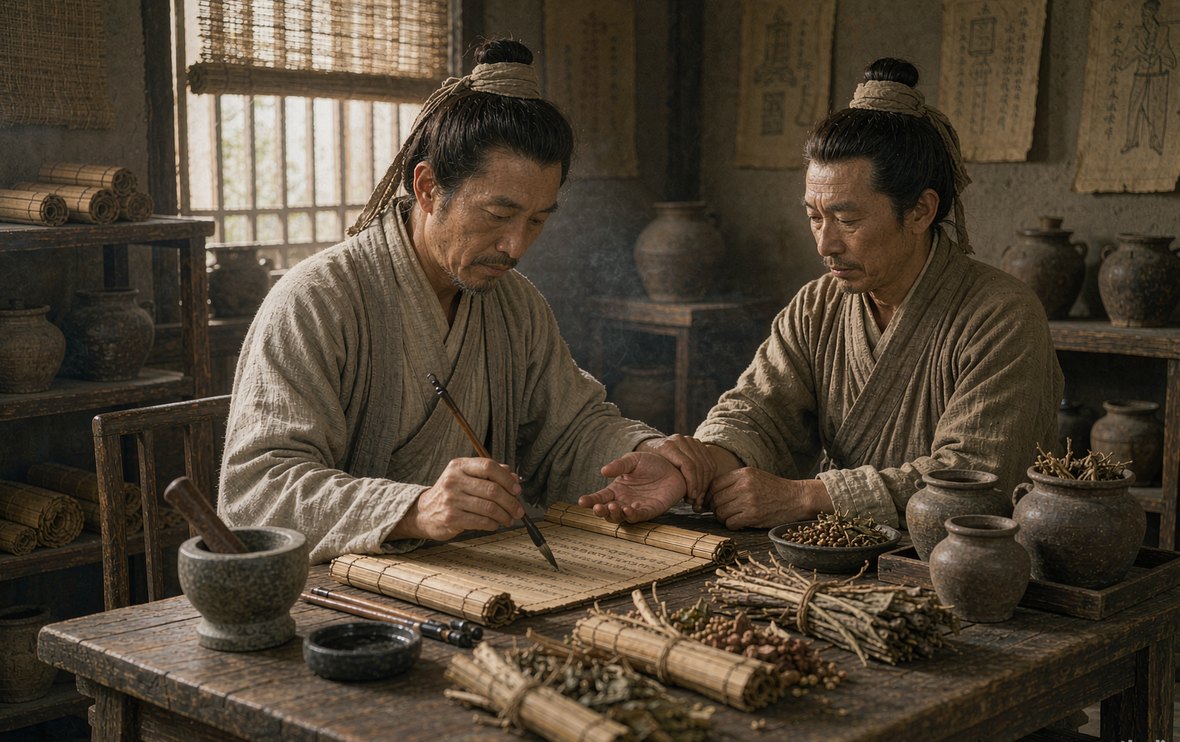
The Jingui Yaolue (Essential Prescriptions from the Golden Cabinet) was originally the "miscellaneous diseases" portion of the Shanghan Zabing Lun, edited into an independent work by the Northern Song Bureau for Collating Medical Texts, and became the founding classic of Chinese internal medicine for chronic disorders. Its twenty-five chapters take "zang-fu organs and jing-luo (meridians)" as the guiding principle of differentiation, discussing the causes, mechanisms, diagnosis, and treatment of internal injury — it does not ask "which disease is this," but "which organ is in imbalance, which channel is blocked, how do deficiency and excess, root and branch stand." Its opening chapter, "On Disorders of the Zang-Fu and Channels," sets the master key: "the superior physician treats what is not yet ill" and "when the primal qi of the five organs flows unobstructed, the person is at peace" — health is, in essence, flow and harmony; imbalance is, in essence, blockage and skew. Unlike the Shanghan Lun, which treats externally contracted transmission, the Jingui faces chronic, constitutional, internally generated patterns — it teaches the medical thinking of "the long term."
The entrance to differentiation in the Jingui is the organs and channels: first judge which zang, which fu, which channel the imbalance has fallen upon, then weigh its deficiency-excess and root-branch — the same outward signs may spring from different organ imbalances, calling for different directions of treatment. This "localization first" habit keeps Chinese medicine always pointed at "the person’s state" rather than "the disease’s name."
The deeper meaning of organ differentiation is wholeness: the five zang generate and restrain one another, and an imbalance in one necessarily tugs at the others — "seeing illness in the liver, know it will transmit to the spleen; fortify the spleen first" is the Jingui’s most famous treatment principle, and it speaks of "anticipating chain reactions": do not wait for the next link to fail — guard it in advance. This is the doctrine of "treating before illness" made concrete in clinical thought.
"Root and branch" (biaoben) is the Jingui’s core instrument of judgment: the branch is the outward manifestation, the root the inner source; in urgency treat the branch, in calm treat the root, and when both are urgent address them together — a decision science of "sequence." Clinical difficulty often lies not in failing to see the problem but in deciding "what to handle first"; the theory of root and branch supplies exactly the framework of priority.
The distinction of deficiency and excess is equally vital: deficiency means upright qi is insufficient, excess means evil qi abounds; supplement deficiency, drain excess, and where both mingle, attack and tonify at once. To judge deficiency and excess is essentially to judge "the body’s capacity to bear treatment" — the same imbalance, in a strong and a weak constitution, may call for opposite directions. The individualization of Chinese medicine rests on this fine discernment of "the balance of upright and evil."
若五脏元真通畅,人即安和。 — When the primal qi of the five organs flows unobstructed, the person is at peace.——Jingui Yaolue · "Zangfu Jingluo Xianhou Bing Maizheng"
The Jingui wields pulse diagnosis with great delicacy: the floating, deep, slow, or rapid quality of a single position, forceful or feeble, is judged together with season, constitution, and course of illness — the pulse is not an isolated index but a slice of the whole state. The book also repeatedly cross-reads the "cunkou pulse" and the "fuyang pulse," inferring from surface pulses the abundance or stagnation of the inner qi dynamic.
Even more distinctive is abdominal diagnosis: press the abdomen with the hand, noting tenderness, fullness, pulsing, warmth or cold — extending the art of "touch" from the wrist to the whole trunk. Abdominal diagnosis embodies a strikingly modern clinical intuition: the body "speaks," and the physician’s hand is another stethoscope. This palpation tradition survives intact today in Japanese Kampo medicine.
The Jingui faces a class of imbalance that is "not urgent but intractable": mostly born of internal injury, constitution, emotion, and long-accumulated habits of diet and daily life, slow in progress and wide in reach. Its treatments therefore stress "gradual strategy": not chasing quick effect but the stepwise adjustment of the whole pattern — "when the primal qi of the five organs flows unobstructed, the person is at peace": the goal is always restoring the system’s flow and accord.
The contemporary significance of this "slow medicine" is emerging: in an era when chronic health problems are the mainstream, one-shot antagonistic fixes often fall short, while adjusting lifestyle, constitution, and overall state comes closer to the nature of the problem. The Jingui’s value lies not only in its formulas but in its demonstration of patience and method in facing "long-term imbalance."