01
Yin-Yang & the Five Phases
The master key of Chinese medicine: yin as nutritive matter, yang as motion — joined they are qi, the way life exists.
Read the full entry “Yin-Yang & the Five Phases” →From stillness into motion: nourish spirit, build qi, train form; read the cold and heat of heaven and earth, examine the qi and blood of the body, and hold life in balance with herbs and needles.
The heart of Chinese medicine: first the worldview, then the body, then imbalance, then daily practice — a bridge for every reader who wants to understand Chinese medicine.
The master key of Chinese medicine: yin as nutritive matter, yang as motion — joined they are qi, the way life exists.
Read the full entry “Yin-Yang & the Five Phases” →The five zang are functional systems, not anatomical organs — how Chinese medicine sees the body.
Read the full entry “The Visceral Systems (Zangxiang)” →How qi, blood and fluids are generated, circulate and fall out of order — the framework of bodily energy and nourishment.
Read the full entry “Qi, Blood & Body Fluids” →The courses and junctions of the twelve regular channels and their key points — the body’s information pathways.
Read the full entry “The Twelve Channels” →The six excesses, the seven emotions, diet and overwork — explaining "why you feel unwell" more kindly than a disease name.
Read the full entry “Why We Fall Ill: Causes & Mechanisms” →Nine constitutions: why the same method works for others and not for you.
Read the full entry “The Nine Constitutions” →Spring birth, summer growth, autumn harvest, winter storage — seasons and sleep, food and movement.
Read the full entry “Living with the Seasons” →Why old symptoms can resurface and you may feel briefly worse on the way to better.
Read the full entry “The Healing Crisis (Mingxuan)” →Food therapy, daoyin, acupressure, moxibustion — each with safety notes, no medical promises.
Read the full entry “Everyday Practices at Home” →More than fighting: a bodily practice that harmonizes qi and blood and accords with heaven and earth — from stillness into motion, nourishing spirit, building qi, training form.
Expel the old, draw in the new: breath as the bridge — the first lesson and the master gate of Daoist inner alchemy.
Read the full entry “Tuna: The Daoist Art of Breath” →Keep the mind still, regulate the breath and look within: the root of all martial and health cultivation.
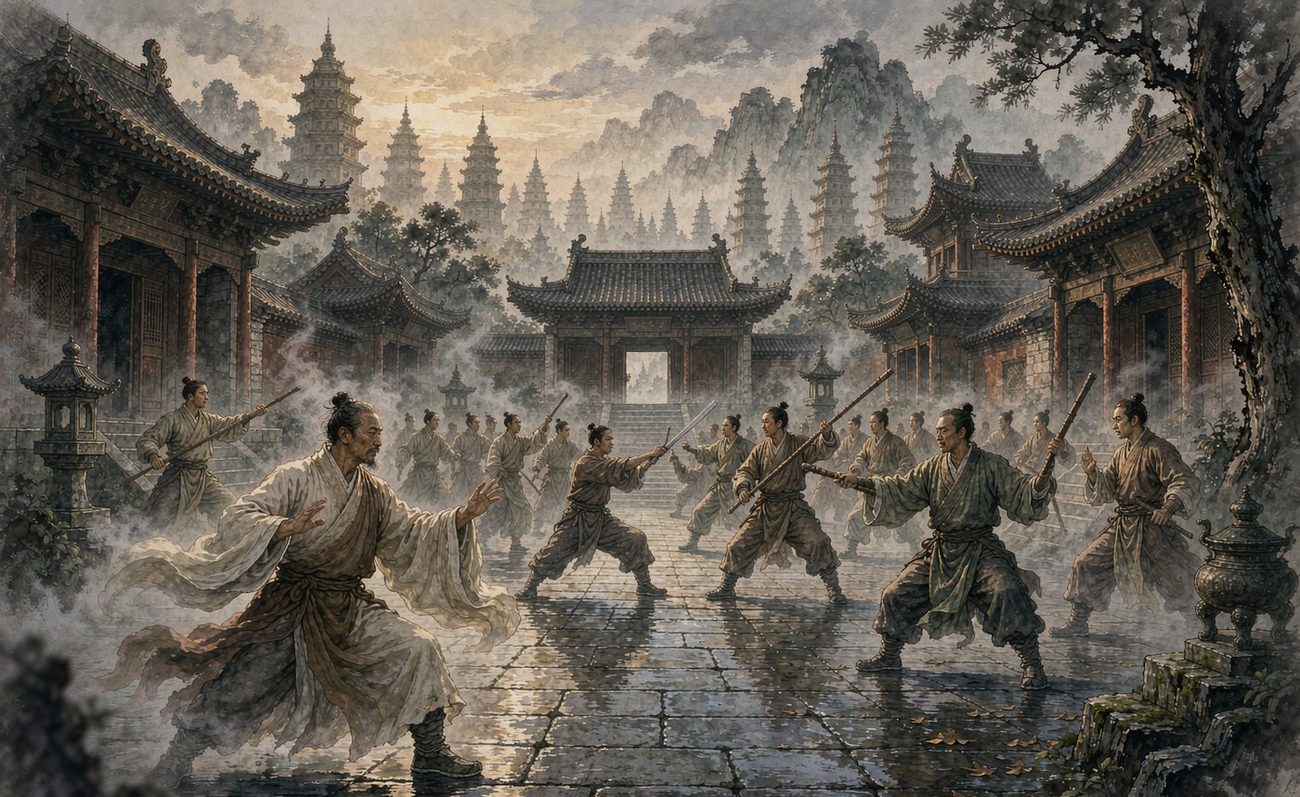
Shaolin Monastery and Wudang, home of tai chi — Chinese martial arts are at once fighting systems and philosophy made bodily: tai chi overcomes hardness with softness, kung fu seeks the Way through combat. The character wu (武) is made of “stop” (止) and “spear” (戈): to end weapons is the original meaning of martial skill.
Read the full entry “Seated Meditation” →Nurture a body of primal qi in stillness: form quiet, qi moving — the body’s foundation laid firm.
Shaolin Monastery and Wudang, home of tai chi — Chinese martial arts are at once fighting systems and philosophy made bodily: tai chi overcomes hardness with softness, kung fu seeks the Way through combat. The character wu (武) is made of “stop” (止) and “spear” (戈): to end weapons is the original meaning of martial skill.
Read the full entry “Standing Meditation (Zhan Zhuang)” →Stretch sinew and draw bone, open the body’s fascia, and transform the strength of muscle and frame.
Shaolin Monastery and Wudang, home of tai chi — Chinese martial arts are at once fighting systems and philosophy made bodily: tai chi overcomes hardness with softness, kung fu seeks the Way through combat. The character wu (武) is made of “stop” (止) and “spear” (戈): to end weapons is the original meaning of martial skill.
Read the full entry “Yijin Jing (Muscle-Tendon Change Classic)” →A gentle old daoyin, simple and soft: stretch the body and free the flow of qi.
Shaolin Monastery and Wudang, home of tai chi — Chinese martial arts are at once fighting systems and philosophy made bodily: tai chi overcomes hardness with softness, kung fu seeks the Way through combat. The character wu (武) is made of “stop” (止) and “spear” (戈): to end weapons is the original meaning of martial skill.
Read the full entry “Baduanjin (Eight Pieces of Brocade)” →Strength hidden in slowness, softness overcoming hardness: body and mind harmonized in slow, flowing motion.
Shaolin Monastery and Wudang, home of tai chi — Chinese martial arts are at once fighting systems and philosophy made bodily: tai chi overcomes hardness with softness, kung fu seeks the Way through combat. The character wu (武) is made of “stop” (止) and “spear” (戈): to end weapons is the original meaning of martial skill.
Read the cold and heat of heaven and earth, examine the qi and blood of the body, and hold life in balance with herbs and needles.
The wellspring of Chinese medical thought: how humanity lives in tune with heaven and earth.
Read the full entry “The Yellow Emperor's Inner Classic” →The earliest Chinese pharmacopoeia, recording the properties of plants, minerals and stones.
Read the full entry “Shennong's Classic of Materia Medica” →It established pattern-differentiated treatment, landing Chinese medical theory in the clinic.
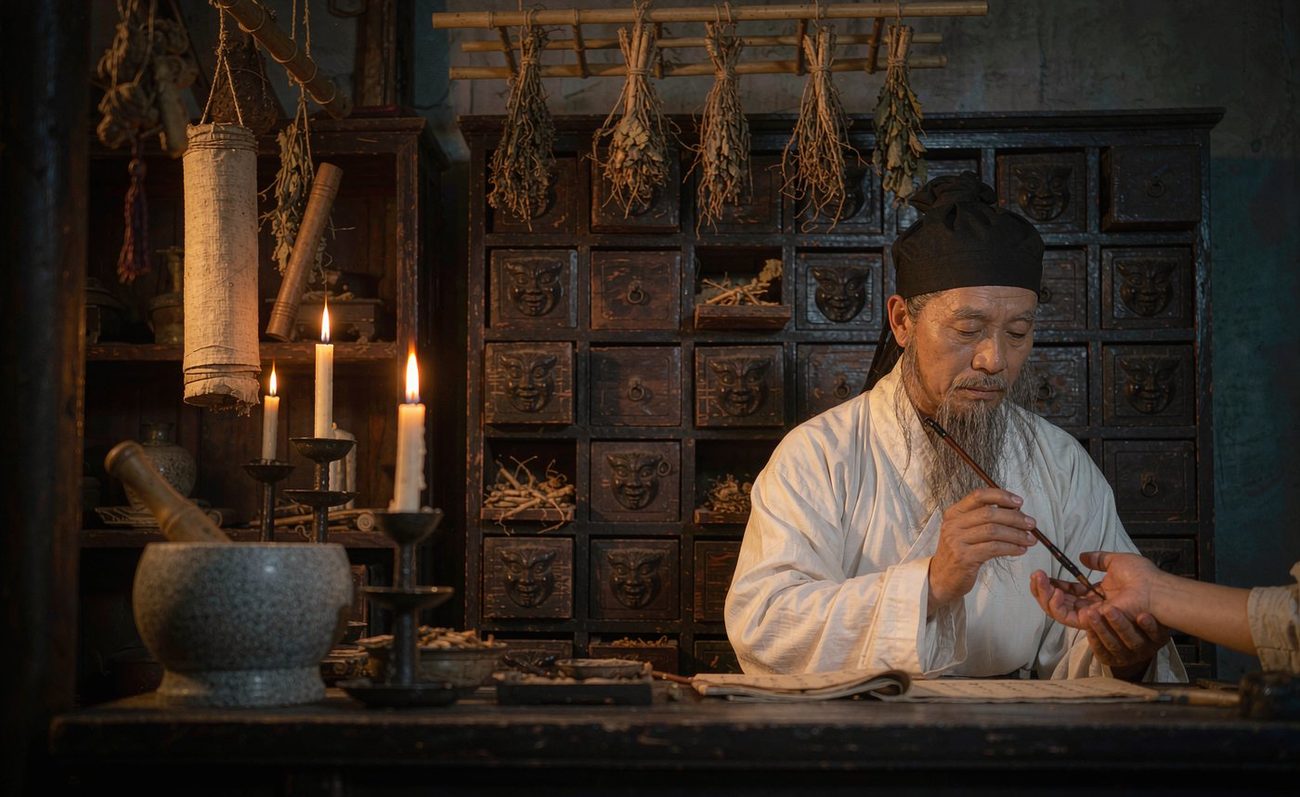
In a great plague at the end of the Eastern Han, two-thirds of Zhang Zhongjing's family died within two years; he “diligently sought the old teachings and widely gathered remedies” and wrote the Treatise on Cold Damage and Miscellaneous Diseases. It established diagnosis and treatment by pattern and is revered as the ancestor of the formula books.
The classic of internal disorders: a thousand-year standard for chronic illness and constitutional care.
Read the full entry “Essential Prescriptions from the Golden Cabinet” →It completed the treatment of epidemic fevers, rounding out the ancients’ system for seasonal disease.
Read the full entry “Treatise on Warm Diseases” →Without decoctions: hands, fire and needle-stone harmonize the channels and qi-blood — the plainest bodily healing of the Chinese.
Needles open the channels, bones are set right: motion and stillness together adjust structure and qi.
Read the full entry “Acupuncture & Bone-Setting” →Borrow the pure-yang heat of mugwort to warm the channels, disperse cold and support yang, gently renewing the body’s vitality.
Read the full entry “Moxibustion” →The hand in place of medicine: kneading open knotted sinew, freeing qi and blood, soothing fatigue and stagnation.
Read the full entry “Tuina Therapeutic Massage” →Drain stagnation and free the interstices: by suction and collateral lancing, the body’s turbid buildup is drawn out.
Read the full entry “Bloodletting & Cupping” →