Author
Wu Tang (Jutong), 1758–1836
The Wenbing Tiaobian (Systematic Differentiati...
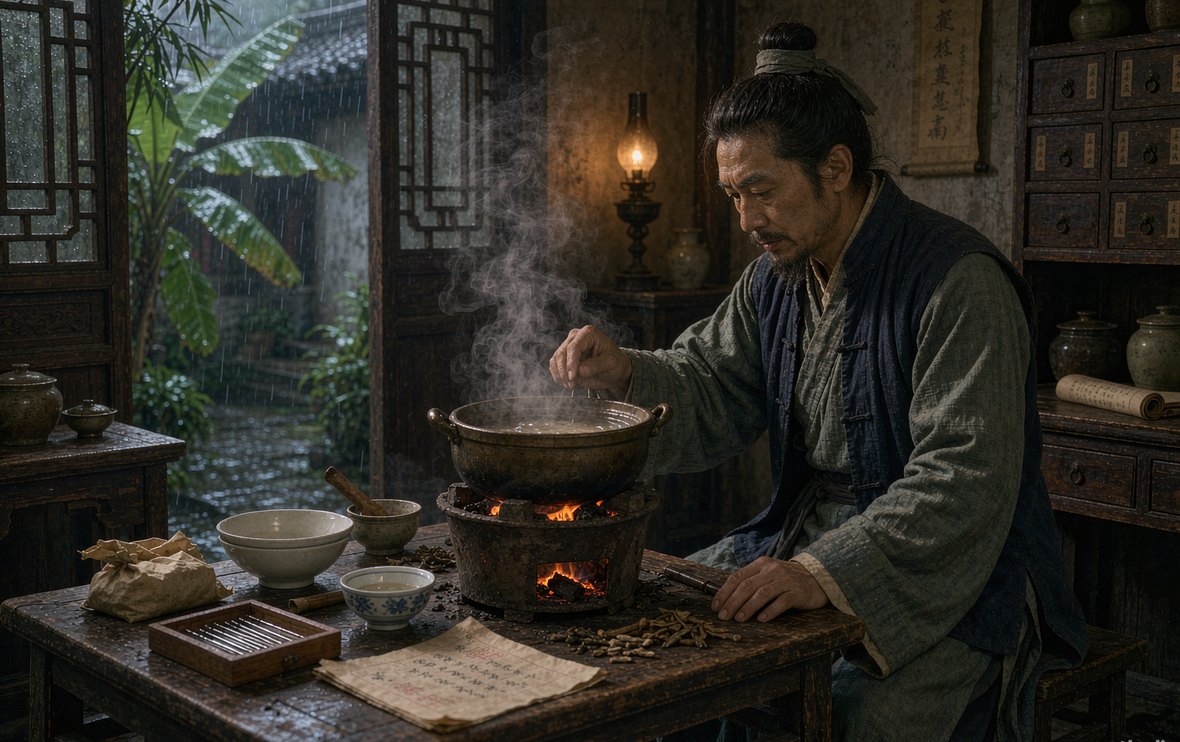
The Wenbing Tiaobian (Systematic Differentiation of Warm Diseases), by the Qing physician Wu Tang (courtesy name Jutong, 1758–1836), is the culminating synthesis of the warm-disease school, published in 1798 (the third year of Jiaqing). It systematically proposes "three-burner differentiation": taking the upper burner (lung and pericardium), middle burner (spleen and stomach), and lower burner (liver and kidney) as the framework, it describes how warm-heat external illness enters through mouth and nose and descends layer by layer, interweaving with Ye Tianshi’s wei-qi-ying-xue (defensive, qi, nutritive, blood) differentiation — a theoretical system aimed specifically at "warm-natured external illness," completing what the Shanghan Lun’s six channels left unfinished. Wu Jutong’s treatment principles — "treat the upper burner as lightly as a feather, the middle burner as evenly as a balance, the lower burner as heavily as a weight" — express "guiding the momentum, treating by layer" with extreme concision. It is not a casebook but a theoretical work about "layers of transmission" — with it, Chinese medical differentiation completed its territorial expansion from "cold" to "warm."
Three-burner differentiation divides the transmission of warm-heat illness into three layers: the upper burner (lung, pericardium) is the initial stage — the illness sits shallow, upright qi unharmed; the middle burner (spleen, stomach) is the advancing stage — the struggle between upright and evil is fierce; the lower burner (liver, kidney) is the deep stage — yin fluids are consumed and upright qi wanes. Three layers like floors: descending from above, deepening step by step — the physician’s first task is to judge "which floor are we on now."
This layering complements the six channels of the Shanghan Lun: the six channels excel at tracing how cold evil enters from the surface inward; the three burners describe how warm evil enters by mouth and nose and moves from above downward. The two systems of "cold" and "warm" standing side by side gave Chinese medicine a far more complete spectrum for understanding external illness — the most important theoretical addition of Qing medicine.
Running parallel to the three burners is the wei-qi-ying-xue differentiation proposed by Ye Tianshi: the wei level (the body’s defensive surface), the qi level (functional activity), the ying level (the nutritive stratum of the blood), and the blood level (the blood itself) — four layers from shallow to deep, marking the depth of the struggle between evil and upright qi. Wu Jutong absorbed this framework extensively in the Wenbing Tiaobian, letting the three burners (spatial position) and the four levels (depth) serve as coordinates for one another.
Where the two coordinate systems cross, a three-dimensional judgment forms: disease at the upper burner’s wei level is shallow and mild; at the middle burner’s qi level, the struggle rages; sunk to the lower burner’s blood level, yin is harmed and upright qi damaged. The subtlety of Chinese diagnosis lies in precisely this "multi-coordinate localization" — not issuing a name, but issuing a position and a trend.
治上焦如羽,非轻不举;治中焦如衡,非平不安;治下焦如权,非重不沉。 — Treat the upper burner like a feather: nothing light will rise; treat the middle burner like a balance: nothing even will settle; treat the lower burner like a weight: nothing heavy will sink.——Wu Jutong, Wenbing Tiaobian · Juan 4 · "Zashuo"
The Wenbing Tiaobian’s most famous principles are three sentences: "Treat the upper burner as a feather — nothing light will rise; treat the middle burner as a balance — nothing even will settle; treat the lower burner as a weight — nothing heavy will sink." The upper burner sits high and shallow: medicines should be light and lifting, pressing like a feather; the middle burner is the pivot of qi’s rise and fall: medicines should be moderate and measured, restoring its rhythm; the lower burner sits deep and deficient: medicines should be weighty and sinking, reaching the lower origin like a scale-weight.
These three sentences are the utmost expression of Chinese medicine’s "guide the momentum, do not clash": not brute opposition, but choosing the fitting "force" according to the position and direction of the illness’s momentum. It is structurally the same as Tai Chi’s "lead in, land empty" — Chinese wisdom, in handling conflict, always reads the momentum first and decides the force second.
The rise of warm-disease studies grew out of a reflection on "all external illness is cold damage": Ming and Qing physicians found that warm-heat external illness differs from cold-induced disease in both transmission and treatment, and that applying cold-damage methods wholesale often fails. Wu Youke’s Wen Yi Lun, Ye Tianshi’s Wenre Lun, Wu Jutong’s Wenbing Tiaobian, and Wang Mengying’s Wenre Jingwei appeared in succession, forming the complete warm-disease school — this two-hundred-year scholarly controversy was Chinese medicine’s most important internal "paradigm expansion."
The value of the debate lies not in who was right but in what it displayed: a mature scholarly mechanism. Facing new experience the old theory could not cover, it did not discard the old but extended its boundary and added new dimensions. Six channels and three burners coexisting, cold damage and warm disease complementing — this tradition of "compatibility rather than replacement" is a key reason the theoretical system of Chinese medicine has kept its vitality.