Technique type
External treatment · Manual therapy
Tuina (anciently called anmo or anqiao) applie...
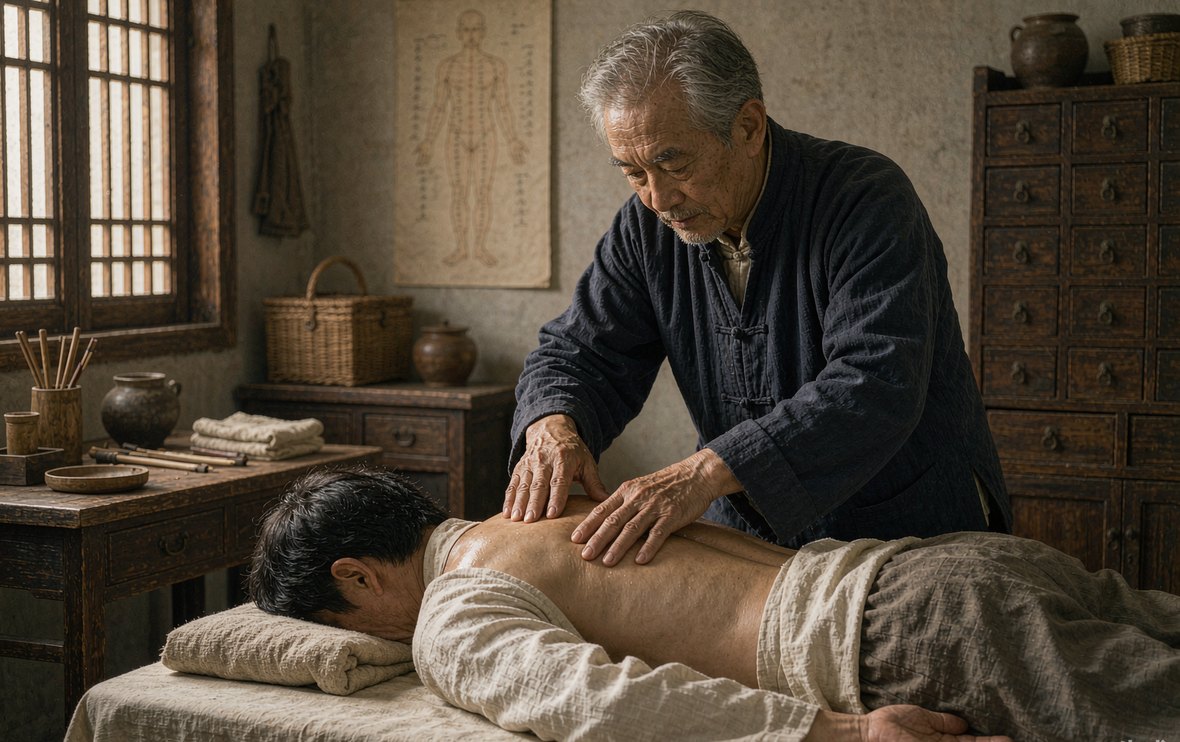
Tuina (anciently called anmo or anqiao) applies standardized manual techniques on the body’s surface with the hands or limbs, to adjust qi and blood and release sinews and channels: "the hand in place of medicine, the finger in place of the needle." Its history is nearly as old as Chinese medicine itself — the Huangdi Neijing discusses anqiao repeatedly, the Zhubing Yuanhou Lun records daoyin and massage methods, and by Ming-Qing times tuina had become a complete discipline (pediatric tuina especially developed); in modern times arose the schools of Yizhi Chan (one-finger meditation), rolling-method tuina, bone-setting tuina, and acupoint-pressing tuina. Its system of techniques is vast: pushing, grasping, pressing, rubbing, kneading, pinching, pointing, patting, rolling, thrusting, traction — over ten families and hundreds of methods, each with its own frequency, force, direction, and layer of action; its theory rests on the jing-luo (meridians) and acupoints, the channel sinews and skin zones, and the doctrine of qi and blood. It is the most "intimate" of the medical arts: no instruments, nothing entering the body — everything rests on the judgment and measure of a pair of hands.
The technical core of tuina is the shoufa (manual techniques): pushing travels in straight lines, grasping lifts and pinches the muscle, pressing goes straight down, rubbing circles on the surface, kneading is gentle and deep, rolling is continuous and rhythmic, pointing concentrates on one spot, thrusting adjusts the joints — each technique has its layer of action: skin, flesh, sinew, bone, or channel. The power of a technique lies not in "heaviness" but in "penetration": the force must sink in, hold steady, and spread even.
"Lasting, forceful, even, gentle, penetrating" are the five standards of tuina technique. These five words reveal a paradox: the gentler, the deeper — brute force acts only on the surface; sunk force reaches the depths. Thus a tuina master’s hands often look soft, yet what lands carries a thousand-weight — precisely the same kung fu as Tai Chi’s "loose and sunk."
Tuina’s theoretical basis is the jing-luo and the skin zones: the twelve skin zones are the channels’ divisions on the body surface; imbalances of the organs show themselves in the corresponding zones (cold or warmth, tenderness, nodules, cords), and stimulating the zones can in turn influence the channels and organs — "inner illness surfaces outward; outer treatment answers inward." The "sinew knots," "cords," and "tender points" a tuina practitioner searches for are, in essence, the body’s "map of abnormalities" being read.
This logic of "knowing the inner by the outer, regulating the inner through the outer" resonates strongly with modern fascia research and viscerocutaneous reflex studies: fascia is a continuous network; a local adhesion tugs at the distal end, and manual technique can alter the distribution of fascial tension. Chinese medicine’s contribution is that it possessed, long ago, a systematic "surface-zoning doctrine" that gives the placement of hands a traceable order.
按跷者,所以通其经脉,调其血气,使其和也。 — Anqiao (manual therapy) serves to free the channels, harmonize the blood and qi, and bring the body into accord.——A summation of the meaning of anqiao in the Huangdi Neijing
Tuina’s mechanisms can be summarized in three: regulate qi and blood (promoting circulation and metabolism), free the channels (releasing adhesions and easing constriction), and set right sinew and bone (restoring joint alignment and mechanical balance). It introduces no foreign substance and stages no "combat" — only through the force and rhythm of the hands does it help the body restore its own order. This is the true meaning of "the hand in place of medicine": the hand is merely the medium; the medicine is the body itself.
Tuina also carries a strong "relational" dimension: the practitioner’s hands are warm, rhythmic, and perceptible — within them the recipient lowers guard, releases muscle, and settles the mind. This experience of "being cared for" is itself therapeutic. Modern research calls it "touch intervention"; Chinese medicine, two thousand years ago, already listed "the hand" as a method of treatment.
Pediatric tuina is the most distinctive branch of the system: using specific points (mostly on fingers, palm, and forearm) and gentle techniques to regulate a child’s spleen-stomach, lung qi, and constitution, it insists on "light, quick, soft, steady, and substantial" and forbids heavy techniques. It embodies the extreme of Chinese medicine’s "adapt to the person": one and the same theory demands entirely different force and rhythm for bodies of different ages.
Tuina’s contemporary map keeps expanding: from classical channel work to sports rehabilitation, postpartum care, and desk workers’ neck-and-shoulder maintenance; the Yizhi Chan and rolling-method schools have entered heritage lists, and tuina is an independent major in Chinese medical colleges. It endures because it answers a timeless need: everyone needs to be treated, seriously and kindly, by a pair of hands.