Technique type
External treatment · Draining pair
Bloodletting and cupping are a paired techniqu...
Bloodletting and cupping are a paired technique of Chinese external treatment that "drains in order to nourish": bloodletting (ciluo) pricks superficial blood collaterals with a triangular needle, releasing a small amount of blood to drain heat, dissolve stasis, and free the channels; cupping (jiaofa, the horn method) uses negative pressure to draw cups onto the skin, bringing local congestion, opening the skin’s interstices, to disperse cold, expel damp, move qi, and reduce swelling. Both rest on the same source — the Huangdi Neijing’s "wan chen ze chu zhi" (what has long stagnated must be removed) — holding that when qi and blood are stilled and evil heat congested, the body must be given an "exit." Bloodletting traces back to the bian stones of the Stone Age; cupping already appears in the Mawangdui silk manuscript Wushier Bingfang (as the horn method), and from Tang-Song times spread among the people, becoming the most down-to-earth pairing of external treatments. Together they embody a therapeutic philosophy: not "putting in," but "letting out."
The shared premise of bloodletting and cupping is that "stagnation needs an exit": the Suwen’s "Zhen Jie" explains, "‘Wan chen ze chu zhi’ means draining the stale blood" — when qi and blood, long stilled, have formed stasis, and congested heat will not disperse, "regulation" alone no longer suffices; "drainage" must open the way. This is the very opposite of the supplementing approach: tonification is addition, drainage is subtraction; when to add and when to subtract depends on differentiation — supplement deficiency, drain excess: the master balance of Chinese treatment.
"Drain in order to nourish" speaks the inner mystery: once stagnation departs, qi and blood flow of themselves, and upright qi is freed to expand. Drainage therefore does not "harm the upright" — provided there is truly excess to drain, and treatment stops once the illness yields; excess drains qi and damages blood. The sense of proportion remains the shared soul of all Chinese techniques.
Bloodletting (ciluo) pricks the superficial veins of the body surface (the elbow crease, the popliteal fossa, the ear tip, beneath the tongue) with a triangular or dermal needle, releasing a small amount of blood — extremely shallow, extremely little, aiming to "stop when the blood changes." Its direction of action is "drain heat, dissolve stasis, free the collaterals": heat exits with the blood and is relieved; stasis moves with the blood and disperses; collaterals open with the blood and clear. It suits patterns of qi-blood congestion and inward-bound stagnant heat.
Its theoretical basis is the doctrine of the collaterals (luo): the channels divide into jing (channels) and luo (collaterals); the collaterals run at the surface, fine and interlacing, the very tips through which qi and blood are distributed. Stagnation arises first in the collaterals ("long illness enters the collaterals"), so treatment begins there too — the smallest intervention on the smallest vessels, influencing the largest circulation. A very Eastern way of "levering the great with the small."
菀陈则除之者,出恶血也。 — "Remove what has long stagnated" means draining the stale blood.——Huangdi Neijing · Suwen · "Zhen Jie"
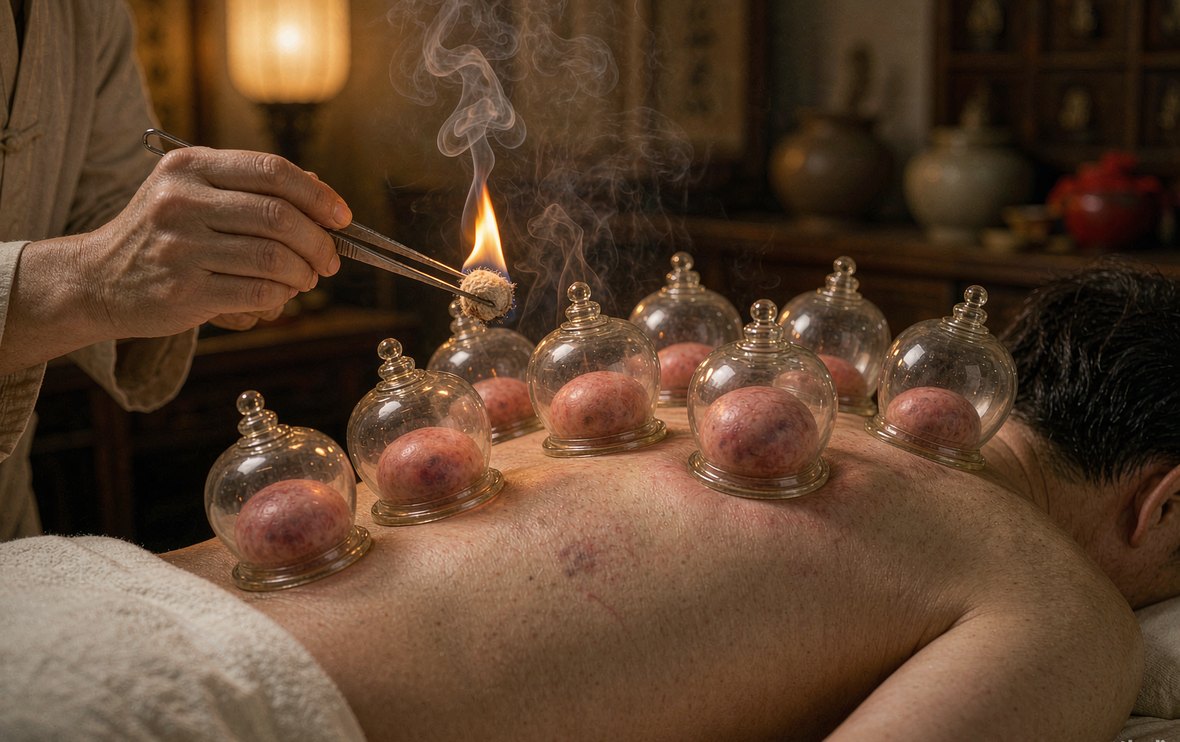
Cupping (anciently the horn method, first using animal horns as cups) creates negative pressure in the cup by burning flame or suction pump, so the cup clings to the skin: the negative pressure draws the skin, subcutaneous tissue, and superficial muscle, dilating local capillaries, opening the skin’s interstices, gathering qi and blood — Chinese medicine calls it "guiding the evil outward, moving qi and quickening blood, dispersing cold and expelling damp." Duration of retention, number and placement of cups, whether to glide the cups or bleed before cupping — all are decided by differentiation.
The color and shape of the cupping mark is, in Chinese medicine’s eyes, "information to be read": pale marks mostly signal deficiency-cold; deep purple, stasis; blisters (anciently the "water cup") are seen as damp-turbidity leaving — this empirical reading of cup marks, though not fully explained by modern medicine, remains one of the most widespread forms of popular self-observation. It turns "invisible qi and blood" into "visible traces."
Bloodletting and cupping often work together: first bleed locally, then cup to draw the stasis out ("collateral bloodletting with cupping") — one prick, one draw, draining more thoroughly. Both also alternate with moxibustion and tuina: drain the stagnation, warm the channels, regulate the qi and blood — the external treatments are in truth a "toolbox" that can be combined, paired according to the pattern as formulas are composed.
The limits of these draining methods are equally clear: not for the constitutionally weak or blood-deficient; strict disinfection and control of blood loss and cup time are mandatory; broken skin and great vessels must be avoided. Chinese "technique" has always walked with "contraindication" — to know what may be done, and still better what may not: that is the complete way of medicine.