Nature
Stillness practice · breath regulation
Tuna is the umbrella name of all Chinese breat...
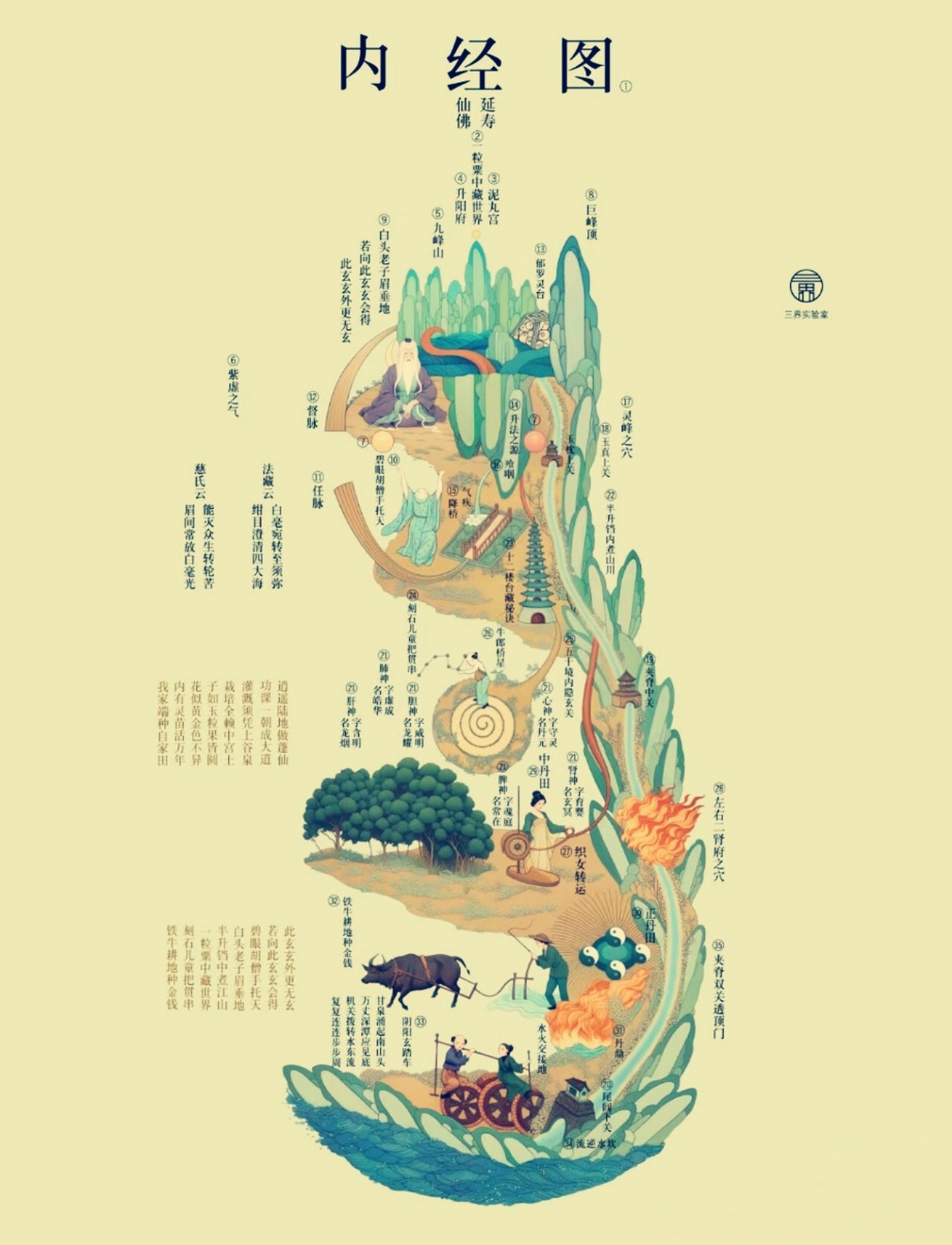
Tuna is the umbrella name of all Chinese breath cultivation: expel the old (breathe out the turbid), draw in the new (take in the clear) — two characters that write the whole art. It is older than seated meditation and standing practice: the Zhuangzi's "blowing and breathing, expelling the old and taking in the new" is the art's earliest literary record and the birthplace of the idiom "tugu naxin." For the Daoists, breath is the one channel of exchange with heaven and earth — the handle of "borrowing the false to cultivate the true": thoughts cannot be commanded directly, but breath can; regulate the breath and the mind follows; regulate the mind and the body follows. Tuna is therefore the first lesson of Daoist internal alchemy and the common foundation of seated meditation, standing practice and daoyin. Read the breath, and you have read the master chart of Chinese cultivation — the "landscape city" drawn inside the body on the Neijing Tu, whose gate stands exactly between one breath and the next.
The Zhuangzi, chapter "Ke Yi," writes: "Blowing and breathing, expelling the old and drawing in the new; moving like the bear and stretching like the bird — for long life and nothing more. Such are the students of daoyin, those who nurture the form, the devotees of Peng Zu." More than two thousand three hundred years ago, breath cultivation and daoyin were already an established popular practice. "Tugu naxin" then walked into everyday Chinese as the idiom for renewal and metabolism — one practice lent its name to the whole language.
Why did the ancients prize breath so? Because among all physiological functions, breath is the only one that runs automatically yet can also be directed by will — the single door between the voluntary and the autonomic. Breath quick and shallow: heart quickens, mind scatters; breath deep and slow: heart settles, mind stills. The Daoists drew the conclusion: seize the breath, and you hold the reins between body and mind. That judgment, and modern findings on slow breathing and vagal tone, recognize each other across two thousand years.
The foundation is natural abdominal breathing: inhale through the nose and let the lower belly rise ("the qi sinks to the dantian"); exhale and let it settle back. Four characters govern everything — even, fine, deep, long: rhythm even as a brook, current fine as a thread, inhale deep to the lower belly, exhale long without straining. The advance is reverse abdominal breathing: belly drawing in on the inhale, expanding on the exhale — paired with the force work of the internal martial arts and with "lifting the pelvic floor," it is the fire-timing more used in martial and alchemical practice. Progress gradually; the standard is "natural, never holding the breath, never dizzy" — all forcing is a wrong path: the aim of tuna is to give the body back the breath it was born with.
The alchemists divided breath's fire-timing into "civil fire" and "martial fire": civil fire is the long, soft, natural breath used for quiet nourishment (nurture); martial fire is the deep, strong breath used to rouse and revolve (refine). When to use which — "knowing the hour and the measure" — belongs to the graduated path; the beginner need only remember: for daily wellness, civil fire suffices. Best hours are early morning and before sleep, in moving air; not within an hour after meals; those with hypertension should avoid breath-holding and forceful breathing entirely.
Inhale and gather at once — the qi returns to the navel; gather and swallow at once — water and fire meet. — Inhale and gather: the qi returns to the navel; gather and swallow: water and fire meet.— Ming · Leng Qian, Xiuling Yaozhi (the "Sixteen Gold Ingots" formula)
The Neijing Tu ("Chart of the Inner Landscape") is the most famous master chart of Daoist internal alchemy, drawn in its present form in the Qing dynasty and preserved at the White Cloud Monastery in Beijing. It paints the human body as a landscape city: the spine is a mountain path winding upward from the Weilv pass at the base, through the three passes — Jiaji and Yuzhen — up to the "Niwan Palace" of the crown (the upper dantian); the kidney-water tends to flow downward and must be lifted by two waterwheels (the fire of mingmen); midway, "the Weaver turns her wheel" stands for the harmonizing of the heart-spirit, the "Ox-Herder bridge star" for heart and kidney meeting; fields, city walls, oxen and children — every pastoral scene is a metaphor for a pass in the body and a stage of the work. The inscription betrays the secret: "the iron ox ploughs the field to sow gold coins" — inner alchemy is farming one's own body.
The right way to read the chart is as a route map of cultivation, not an anatomy plate: the lower dantian (below the navel) is the field of essence and qi, the middle dantian (at the chest center) the hinge of the qi-machinery, the upper dantian (Niwan) the residence of spirit; tuna lights the furnace-fire and turns the waterwheels; essence and qi climb the du channel, pass the three passes, enter Niwan, then descend the ren channel — the "du rises, ren falls" microcosmic orbit is the bodily geography of "refining essence into qi, refining qi into spirit." We need not chase the esoteric reading of every metaphor today, but its core message stands clear and startling: the ancients made so systematic an "inner survey" of the body — and it all begins with a few breaths taken seriously.
The Daoist path of cultivation has a clear route: one hundred days of laying the foundation (building essence and qi, opening the basic circulation) → refining essence into qi (the microcosmic orbit) → refining qi into spirit (the macrocosmic orbit) → returning spirit to emptiness → merging emptiness with the Dao. Tuna stands at the very first lesson: learn the breath, then sitting and standing practice, then the orbit's turning — "refining the self" precedes "refining the elixir"; without the foundation, all is a tower in the air. This is why seated meditation, standing practice and tai chi all place breath regulation first: breath is the gate of the whole road.
Today, most of us need not walk the entire way, but its entrance stands open to everyone: ten minutes of abdominal breathing a day, kept for a month, and the change in sleep, mood and focus will speak for itself. Here the old art of tuna shows its value beyond the age — it asks you to believe nothing, only to breathe with care. That is the Daoist inheritance's humblest gift: the Dao lies between one breath and the next.