Practice type
Stillness practice · Internal nourishment
Seated meditation is the most foundational sti...
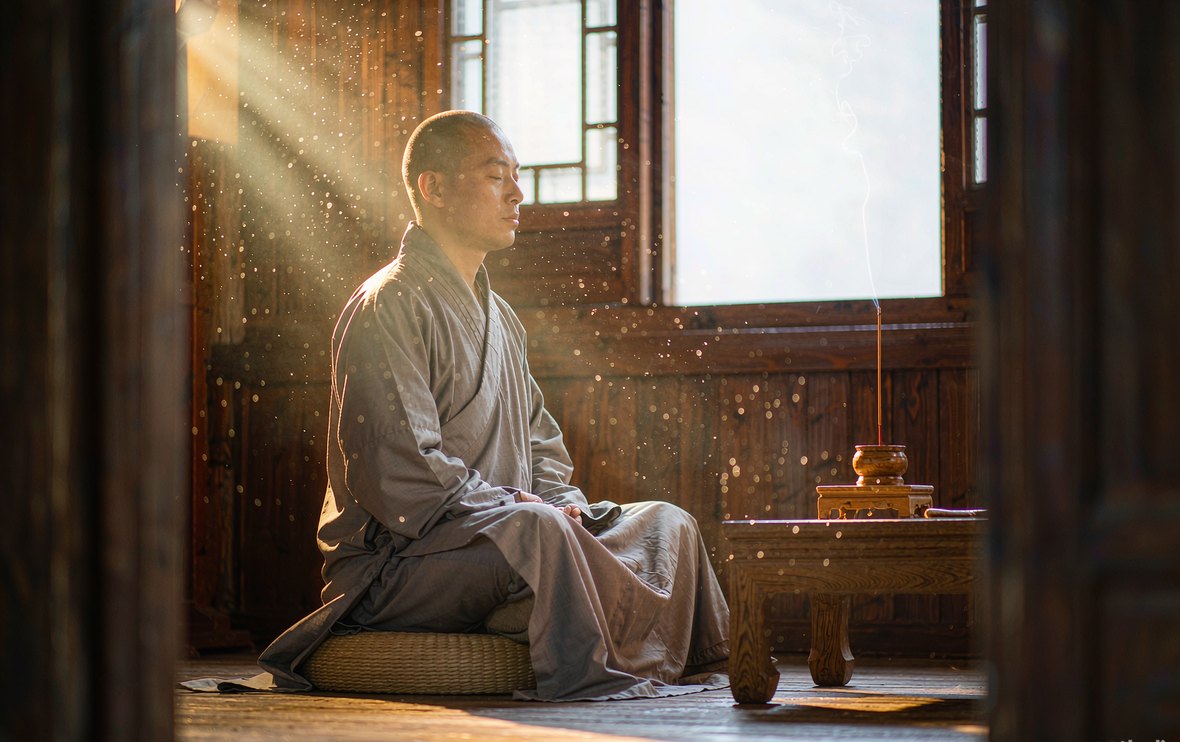
Seated meditation is the most foundational stillness practice in China’s whole system of mind-body cultivation: sit cross-legged with the spine upright, gather body and mind inward, regulate the body, the breath, and the mind, and move from stillness into concentration. It belongs to no single school — Daoists called it "sitting in oblivion" (zuowang) or "the fasting of the mind" (xinzhai); Buddhists called it "Chan sitting" or "calming and insight" (zhi-guan); Confucians called it "quiet sitting" and "holding to reverence." Three currents converge on the single word "stillness," together forming the underlying technology by which the Chinese settle body and mind. Its method is so plain as to be nearly invisible: straighten the body, release the shoulders, lower the gaze, count the breath, follow the breath, until thoughts gradually subside. Yet it is precisely this plainness that makes it the shared starting point of every internal art and regimen of nourishing life: the form does not move, yet qi circulates on its own; nothing is done outside, yet clarity arises within. In an age of information overload, this art of "doing nothing" has become the rarest ability of all.
The first layer of seated meditation is regulating the body: sit cross-legged (full lotus, half lotus, or simply crossed, whatever allows long sitting), spine straight but not rigid, shoulders settled but not collapsed, chin slightly tucked, tongue resting against the upper palate, hands folded in a seal upon the knees — the whole posture has one aim: let the skeleton carry itself, and let the muscles fully let go. When the posture is right, the body becomes a stable tower, and the breath naturally sinks to the dantian.
The second layer is regulating the breath: seek not depth or length but naturalness; gather the mind by "counting the breath" (one exhalation and inhalation make one count; count to ten and begin again), and once the mind has quieted somewhat, shift to "following the breath" (counting ceases, awareness follows, knowing each breath in and out). Breath is the only two-way channel between body and mind — when the mind is agitated the breath turns coarse; when the breath grows subtle the mind settles. The ancients therefore took regulating the breath as the handle for regulating the mind. The third layer, regulating the mind, is the subtlest: neither suppress thoughts nor chase them; the moment one arises, notice it; the moment it is noticed, release it — this art of "neither welcoming nor refusing" is the true technical core of seated meditation.
The Daoist form of sitting pursues "sitting in oblivion" (zuowang): the Zhuangzi speaks of "dropping away body and limbs, dismissing perception and intellect, departing from form and casting off knowing, and merging with the Great Thoroughfare" — laying down both attachment to the body and the discriminating mind, becoming one with the vast flow of heaven and earth. Its companion, the "fasting of the mind" (xinzhai), listens with qi rather than with the ears, awaiting things in emptiness. From this the Daoists developed the seated work of internal alchemy — "refining essence into qi, refining qi into spirit" — treating the sitting posture as a furnace for the transformation of life.
The Buddhist form of sitting is "calming and insight" (zhi-guan): calming is one-pointedness of mind, insight is seeing things as they truly are; the Tiantai treatise Concise Methods of Cultivating Calming and Insight sets out the stages of sitting meditation with extraordinary precision. The Confucian form of quiet sitting is "holding to reverence" and "gathering in body and mind": the Cheng brothers and Zhu Xi taught "half a day of quiet sitting, half a day of reading," and Zhu Xi said, "Quiet sitting does not mean entering samadhi like a Chan monk and cutting off all thought — it means only gathering this mind in, not letting it run off." The three paths differ, but their destination is the same: bringing the scattered mind home.
恬淡虚无,真气从之,精神内守,病安从来。 — When the mind is tranquil and void, true qi follows; when spirit is guarded within, whence could illness come?——Huangdi Neijing · Suwen · "Shanggu Tianzhen Lun"
The theoretical basis of seated meditation is the "essence, qi, and spirit" (jing-qi-shen) model shared by Chinese medicine and Daoism: spirit is the master of the body; when spirit scatters, qi disperses; when qi disperses, essence is spent. Conversely, when spirit gathers, qi collects; when qi collects, essence is generated. The "gathering in" of quiet sitting is essentially a form of energy management — drawing back the spirit that leaks outward, so that qi and blood turn inward and the organs are nourished. The Huangdi Neijing’s line "When the mind is tranquil and empty, true qi follows; when spirit is kept within, whence could illness come?" states exactly this principle.
Modern research offers corroborating evidence: during quiet sitting, sympathetic nervous tension falls, heart rate and oxygen consumption drop, and alpha brain waves strengthen — the body enters a state of "low consumption, high efficiency" repair. The ancients called it "returning to the root and renewing life"; moderns call it the "relaxation response." They are describing the same thing: stillness is life’s most economical mode of repair.
The threshold of seated meditation is vanishingly low; the difficulty is persistence: one sitting a day, starting from ten minutes, at a fixed hour and a fixed place; neither full nor hungry before sitting, neither hurried nor restless after; if the legs go numb, switch them; if the mind scatters, count the breath — there is no need to chase extraordinary states, for "being able to sit" is itself the kung fu. Traditional practice lists it among the daily duties, ranked with eating and sleeping: a day without sitting is like a day without food.
Today, seated meditation has walked out of the temples and monasteries into office towers and campuses: mindfulness-based stress reduction, meditation courses, the corporate "ten minutes of quiet" — the forms change, but the principle does not. What it offers is a "capacity for non-doing": in an era that treats attention as a resource, being able to sit in silence is already a scarce freedom.