Technique type
External treatment · Needling and manual therapy
Acupuncture and bone setting are the two main ...
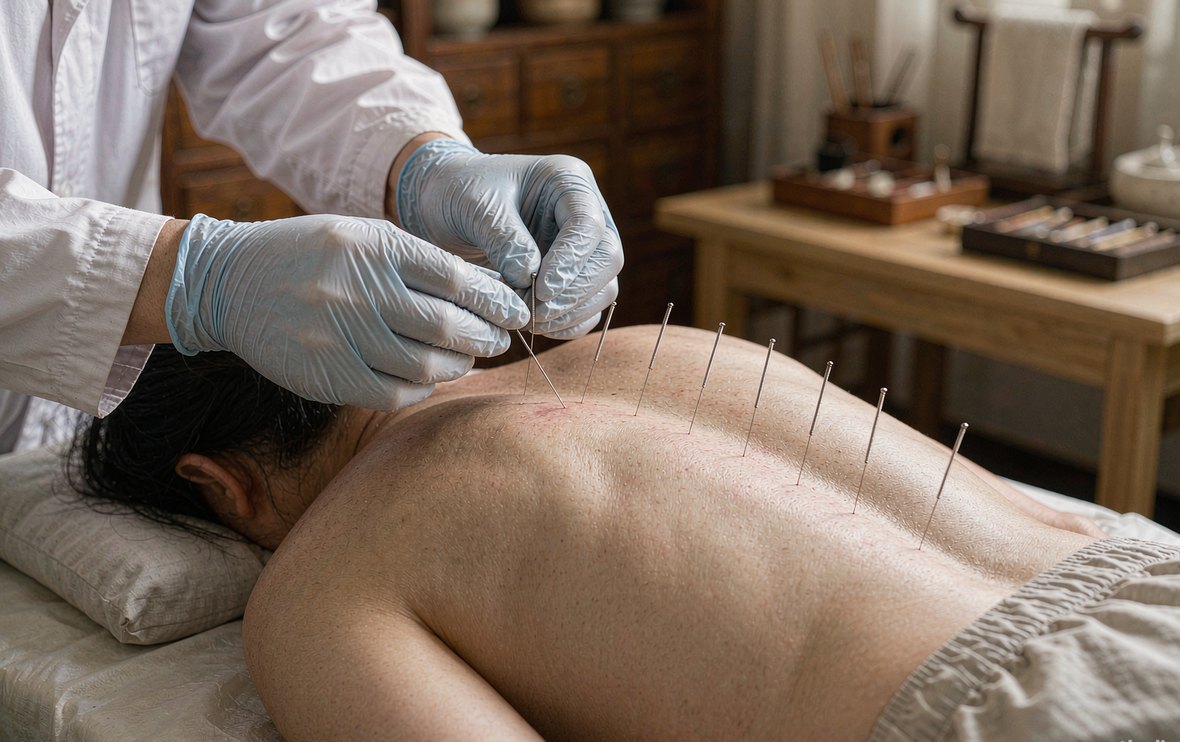
Acupuncture and bone setting are the two main lines of Chinese medicine’s external treatment: one points inward, regulating qi with needles; one points outward, restoring form with hands. Acupuncture takes the jing-luo (meridians) and their acupoints as its map, inserts fine needles into specific points, and guides the arrival of deqi through lifting, thrusting, and twirling, thereby adjusting the deficiency or excess and the blockage or flow of qi and blood — "the meridians decide life and death, treat a hundred ills, and adjust deficiency and excess; they must be kept open." Bone setting takes "bones straight, sinews supple, qi and blood flowing" as its guiding maxim, using manual techniques of reduction, sinew-soothing, and spinal adjustment to restore the mechanical order of bone and fascia. The two seem one empty and one solid, but share one source: both trust that the body has a self-consistent order (the meridians and the skeletal frame), and that the healer’s role is "helping it return to order," not "fighting on its behalf." In 2010, acupuncture and moxibustion of Chinese medicine were inscribed on UNESCO’s Representative List of the Intangible Cultural Heritage of Humanity.
Acupuncture rests on the doctrine of the jing-luo: the twelve regular channels and eight extraordinary vessels run through the whole body like a network of rivers, attaching inward to the organs and reaching outward to the limbs and joints, with qi and blood circulating within; the acupoints are the "nodes" where qi and blood infuse and gather along the channels — more than three hundred sixty classic points, each with its channel and its field of indication. The operation of acupuncture is, in essence, choosing coordinates on this map and influencing the inner qi dynamic through external stimulation.
Modern interpretations of the jing-luo abound (nervous conduction, fascia, connective tissue, viscerocutaneous reflexes have all been studied), but its clinical value does not depend on an anatomical correspondence: what the system provides is a language of "integrated connection" — linking distal and local, surface and organ, left and right into one network. Chinese medicine’s "distal point selection" is the classic expression of this network thinking: needle not where it hurts, but upstream or downstream along the same channel.
The core of needling is not "inserting the needle" but "deqi" — the arrival of qi: once the needle enters the point, the physician’s fingers feel a heavy, grasping pull, and the patient feels soreness, numbness, distension, or weight — when qi arrives, treatment works; when it does not, needling feels like piercing rubber. Deqi is a confirmation between physician and body: the location is right, the qi dynamic has been awakened. Then, through techniques of lifting-thrusting, twirling, quick-slow, and open-close, one applies reinforcement or drainage — "supplement what is deficient, drain what is in excess," the direction decided by differentiation.
The differences of technique are minute: tempo, depth, direction, duration of needle retention — each can shift the tendency of action. The brilliance of this technology lies in "fine-tuning the whole through the small": one slender needle, a few grams of force, amplified through the network of the jing-luo into a full-body regulation. It relies on the body’s own responsiveness — acupuncture never "replaces" the body’s work; it merely "reminds" the body to resume it.
骨正筋柔,气血以流,腠理以密,如是则骨气以精。 — When the bones are straight and the sinews supple, qi and blood flow freely, the interstices of the skin close firmly, and thus the essence of bone and qi is perfected.——Huangdi Neijing · Suwen · "Shengqi Tongtian Lun"
The theoretical guideline of bone setting is only eight characters: "bones straight, sinews supple, qi and blood flowing" (Suwen, "Shengqi Tongtian Lun"). When bones slip from place, sinews are pulled taut; when sinews clamp tight, qi and blood are obstructed — so the first step of bone setting is "setting the bone" (restoring joint alignment), the second is "soothing the sinew" (releasing spasm in the soft tissue), and the final aim is "qi and blood flowing." The techniques comprise eight methods — feel, join, lift, raise, press, rub, push, grasp — governed by the maxim: "the mechanism is touched outside, the ingenuity born within; the hand turns with the mind, the method issues from the hand."
The greatest skill of bone setting lies in the "feeling" method: reading joints, muscles, warmth, and cord-like knots through the palm to locate displacement and spasm — "the hand feels, the mind understands": touch and judgment as one. This craft of "the hand as eye" flows in the same stream as Chinese medicine’s holistic view: not only the bone, but the sinew, the qi, the person’s posture and habits.
Acupuncture and bone setting together answer one question: why can operating on the body’s surface influence the interior? Chinese medicine’s answer is "inner and outer correspond" — the jing-luo join surface and interior, the skeleton bears the form, and every point of the surface is a projection of, and an entrance to, the inner state. This resonates with modern research on viscerocutaneous reflexes, fascial chains, and proprioception, but Chinese medicine’s formulation is more systematic, more operational, and more instructive.
Deeper still is the philosophy of treatment: external treatment in Chinese medicine does not seek "to remove something" but "to restore an order" — the free flow of the qi dynamic, the centeredness of the frame, the suppleness of the fascia. Hence it is gentle and gradual, and it asks the recipient’s participation (posture, daily rhythm, emotional cooperation). "Bones straight, sinews supple, qi and blood flowing" — within those eight characters there is no "disease," only the "norm": restore the norm and the abnormal departs of itself.