Patriarchal line
Bodhidharma → Huike → Sengcan → Daoxin → Hongren → Huineng
Chan is the masterpiece of Buddhism’s siniciza...
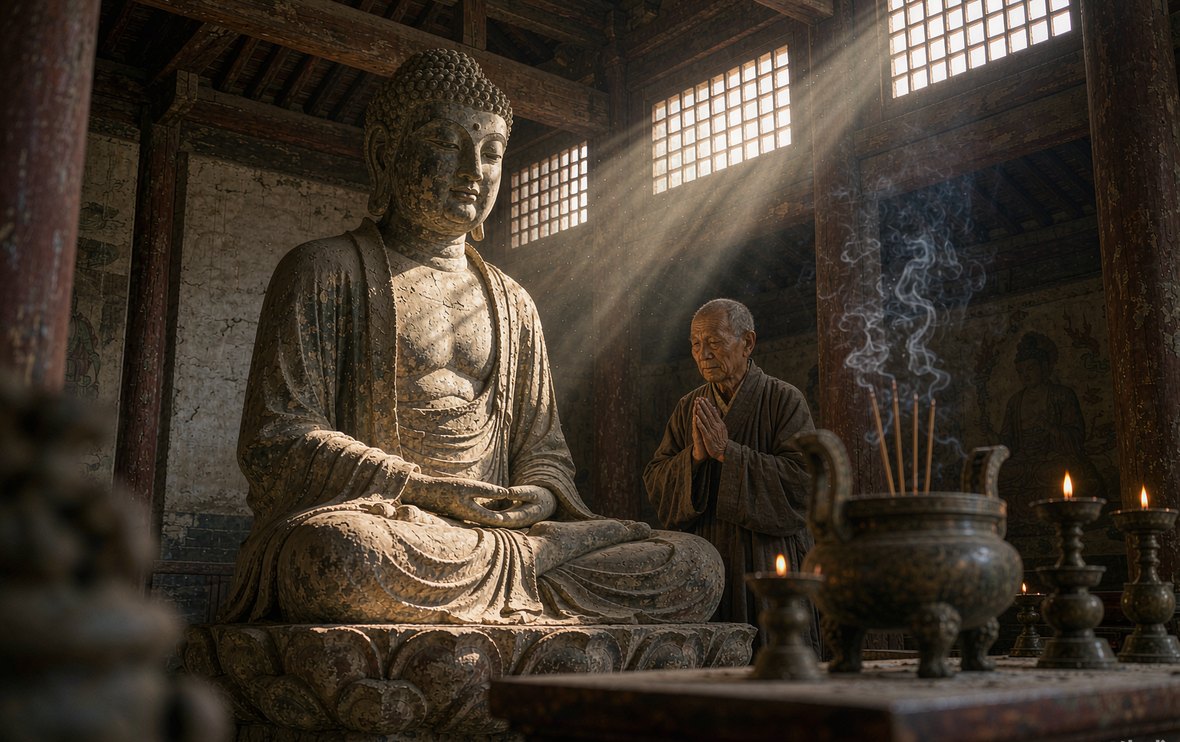
Chan is the masterpiece of Buddhism’s sinicization: the dharma that came from India was reinvented on Chinese soil. Tradition holds that at the assembly on Vulture Peak the Buddha held up a flower and Kashyapa smiled, the robe and bowl passing mind to mind; westward from India it passed through twenty-eight patriarchs to Bodhidharma, who crossed east, faced the wall at Shaolin, and six generations later the line reached Huineng — an illiterate woodcutter from Lingnan who won the dharma with a single verse and founded the Southern School of sudden enlightenment: “pointing directly at the human mind, seeing one’s nature and becoming Buddha.” Chan discarded cumbersome ritual and piled-up concepts, teaching that Buddha is within one’s own mind and need not be sought outside: carrying water and chopping firewood — nothing but the wondrous Dao; hungry, eat; tired, sleep. It turned abstruse doctrine into practicable daily life and profoundly reshaped the aesthetics and life-philosophy of the Chinese literati — the temperament of Song–Ming Neo-Confucianism, the limpidity of landscape poetry and painting, the simplicity of the tea ceremony and ikebana all have Chan flowing at their depths. The Zen the whole world speaks of today is the echo of Chan after it crossed to Japan.
Chan begins with a gesture: the Buddha holds up a flower, Kashyapa smiles, and the treasury of the true dharma eye passes in that instant — truth is not in verbal teaching but in the moment when minds meet minds. Bodhidharma came east and fixed the school’s style in sixteen characters: “No reliance on words, a transmission outside the teaching; pointing directly at the human mind, seeing one’s nature and becoming Buddha.” Buddhahood is not in external scriptures and statues but in each person’s own mind; the whole task of practice is to recognize it.
In the history of Chinese thought this was a turn that pulled the rug out from under everything: Confucians asked “how should one be a person,” Daoists asked “how to accord with the Dao,” and Chan pressed further — “who is being a person, who is according with the Dao?” — returning to the mind itself, unadorned. The most elaborate system of doctrine was gently pushed over by one line — “originally there is not one thing” — and wisdom arrives not by accumulation but by shedding. This path of “breaking through from within” became, after the Song, the deepest undercurrent of Chinese thought.
The Fifth Patriarch Hongren passed the robe by night. Shenxiu wrote his verse: “the body is the bodhi tree, the mind a bright mirror stand; wipe it diligently hour by hour, and let no dust alight” — the gradual path, treating the mind as a mirror to be polished daily. Huineng wrote another: “Bodhi is fundamentally no tree, the bright mirror no stand; originally there is not one thing — where could dust alight?” — the mind’s nature is pure from the start; why seek polishing outside? Hongren thereupon gave the robe and bowl to Huineng, the Sixth Patriarch.
South and North, sudden and gradual, thus parted ways: the Northern School taught gradual cultivation, seated meditation, and contemplation of the mind; the Southern School taught sudden awakening — “the deluded hear of it through many kalpas; the awakened grasp it in an instant.” The South alone flourished thereafter, branching into five houses and seven schools — Linji’s shout, Deshan’s staff, Yunmen’s cake: a thousand forms, all devices for pointing. The essence of the sudden-gradual dispute was whether to admit that “every person is originally Buddha”: if Buddha-nature is innate, practice is not the manufacture of a Buddha but the removal of obscuration — an insight that deeply shaped later understandings of education and of becoming a person.
菩提本无树,明镜亦非台。本来无一物,何处惹尘埃。 — Bodhi is fundamentally no tree, the bright mirror no stand: originally there is not one thing — where could dust alight?——The verse of Huineng, Sixth Patriarch
Chan knew the limits of language: “to say it is a thing is already to miss.” So it invented the koan — Zhaozhou’s “go drink tea,” the cypress tree in the courtyard, “what is Buddha?” — “three pounds of flax,” “all things return to one — to what does the one return?” These seemingly senseless replies exist precisely to shatter the lasso of logic: when concepts cannot catch it, thought is forced to a standstill, and in that standstill direct experience appears. Xiangyan awakened at the crack of bamboo; Lingyun at the sight of peach blossoms — awakening is not in the scriptures but between one crisp sound and one tree in bloom.
The sharp exchange (jifeng) is an improvised duel of minds: “What is Buddha?” “The cypress tree in the courtyard.” “What is the meaning of the Patriarch coming from the west?” “The Zhenzhou radishes weigh three jin.” Between question and answer no knowledge appears — only a living mind running like a pearl on a tray. This verbal art seeped into Chinese aesthetics: the “wondrous awakening” of poetry, the “untrammeled grade” of painting, the garden’s “meaning beyond the words” — all variants of Chan’s view of language within art.
Mazu Daoyi said “ordinary mind is the Dao”; the layman Pangyun said “the wondrous use of supernatural power is carrying water and hauling firewood” — Chan finally pulled Buddha back into the human world: practice is not in deep mountains and ancient temples but between carrying water and splitting wood, sweeping and answering the door. Baizhang Huaihai set the rule “a day without work, a day without food”; the sangha farmed for itself and ate its own grain — the Indian begging tradition thoroughly sinicized, labor and practice made one, the meditation hall joined to the furrow.
This character of “being in the world yet beyond the world” became the Chinese heart’s remedy: no need to shave the head and enter the gate — between the office and the cooking pot one can still find a moment of clarity. Su Shi’s breadth — “looking back at the bleak place I crossed: no storm, and no clear sky” — and Wang Wei’s composure — “walk to where the water ends, and sit and watch the clouds rise” — are both footnotes to Chan lived as a life. The mindfulness now sweeping the West traces back to Chan’s plainest sentence: when eating, eat; when sleeping, sleep.