Commandery-County System
Instituted by Qin (221 BC) · used to this day
The two institutional pillars that sustained C...
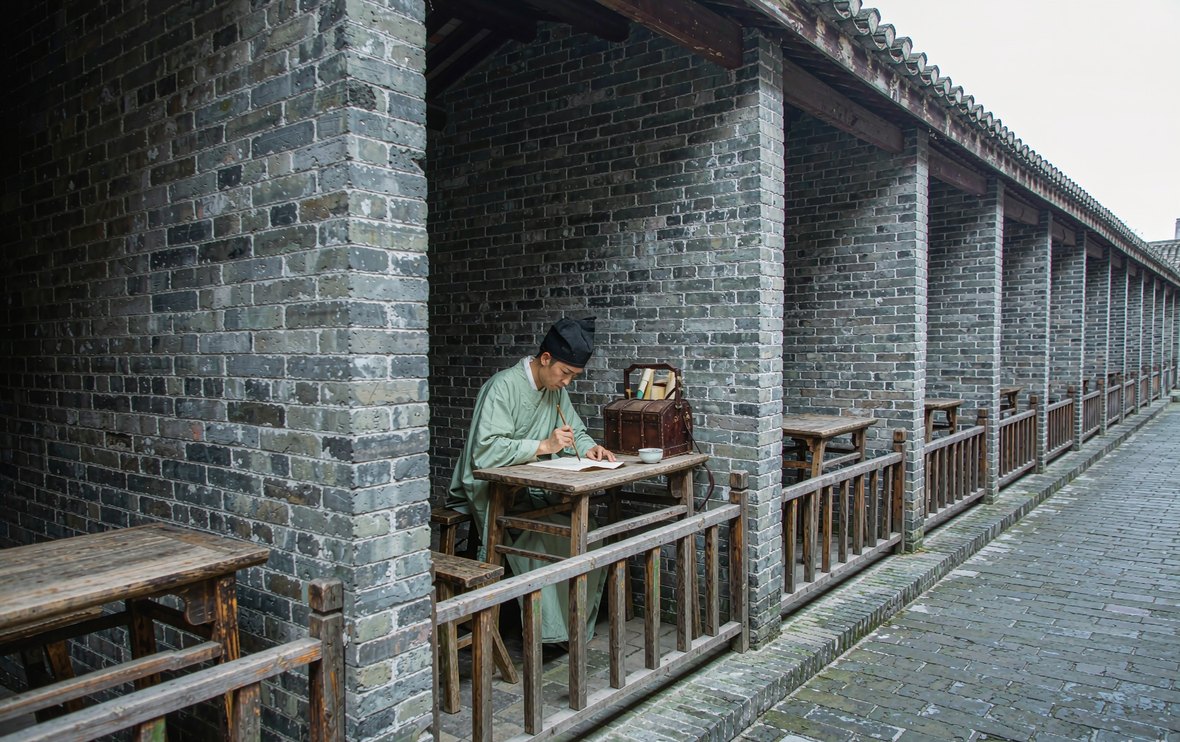
The two institutional pillars that sustained Chinese civilization’s super-scale continuity for two thousand years. The commandery-county system solved "territory": centrally appointed, rotating officials replaced hereditary fiefs; the realm was divided into commanderies and counties with registered households and documentary administration — instituted by Qin, perfected by Han, with today’s province-county system as its extension — making China the world’s first mature bureaucratic state. The examination system solved "talent": from Sui and Tang, office went by examination rather than birth — "a farm boy at dawn, at the Son of Heaven’s hall by dusk" — social mobility institutionalized, civil government founded, until abolition in 1905 after thirteen centuries. One system governed territory, one selected the worthy; together they kept the Chinese empire, in an age of horse-borne mail and boat-borne trade, the largest unified governance in human history. Modern civil-service examinations and central-local relations still carry the genes of these two systems.
When Qin unified the realm, the court debated fiefdoms versus commanderies; Li Si settled it in one speech: "King Wen and King Wu enfeoffed many kinsmen, yet their descendants grew distant and attacked each other like enemies... the realm suffered endless war because of the lords." Feudalism must end in fragmentation; only commanderies preserve unity. So the realm was divided into thirty-six commanderies, governors and magistrates appointed and dismissed by the center, non-hereditary, regularly rotated; households registered and taxed — a kinship state remade as a registered state.
The subtlety of this "rotating-official" system lies in two designs: power flows from the center, not blood; and local offices are detachable from officeholders — "iron yamen, flowing officials." Han inherited Qin’s system and added inspecting governors; Tang and Song split it into circuits, prefectures, and counties; Yuan created provinces; Ming and Qing fixed the province-prefecture-county ladder — two thousand years of administrative evolution, one unchanged skeleton. Today’s provinces, civil service, and central-local finance are all modern descendants of the commandery-county system.
Before the examinations, office went by inheritance (hereditary ranks) and recommendation (inspectations and the nine-rank system), both sliding into clan monopoly — "in the upper ranks no poor man’s son; in the lower none of a great house’s fall." Sui and Tang changed course: examinations by subject, selection by the paper, open to all who studied. Wu Zetian created the palace examination and military examination; Song sealed and transcribed candidates’ names; Ming and Qing fixed the eight-legged essay — across thirteen centuries, the examinations took the qualification for office out of birth’s hands and gave it to the exam paper.
The social effects ran deepest: any farm boy who climbed the three ladders of provincial, metropolitan, and palace examination could enter office — mobility had its institutional channel. The ideal of "a farm boy at dawn, at the Son of Heaven’s hall by dusk" gave the whole society a fervent faith in education; scholar-officials displaced aristocrats as the governing class, and the Song’s civil order of "governing the realm with the scholar-officials" was founded. That belief — examinations change destiny — remains among the Chinese’s deepest collective psychologies.
朝为田舍郎,暮登天子堂。将相本无种,男儿当自强。 — A farm boy at dawn, at the Son of Heaven’s hall by dusk. Ministers and generals are no special seed — a man must make himself strong.——Poems of the Prodigy (Shentong shi)
Both systems had their costs. Under commanderies, central control and local vitality pulled against each other: over-centralize and the counties wait and watch; over-devolve and the tail wags the dog — the Seven Kingdoms of Han, the garrisons of Tang, the Three Feudatories of Qing are lessons of failed balance. In the examinations’ late period, the eight-legged essay fettered thought — "what was learned was not used; what was used not learned"; nineteenth-century scholars knew the classics by heart and not the world, becoming a burden of modernization. The abolition of 1905 is widely seen as the first domino of the empire’s fall.
Yet the legacy is real: the examinations produced the world’s earliest mature civil-service testing — Britain’s nineteenth-century reforms drew directly on Chinese experience; the commandery system’s administrative technology — documents, evaluation, inspection, rotation — supplied a prototype of modern governance. Western scholars (Weber, Fukuyama) regard imperial China as an ancient forerunner of the "modern state" — these two systems are humanity’s earliest living textbook of governance technology.
Set commanderies beside examinations and the core design of Chinese political civilization appears: territory is woven by an official network; talent is supplied by examinations; each completes the other — without examinations, rotating officials have no source; without commanderies, the talented have no stage. On these two pillars China maintained unified governance over millions of square kilometers and tens of millions of people under ancient transport conditions, and rejoined itself after every rupture — here lies the institutional confidence behind "long divided, must unite."
Looking back today, their modern reincarnations are plain: the gaokao and civil-service examinations carry the examinations’ spirit of fairness; the province-county system and cadre-rotation carry the commanderies’ logic of governance. An institution can outlive the dynasty that made it — this is Chinese civilization’s deepest political experience, and the real legacy the examinations and commanderies left to modern China.