Time Span
c. 2070 BC – 1912 AD · over 4,000 years
From the Xia to the Qing, over four thousand y...
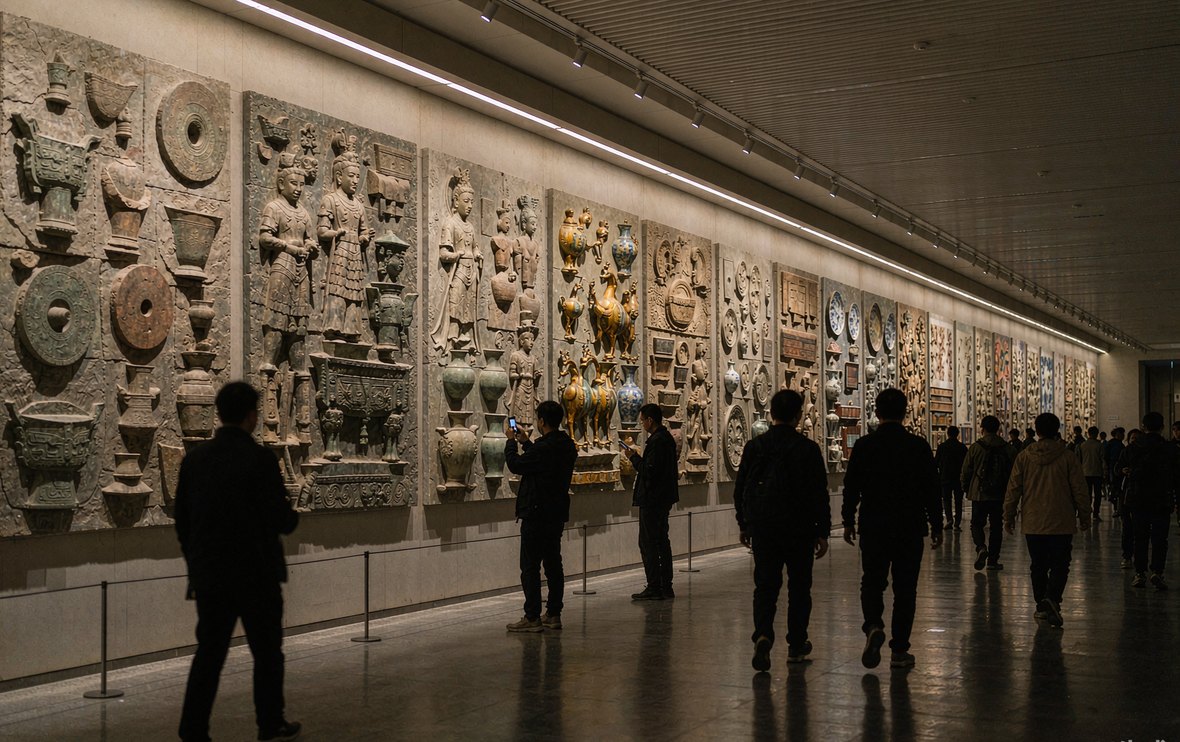
From the Xia to the Qing, over four thousand years and more than twenty major dynasties succeeded one another, forming the only unbroken chronicle of continuous civilization in human history. This was never a mere change of banners: it is an evolution of institutions, thought, aesthetics, and ways of living. The Three Dynasties laid down ritual; Qin and Han built the framework of unification; the Wei-Jin era freed the individual spirit; the High Tang embraced all the world’s peoples; the Two Songs refined elegance to its utmost; Yuan, Ming, and Qing integrated a plural empire. Each dynasty added a distinct color to the civilization — the ritual of Zhou, the law of Qin, the vigor of Han, the breadth of Tang, the refinement of Song, the craftsmanship of Ming, the synthesis of Qing; seen together, they are the answers one civilization gave, era after era, to its own changing questions. The twenty-eight-character "Dynastic Song" compresses a thousand years: "From the Three Sovereigns and Five Emperors the line began, passed down through Yao, Shun, and Yu." From it the Chinese developed a depth of historical consciousness rare among world civilizations: any affair can be measured on a scale of centuries and millennia.
Yu the Great founded hereditary rule; Shang and Zhou carried it forward. The Shang laid the documentary bedrock of history with oracle bones and bronze inscriptions; the Zhou, with its patriarchal feudal order and civilization of ritual and music, framed the moral geometry of the next three thousand years — "How resplendent its culture! I follow Zhou," said Confucius, whose ideal was precisely the Zhou order. The five hundred years of Spring and Autumn and the Warring States saw ritual collapse — and thought flourish: the masters arose in throngs, the Hundred Schools contended, and the entire source code of Chinese thought was written amid disorder.
Qin absorbed the six states, standardized script and axle widths, and instituted the commandery-county system, laying the operational framework of great unification. Han kept Qin’s institutions while tempering their harshness, honored Confucianism alone while wielding statecraft alongside, and over four hundred years forged the self-identity of the "people of Han" — from then on, the people of this land had a common name. Three centuries of division under Wei, Jin, and the Northern and Southern Dynasties, through the mingling of Hu and Han and the eastward arrival of Buddhism, poured fresh blood into the great reunification of Sui and Tang.
Sui rebuilt unity and cut the Grand Canal, joining north and south; Tang then pushed the empire to a civilizational summit: Changzhou’s Chang’an held a million souls, envoys from every nation bowed before the imperial canopy, the examinations opened office to men of humble birth, and Hu music, Hu dance, and Hu food filled the wards — the High Tang spirit was a duet of confidence and openness. "I recall the fullness of the Kaiyuan years, when even small towns sheltered ten thousand households": Du Fu’s recollection is the era’s marginal note.
Song, weak in arms, brought culture to its utmost: perfected examinations, rule by scholar-officials, the economic center shifting south, flourishing urban markets, and the jiaozi — the world’s first paper money. Scholar-officials governed with the Son of Heaven; scholarship had Cheng-Zhu Neo-Confucianism, letters had Su, Huang, Mi, and Cai, and the towns had their theaters and storytellers. Chen Yinke wrote that the culture of the Chinese people, "after millennia of evolution, reached its summit under the Song." The elegant templates of daily life today — incense, tea, hanging paintings, flower arranging — were all patterns set by the Song.
三皇五帝始,尧舜禹相传。夏商与西周,东周分两段。 — From the Three Sovereigns and Five Emperors the line began, passed down through Yao, Shun, and Yu; Xia, Shang, and Western Zhou, with Eastern Zhou split in two.——The Dynastic Song (Chaodai ge)
Yuan, a nomad house ruling the Central Plains, commanded an unprecedented territory; its province system endures to this day. East–west contact opened wide — Marco Polo came east, the Four Great Inventions went west. Ming restored Han dress and rule, and Zheng He’s seven voyages displayed its power across the seas; in the late Ming the market towns of Jiangnan boomed, and commerce, industry, and printing flourished as never before — the Tiangong Kaiwu, the Bencao Gangmu, and the Travels of Xu Xiake all came from this age.
Qing fixed the map of modern China, integrating a multi-ethnic territory of unprecedented scope; under the Kangxi–Yongzheng–Qianlong prosperity the population passed three hundred million. Yet just as the empire felt itself complete, the West completed its Industrial Revolution and institutional leap — one cannon report in 1840 forced the four-thousand-year dynastic narrative into the modern world. In 1912 the Qing emperor abdicated and two millennia of imperial rule closed; but the depth of history remains: only by reading the rhythm of dynastic change can one read the road by which today’s China arrived.
"From the Three Sovereigns and Five Emperors the line began, passed down through Yao, Shun, and Yu. Xia, Shang, and Western Zhou; Eastern Zhou split in two..." Twenty-eight characters of mnemonic verse are every Chinese child’s first history lesson. This chronicle-mindedness, in units of dynasties, joined with the continuous writing of the Twenty-Four Histories, gives the Chinese a rare depth of historical feeling: any matter may be judged on a scale of a hundred or a thousand years. "Learn from the past to know the future"; "the mirror of Yin is not far off" — historical experience is the first reference for present decisions.
Dynastic change also distilled a distinctive political philosophy: he who wins the people’s hearts wins the realm; water can carry the boat, and can capsize it too. "Rising it was swift, falling it was sudden" — the famous cave-dwelling dialogue between Huang Yanpei and Mao Zedong in Yan’an still wrestled with the old question three thousand years of history had posed: how to escape the cycle of rise and fall. The four millennia of dynastic history have closed, but the institutional experience, cultural genes, and historical wisdom they left remain this civilization’s deepest foundation.