Author
Wang Xizhi (303–361)
On the third day of the third month of 353, th...
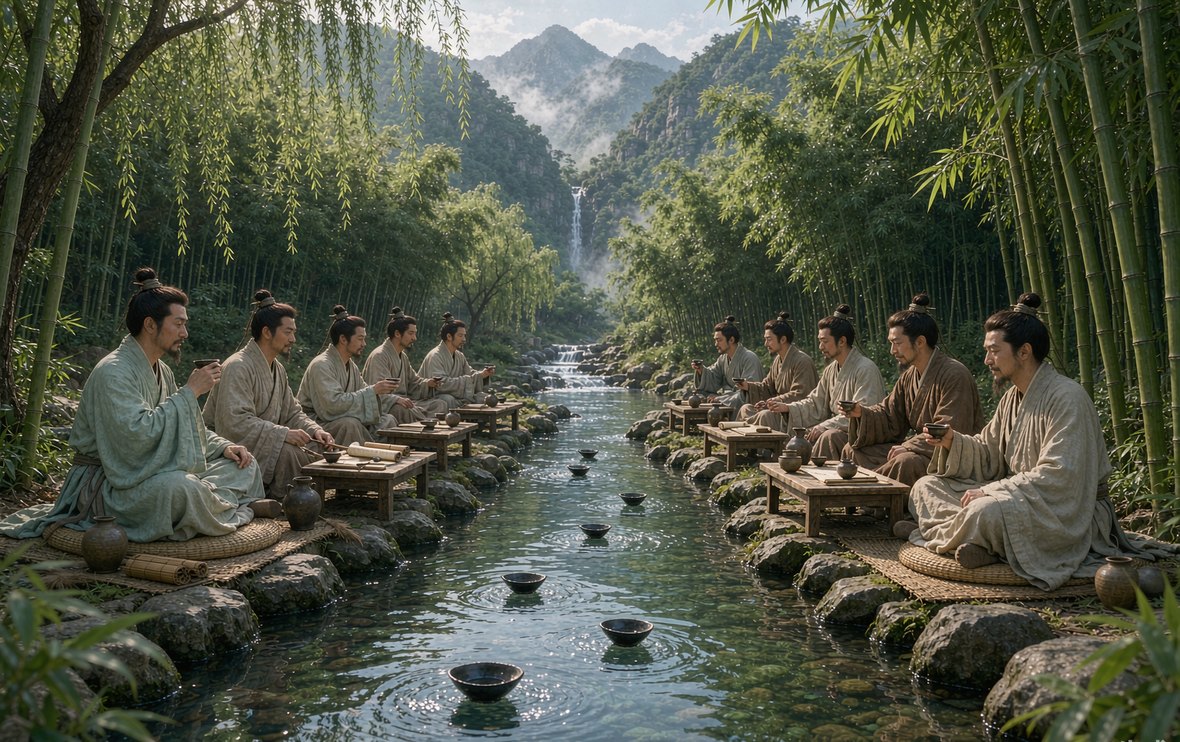
On the third day of the third month of 353, the ninth year of Yonghe, Wang Xizhi gathered with Xie An, Sun Chuo and thirty-eight other men of note at the Orchid Pavilion in Shanyin, Kuaiji, for the spring purification, floating wine cups down a winding stream and composing thirty-seven poems. Half drunk, Wang wrote a preface to the collection in twenty-eight lines and 324 characters, in one unbroken movement: the *Preface to the Orchid Pavilion Gathering*, the finest running script in history. The first half writes the joy of a fine day and good company; the second turns abruptly to death — "what we delighted in, in the space of a glance, is already a trace of the past"; "I know now that to treat life and death as one is a fiction, and to equate Pengzu with a child who dies young is a delusion." In an age of metaphysical talk he alone kept a sober grief for mortality. Among its twenty instances of the character zhi, no two are alike; the brush moves like drifting cloud and startled dragon. The original is said to have been buried with Emperor Taizong of the Tang; the Tang tracing copies survive, the Divine Dragon version chief among them. A gathering, a preface, a piece of calligraphy: three in one, the enduring legend of Chinese art.
On the third day of the third month of 353, at the Orchid Pavilion in Shanyin, Wang Xizhi, then administrator of Kuaiji, invited Xie An, Sun Chuo, the monk Zhi Dun and thirty-eight others to the spring purification — the old rite of washing away ill fortune by water, transformed into the most famous literary gathering of the Eastern Jin. They sat along a winding channel; cups of wine floated down and stopped where they would, and whoever the cup stopped before composed a poem or drank three cups as forfeit: "one cup, one poem, enough to give voice to the deepest feeling." Thirty-seven poems were made that day, and the company asked Wang to write the preface.
He wrote it on the spot. The sky was clear, the air mild, the wine warm, and the brush followed the mind. It is said that when he sobered he wrote it out dozens of times and could never match the first draft. The finest running script in history was born from the afterglow of a parlour game, which suggests something of the nature of art: the best work is not made so much as it overflows at the fullest moment of a life. The elegance of the Eastern Jin set hard into permanence at the Orchid Pavilion.
The beauty of the calligraphy has been accepted for fifteen hundred years. In 324 characters the movement is "like drifting cloud, like startled dragon", the threads between strokes connecting while the breath runs through. The twenty zhi are steady, or steep, or lovely, or expansive, and no two agree. Dong Qichang praised it as first in structure of all time, the characters "born of one another, the small joined to the great, sometimes seemingly unconnected, following nature, and the blood-vein running through of itself". Centred and angled tip, hidden and exposed, the column moving like a boat on water: every technique and aesthetic of running script takes its model here.
It is also a watershed in the aesthetics of the Chinese character. Wang changed the archaic stiffness of Han and Wei into grace and fluency and set the ideal of central harmony — neither agitated nor lax, the standard far-reaching. For sixteen hundred years, from Zhao Mengfu to the calligraphy class of today, copying the Orchid Pavilion has been the first task of anyone learning running script. A draft preface of 324 characters became the constitution of a nation's written beauty.
固知一死生为虚诞,齐彭殇为妄作。 — I know now that to treat life and death as one is a fiction, and to equate Pengzu with a child who dies young is a delusion.——Preface to the Orchid Pavilion Gathering
The stroke of genius in the second half is the turn from the height of joy to the depth of grief: "what we delighted in, in the space of a glance, is already a trace of the past, and still we cannot help being moved by it"; "how much more, since length of life follows nature and all ends in extinction." Wang then attacks the easy optimism of the metaphysics of his day. Zhuangzi's "life and death are one" and "Pengzu and the child are equal" are punctured in the wine of the Orchid Pavilion: "I know now that to treat life and death as one is a fiction, to equate Pengzu with a child who dies young is a delusion." Death is death and life is life; to pretend they are one is self-deception.
That lament is the value of the piece. Wang does not evade or anaesthetise; he faces the final question, that life and death are indeed a great matter, and gives an Orchid Pavilion answer: "later ages will look at us as we look at those before us" — write the feeling down, let posterity share the sigh, and that is resistance to impermanence. Beyond the tradition of literature as a vehicle of the Way, Chinese writing gained a lyric tradition of living toward death: Li Bo's "this floating life is a dream", Su Shi's grief that our life is but a moment — both are echoes of the Orchid Pavilion.
The fate of the original is a mystery. Wang is said to have treasured it above life; it passed to his seventh-generation descendant, the monk Zhiyong, and then to his pupil Biancai. Emperor Taizong of the Tang coveted it, and on Fang Xuanling's advice sent the courtier Xiao Yi to trick it from the monk. Taizong had Feng Chengsu, Ouyang Xun and Chu Suiliang make tracing copies to give to his ministers, and the original went with him into Zhaoling. Only copies remain: the Divine Dragon version attributed to Feng Chengsu with its half-seal, the Dingwu stone rubbings, the Chu Suiliang and Yu Shinan versions — each with its own brilliance.
In 1965 Guo Moruo published an article opening the "Orchid Pavilion debate", questioning whether Wang wrote the text at all; Gao Ershi answered him, and Mao Zedong remarked that in a war of ink and brush it is better to have a dispute than not. The scholarly case became a good story in itself. The Divine Dragon version is in the Palace Museum, and "Yonghe nine, the year guichou" remains the first line every Chinese student of calligraphy writes. The original died with an emperor, but the elegance belongs to the world — which is perhaps what Wang had already understood when he wrote that in the space of a glance it is already a trace of the past, and that words and ink outlast every tomb.