Author
Shen Fu, style Sanbai (1763–?)
The autobiographical notebook of the Suzhou ma...
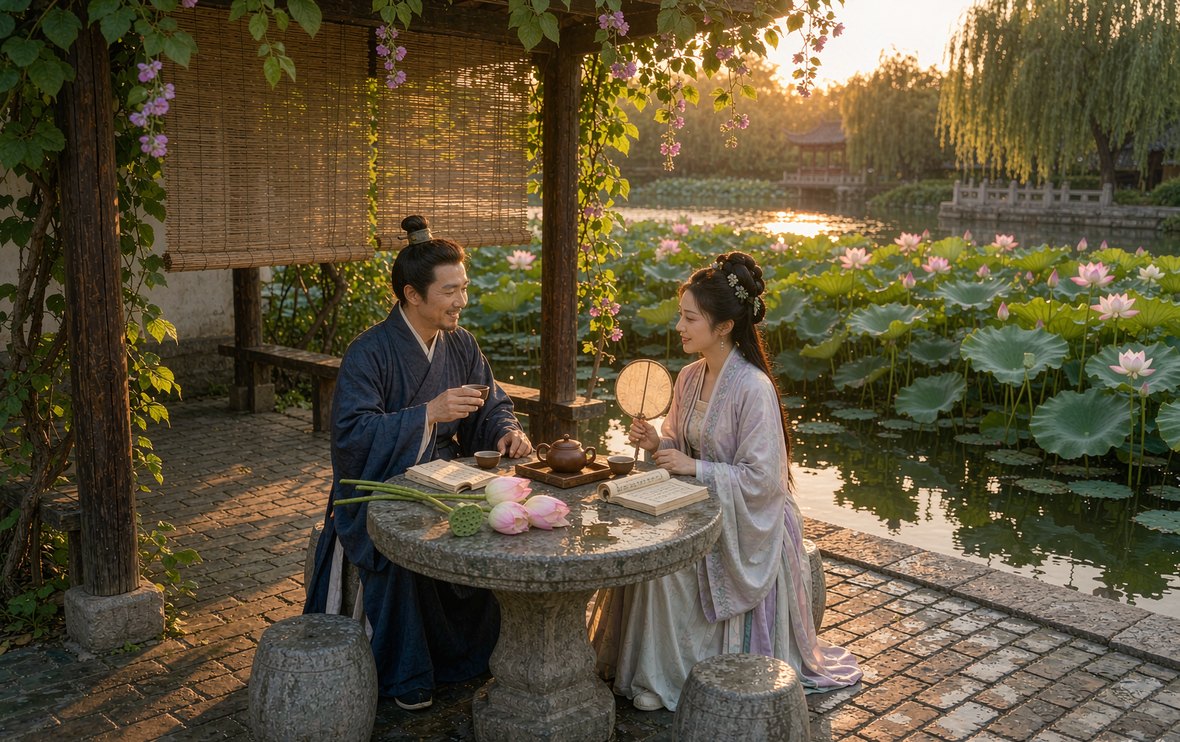
The autobiographical notebook of the Suzhou man of letters Shen Fu (style Sanbai, 1763–?), in six records: of the boudoir, of idle pleasures, of adversity, of travels, of a sojourn in Zhongshan and of the way of nourishing life — the last two lost, four surviving. It is all small things: his love with his wife Chen Yun on plain cloth and vegetables, the pleasures of flowers and pot plants, the miseries of poverty and illness, the joy of travel. No fame, no great events, only the floating life of an ordinary couple. Lin Yutang called Chen Yun "the most lovely woman in Chinese literature": she dressed as a man to go out with her husband, was frank enough to be jealous when he took a concubine, and pawned her hairpin to buy wine for a moonlit evening. The manuscript was lost for a century and found in 1877 on a Suzhou bookstall by Yang Yinchuan; in 1936 Lin Yutang translated it into English, and the Eastern philosophy of "plain cloth and simple food can make a whole life glad" went out into the world.
The first record is the most moving. Shen Fu and Chen Yun grew up together; she hid porridge for him when he was hungry, and they pledged themselves to each other. After marriage "we lived as equals for twenty-three years", in plain clothes and simple food, the wish to grow old together unfulfilled but the tenderness drawn in every detail. Her charm lay in candour and wit. She had "two teeth slightly showing", no great beauty, but a natural grace; she dressed as a man to visit the Temple of the Water Immortal and "saw everything in the temple"; she matched his line "beast-clouds swallow the setting sun, bow-moon shoots the falling star", and talked poetry with him late into the night, invoking Li Bo and Du Fu as if they were ghosts at her brush. Husband and wife conversed like two friends who understood each other.
Lin Yutang wrote of "her gentleness and beauty, her serenity in adversity… we see the ideal of Chinese family life". In an age of rigid propriety, a woman who laughed and talked with her husband as an equal and shared the moon and the wind with him was recorded exactly as she was, and the respect and love in that record make the book a lighthouse of the Chinese ideal of marriage. Love, here, is the daily keeping of company on plain cloth and simple food.
The second record is an aesthetics of poverty. Potted plants should be "set in deep trays of layered foliage"; flower arrangement should "start tight at the base, keep the mouth of the vase clean". "In my idle days there was always a vase of flowers on my desk." Poor and fond of flowers, Chen Yun devised screens of living flowers set with insects and butterflies so that they looked like a garden; as a boy Shen Fu "kept mosquitoes in a plain mosquito net, slowly blew smoke at them… and watched them as blue clouds and white cranes". "For a poor scholar, in dress, food, vessels and rooms, the rule is frugality with cleanliness" — elegance does not lie in money but in eye and mind.
This record is a small textbook of Chinese living aesthetics: one vase, one flower, one rockery, one pot of orchids, each with an entry point. Modern readers are startled to find that a scholar of two hundred years ago had already demonstrated the low-cost poetic life: it waits not on circumstance but on the eye. "In all things I like to have my own view and disdain to follow others" — Shen Fu's aesthetic character is a resistance to every kind of drift.
事如春梦了无痕,苟不记之笔墨,未免有辜彼苍之厚。 — Life is like a spring dream that leaves no trace; if I do not set it down in ink, I shall have failed the generosity of Heaven.——Shen Fu, Six Records of a Floating Life
The third record turns sharply. Because he stood surety for a friend and because of family suspicion, the couple were driven out of the Shen house and lived on others' charity. Chen Yun's illness worsened and she died in Yangzhou; their son Fengsen died young. "A friend like you, a husband like this: in this life I have no regret." The parting at her deathbed is one of the most grief-stricken passages in Chinese prose, and Shen Fu's "this kindness, this goodness, I shall never forget while I have teeth" and his drifting — "from now on all is confusion, and I do not know when I shall wake from the dream" — write out the destitution of a poor scholar.
It is this sorrow that gives the earlier happiness its weight. In "six records of a floating life" the word floating means drifting: joy gathers and scatters like duckweed, and memory is the only anchor. Shen Fu, with no fame, has no place in the orthodox history of literature, but his one autobiography proves that an ordinary life deserves to be written whole. That consciousness of the common man's biography is in no way inferior to European work of the same kind.
Its fate was as floating as its title. The manuscript disappeared for a century; in 1877 Yang Yinchuan bought a damaged copy on a Suzhou bookstall, only four records, and printed it in a collectanea, and it began to be known. The last two records never surfaced; arguments about a "recovered" text continue and the authentic version is doubtful — a broken book becomes a beautiful open case. Yu Pingbo collated and championed it; in 1936 Lin Yutang's English version, *Six Chapters of a Floating Life*, introduced Chen Yun to the world and put the book on reading lists abroad.
It has since become kunqu opera, stage play and film; it holds a high rating on Chinese review sites year after year, and young readers call it a healing book. In an anxious age, "plain cloth and simple food can make a whole life glad" reads as an antidote. The rise and fall of a book is a metaphor for a life: what is buried will be found, and what is broken is still whole — so long as those true everyday hours were once lived.