Scale
24 histories · ~40 million characters · 3,200+ fascicles
From the Records of the Grand Historian to the...
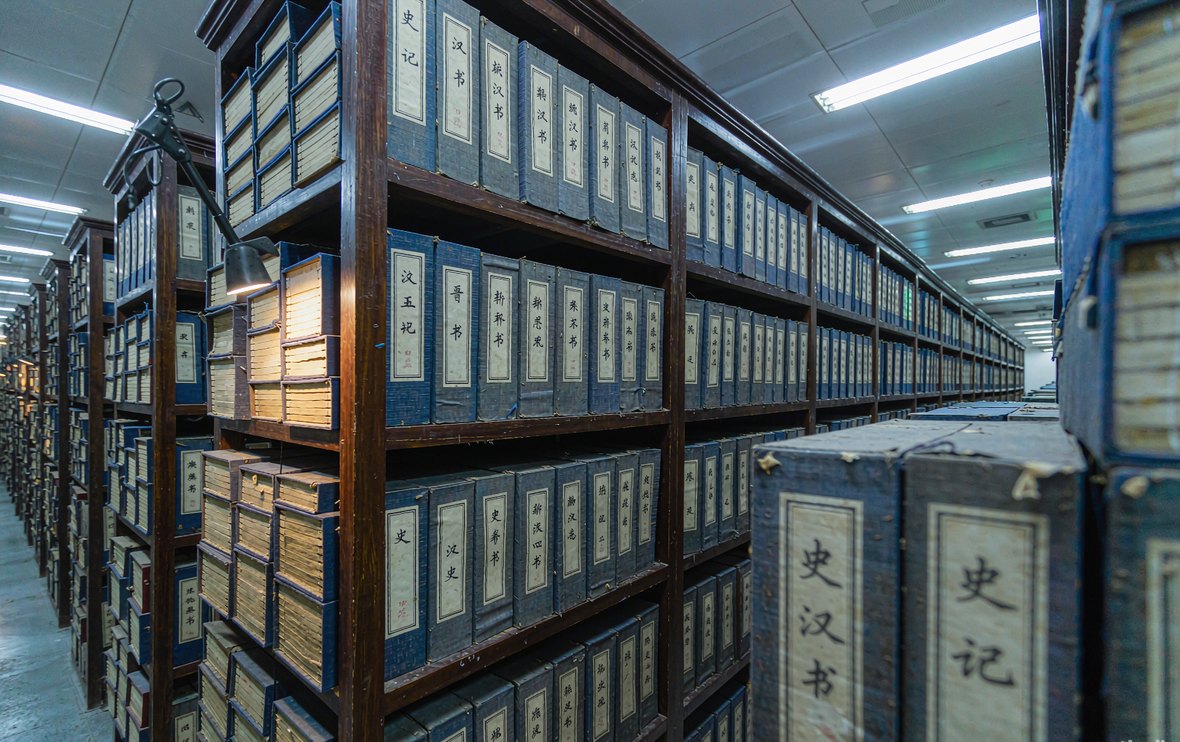
From the Records of the Grand Historian to the History of Ming, twenty-four biographical-annalistic official histories run in succession, some forty million characters in all, covering some four thousand years from the legendary age to the seventeenth year of Chongzhen — a historiographic project unique in human civilization: one civilization, in one form, writing itself without pause for four millennia. Each set of histories follows the fallen dynasty — "the succeeding dynasty writes the fallen one" became tradition; each contains basic annals and biographies (many with treatises and tables), and beyond emperors and generals, scholars, poets, honest officials, virtuous women, physicians and diviners each have their chapters — every stratum of society entered in the record. Wen Tianxiang’s Song of Righteousness ranks "the historians’ tablets of Qi, the brush of Dong Hu of Jin" first among the upright airs of heaven and earth — the tradition of the straight brush is the backbone of civilization. To understand the system of the Twenty-Four Histories is to understand how the Chinese remember themselves.
The most astonishing fact is that the line never breaks: Han falls and Chen Shou writes the Records of the Three Kingdoms; Jin falls and the Southern Dynasties compile the Book of Song; Tang compiles eight histories, Song four; less than a century after the Ming fell, the Qing opened the Ming History Office and spent ninety years completing the History of Ming. When a dynasty collapses, among the victors’ first acts is often to write its history — "the state may perish; history must not be extinguished": the change of regimes must not break civilization’s self-memory.
Hence a phenomenon unique to humankind: one ancient civilization holding a complete, continuous archive from its origin to the modern age. Babylon, Egypt, Greece all broke off; only China’s histories roll on fascicle after fascicle to today. Mao Zedong read the Twenty-Four Histories through with annotations; world sinology rebuilds ancient East Asian history upon them — these forty million characters are the hardest evidence that this civilization "lived to see today."
The tradition, begun with the Shiji and regularized under Tang: the new dynasty opens a history office, gathers the fallen court’s diaries of activity, veritable records, and archives, and compiles a complete official history. The intent is deep: first, to claim the orthodox — my house inherits the Mandate, and so may judge the fallen; second, to sum up rise and fall — "using history as mirror" requires trustworthy history first; third, to settle hearts — the past of the fallen court’s subjects must be formally acknowledged before the new order can stand.
This system made the history office a standard part of the state machine: diarists attending the throne, veritable records compiled reign by reign, the national-history office in long operation; the veritable records and huiyao surviving from Tang on all issue from it. Official narrative inevitably bends, yet precisely this institutionalized writing taught the Chinese a lasting awe of "how will history write us" — the governance of one’s life, the name after death, all under one historian’s brush.
在齐太史简,在晋董狐笔。 — The historians’ tablets of Qi, the brush of Dong Hu of Jin.——Wen Tianxiang, "Song of Righteousness"
The biographical form writes more than emperors: the categories of biography are themselves a social map — scholars (Rulin), writers (Wenyuan), honest officials (Xunli), harsh officials (Kuli), virtuous women (Lienü), physicians and diviners (Fangji), knights-errant (Youxia), merchants (Huozhi), with eunuchs, imperial in-laws, and favorites each their chapter. Sima Qian wrote biographies of knights-errant and merchants; Ban Gu scoffed that his judgments "strayed far from the sage" — yet by this tradition, the swordsman and the trader entered Chinese historical memory.
The treatises are the social encyclopedia of old China: the Treatise on Food and Goods is economic history; Geography, human geography; Offices, administration; Calendar and Astronomy, science; Arts and Letters and Classics, the master catalogs of books in every age — the Han History’s catalog remains the map of pre-Qin scholarship. Seen together, the Twenty-Four Histories are not a roster of emperors but a four-thousand-year general archive of society.
In the Twenty-Four Histories’ tradition, the most prized is the "straight brush": the three historian brothers of Qi were killed one after another for writing "Cui Zhu murdered his ruler," until the last wrote on and Cui Zhu dared not kill — Wen Tianxiang named this the first of the righteous airs. But official history has its shadows: shielding the exalted and flattering one’s own house were chronic ills; the Book of Jin took in fiction; Old and New Tang Histories each bend; Ming-Qing literary inquisitions deleted sources again and again — reading the Twenty-Four Histories requires the craft of textual criticism.
For this very reason the unofficial traditions outside the official histories are precious: private notebooks, local gazetteers, bronze and stone inscriptions, unofficial histories — exactly the checks on the official record. This dual system, official-centered with private supplements, gives Chinese historical memory both institutional continuity and popular correction. The greatness of the Twenty-Four Histories is not spotlessness but that across four thousand years there were always men willing to lose their heads for one true sentence — the civilization’s hardest bone is here.