Founding figures
Confucius · Mencius · Xunzi
Confucianism is not a doctrine of clinging to ...
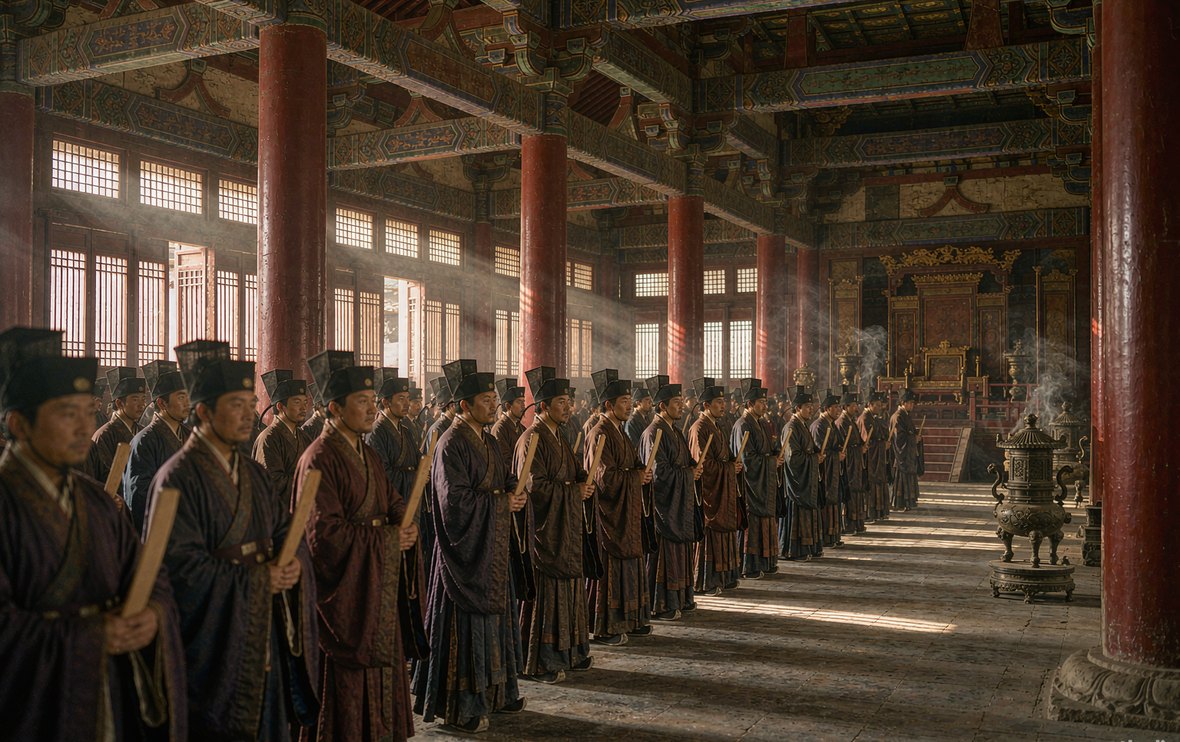
Confucianism is not a doctrine of clinging to the past, but China’s two-millennia master plan for the most fundamental question of all: how should human beings live together. At a time when ritual had collapsed and music lay in ruin, Confucius proposed ren (benevolence); amid the burning wars of the Warring States, Mencius exalted the goodness of human nature; Xunzi gathered and disciplined that nature through exalted ritual and firm law — three men, three prescriptions, together forming the bedrock of Chinese values. Cultivate the self, order the family, govern the state, bring peace to all under Heaven: this path from the inward to the outward joins the moral completion of the individual to the ordering of the world in a single line. For two thousand years after, through every change of dynasty, Chinese ethical life, educational ideals, and political grammar ran within the Confucian frame; the tradition even crossed into Korea, Japan, and Vietnam, becoming the common grammar of the entire East Asian civilizational sphere.
The character ren (仁) is written as “two people” — it concerns how a world of two or more can stand. Confucius grounded the answer in “loving others”: do not impose on others what you do not desire yourself; wishing to establish yourself, establish others; wishing to succeed yourself, help others succeed. The first is a negative boundary (do no harm), the second a positive fulfillment (help others stand on their own). This is one of the earliest clearly formulated expressions of the golden rule in human civilization, more than twenty centuries before Kant’s “man as an end in himself.”
Ren is not idle speculation but a practice embedded in everyday life: filial piety and fraternal respect are its starting point, conscientiousness and empathetic understanding (zhong and shu) its method, and reverence, magnanimity, trustworthiness, diligence, and generosity its outward signs. Confucius refused to discourse on abstract human nature; what concerned him was always the concrete choice in the concrete situation. This quality of “finding the sacred within the ordinary” makes Confucian ethics, to this day, a discipline ordinary people can take up and practice — not a concept game played in the study.
Confucius lived in an age when ritual had collapsed and music lay in ruin, yet he did not simply propose restoring the old rites unchanged. He laid bare the essence of li: “If a man is without ren, what has he to do with ritual?” — rites and music without a heart of ren are empty shells of ceremony. The true function of li is to externalize the inner feeling of ren into forms that can be followed, rehearsed, and handed down: the capping, marriage, mourning, and sacrifice ceremonies; bowing and yielding, advancing and withdrawing — letting abstract morality settle into bodily memory.
This design of “giving emotion a form” proved remarkably far-sighted: institutions crumble, laws grow obsolete, but the rites woven into weddings and funerals, greetings and farewells can outlast dynasties and keep running. The seating order at a Chinese dinner table, the tea served at a wedding, the single stick of incense at Qingming are still living fossils of that ritual way of life.
士不可以不弘毅,任重而道远。仁以为己任,不亦重乎?死而后已,不亦远乎? — The scholar must be broad-minded and resolute: the burden is heavy and the road is long. He takes ren as his own charge — is that not heavy? Only with death does it end — is that not long?——The Analects · “Taibo”: the words of Zengzi
Mencius taught that human nature is good: compassion, shame, deference, and the sense of right and wrong — the four sprouts (siduan) — are found in everyone, and “anyone can become a Yao or a Shun.” This is an optimistic trust in humanity and the theoretical precondition for rule by virtue. Xunzi taught that human nature is bad: born craving profit, it must be “transformed by artifice” (huaxing qiwei) through ritual, righteousness, teachers, and law — a clear-eyed guard against human darkness and the logical starting point for giving ritual and law equal weight.
The two positions seem to clash head-on, yet in fact complement each other: Mencius answers “why can people become good?” while Xunzi answers “why do people need institutions?” Confucian practice after the Han honored Mencius in public while quietly applying Xunzi — the court built its skeleton on ritual and law, and built popular confidence on the goodness of nature. The debate also shaped every later argument about education: the heuristic that trusts the child’s innate goodness and the disciplinary that imposes rules both stand, two thousand years on, on the extended line from Mencius and Xunzi.
The Great Learning’s eight steps — investigating things, extending knowledge, making the intention sincere, rectifying the mind, cultivating the self, ordering the family, governing the state, bringing peace to all under Heaven — supply Confucianism’s most complete blueprint: political legitimacy begins in personal morality, and the peace of the world begins in a single sincere thought. This “inner sage, outer king” route folds every ordinary person into the grand narrative: you need not command armies or serve as chancellor; by cultivating yourself you are already adding bricks to the order of the world.
For two millennia this path shaped the entire spiritual posture of the Chinese scholar: “When successful, bring benefit to all under Heaven; when in adversity, perfect yourself alone”; “be the first to worry over the world’s worries, the last to enjoy its joys.” Fan Zhongyan, Wang Yangming, Gu Yanwu, and Zeng Guofan were all travelers on this line. The educational fervor, the sense of family and nation, the feel for honor and shame in East Asian societies today remain the deep grammar Confucianism wrote into the civilizational body.