Founding figures
Laozi · Zhuangzi · Liezi
If Confucianism answers “how should people liv...
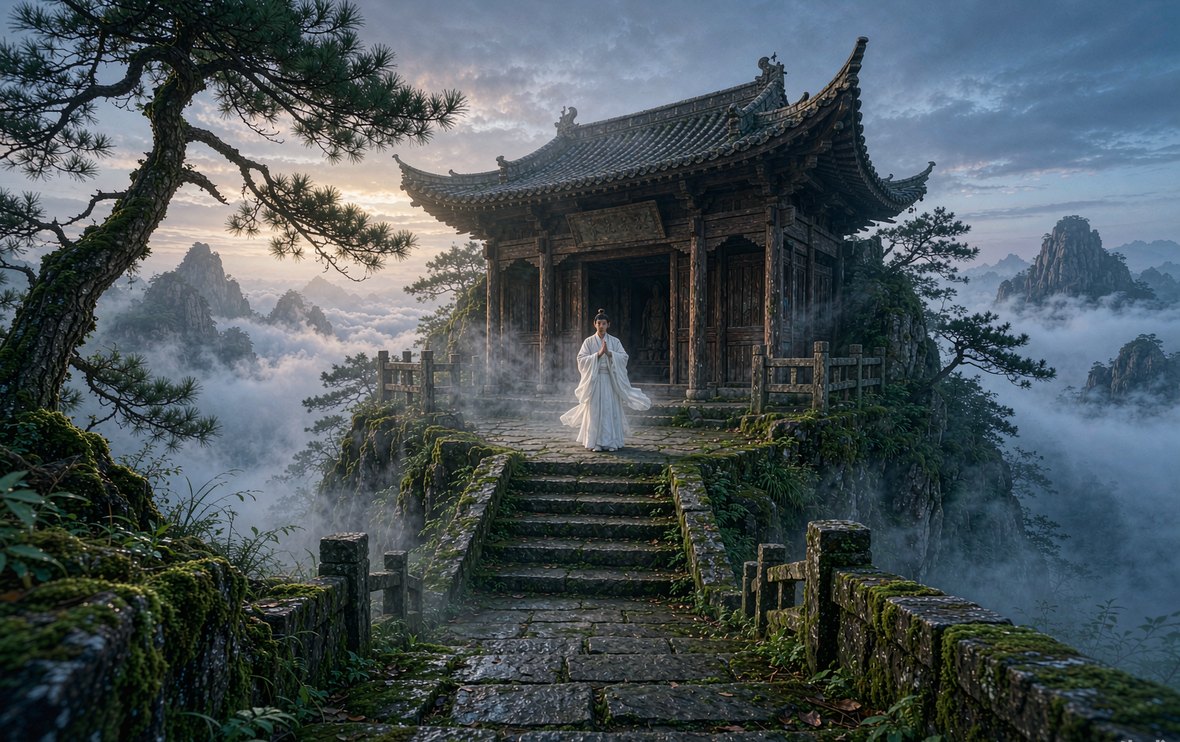
If Confucianism answers “how should people live together,” Daoism answers “how should a person dwell within himself, and with all things under heaven and earth.” Laozi and Zhuangzi saw in a chaotic age that civilization’s over-discipline is itself a form of violence, so they turned to nature for their model, teaching people to release their fixations and look upon things as they are. Daoism takes the Dao as the source of the ten thousand things, wu-wei (non-forcing action) as the wisdom of action, and “free and easy wandering” (xiaoyao) as the farthest reach of the spirit; it profoundly shaped Chinese aesthetics, medicine, regimen, art, and even the tradition of political restraint. It is not Confucianism’s opposite but the other wing of the same bird of Chinese culture: in success one advances with Confucianism, in failure one heals with Daoism; at court one speaks of ordering the world, among the mountains one speaks of being at ease — the elasticity of the Chinese spirit is supplied mostly by the Daoists.
“The Dao that can be spoken is not the constant Dao” — Laozi opens by limiting himself: whatever language can exhaust is not ultimate reality. The Dao is not a personal god or a dogma but the total principle by which the ten thousand things arise and move: “There was something formed in chaos, born before heaven and earth... it may be the mother of all under heaven.” Nameless and formless, it yet “moves everywhere without cease” — the first purely philosophical inquiry into the origin of the world in Chinese thought.
This way of “affirming through negation” shaped Chinese art deeply: the blank space of a painting, the harmonics of the guqin, the borrowed scenery of a garden — all reach “the inexhaustible” by “not saying everything.” Western sinologists have marveled that the Chinese understood, more than two thousand years ago, that the deepest truth happens only beyond the edge of language.
“Wu-wei” is easily misread as doing nothing; it is in fact an advanced wisdom of action: no forcing against the grain of things, no meddling born of one’s own delusions. “Governing a great state is like cooking a small fish” — once the heat is right, constant stirring only breaks it to pieces. “Assist the naturalness of the ten thousand things and dare not force” — what one does is assist along the grain, not compel against it. The Rule of Wen and Jing in the early Han, lightening taxes and letting the people rest, was precisely Huang-Lao wu-wei put into politics, and it laid the very foundations of the Han at its height.
Wu-wei is also a personal method for getting things done: Cook Ding carves the ox “with a blade that has no thickness entering where there is space,” and after nineteen years the edge is as if new — the master’s composure comes from deeply conforming to the pattern of things, not from piling up brute effort. The modern sayings “let the bullet fly a little longer” and “cross the river by feeling the stones” still carry a Daoist core: first read the current, then decide whether to enter the water.
泉涸,鱼相与处于陆,相呴以湿,相濡以沫,不如相忘于江湖。 — When the spring dries, the fish are stranded together on land, moistening one another with their breath and froth; better to forget each other in the rivers and lakes.——Zhuangzi · “The Great Ancestral Teacher” (Dazongshi)
Zhuangzi moved Daoism from political philosophy to a philosophy of life. “Free and Easy Wandering” opens with the kun-peng rising ninety thousand li, then the quail skipping a few fathoms — each thing has its own nature and each state its own limit; true freedom is not how high you fly but “depending on nothing”: not relying on the recognition or the feeding of external things, the spirit making a world of its own. The joy of fish argued from the Hao river bridge, the singing while drumming on a basin at his wife’s death — both place life, death, gain, and loss squarely within the great transformation of heaven and earth and look at them level.
Zhuangzi’s imagination became the wellspring of Chinese literature: Li Bai’s great peng, Su Shi’s moon on the water, the “form and emptiness” of Dream of the Red Chamber echo him everywhere. For later literati, Zhuangzi was the antidote in failure: those battered by official careers read “drag your tail in the mud” and learn that rank and riches are not worth clinging to; those stifled by the system read “the useless tree” and learn that not being consumed is itself preservation. That the Chinese can advance and also retreat, hold on and also let go, is thanks to Zhuang Zhou’s pair of wings.
Observing heaven and earth, the Daoists concluded that “the ten thousand things carry yin on their backs and embrace yang, and through the blending of qi attain harmony”: every existing thing is composed of opposed and complementary forces, seeking balance in motion. The old man losing his horse, fortune and misfortune leaning on each other — the very word “crisis” pairs danger with opportunity. This dialectical intuition gives the Chinese an extra measure of composure before rise and fall, honor and disgrace: in prosperity, think of danger; in decline, see the opening.
This mode of thought seeped into every capillary of Chinese civilization: Chinese medicine speaks of harmonizing yin and yang, strategists of the orthodox and the unexpected, calligraphers of concealing and revealing the brush-tip, architects of solid and void set off against each other. One might say Confucianism gave China its ethical skeleton while Daoism gave China the eyes with which it thinks — that gaze which “watches the change and holds the center” has never shifted in two thousand years.