Founders and synthesizer
Zhou Dunyi · Zhang Zai · Cheng Hao and Cheng Yi · Zhu Xi
Song–Ming Neo-Confucianism was the great rebui...
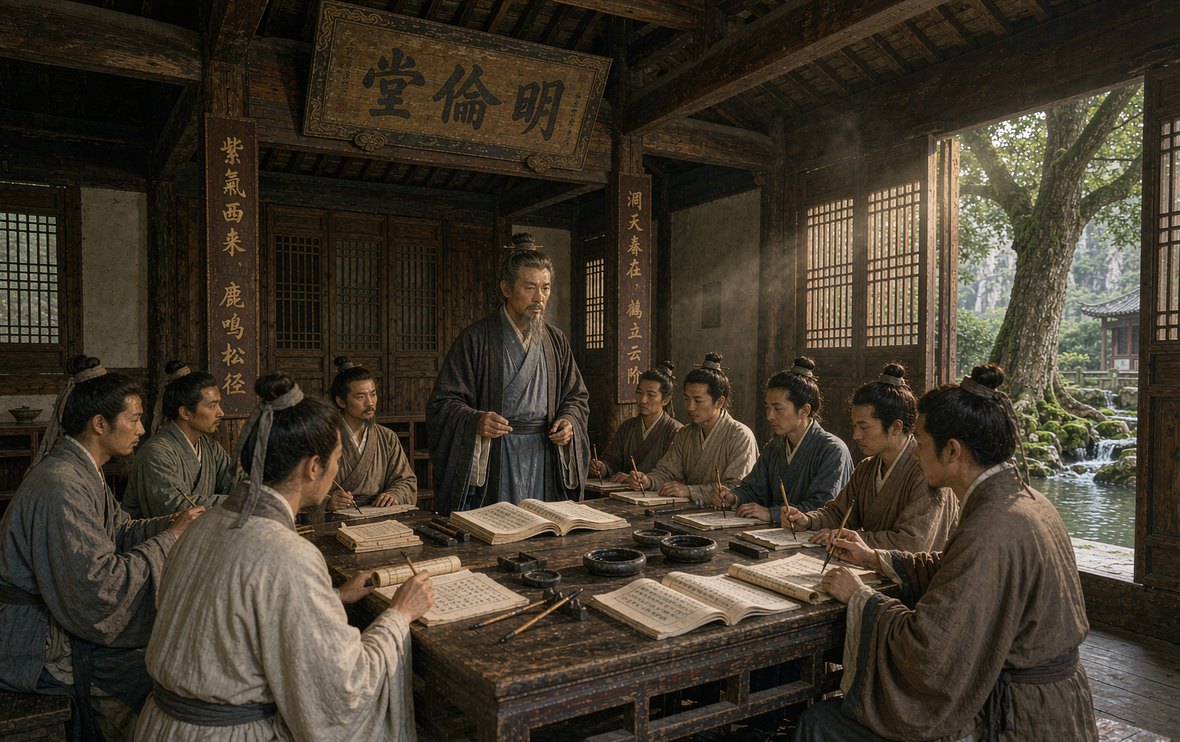
Song–Ming Neo-Confucianism was the great rebuilding of Confucianism in answer to the challenge of Buddhism. After Han and Tang, Confucianism had long been trapped in glossing words and phrases, its spiritual depth no match for the metaphysical systems of the Buddhists and Daoists; the great masters of the two Songs moved through Buddhism and Daoism for decades, returned to the Six Classics, and set Confucian ethical concern upon an entirely new cosmology and theory of human nature — a “New Confucian” revolution. In the Northern Song, Zhou Dunyi, Zhang Zai, and the Cheng brothers laid the foundations; Zhu Xi of the Southern Song brought it to completion in the vast system of “one principle, many manifestations”; in the Ming, Wang Yangming awakened at Longchang and raised “the extension of innate knowledge” (zhi liangzhi), opening the other realm of the School of Mind. The Chengs and Zhu taught “nature is principle”; Lu Jiuyuan and Wang taught “mind is principle”; the two roads of “investigating things” and “rectifying the heart” contested for five hundred years — yet whichever road, the aim was one: give heart to heaven and earth, secure life for the people, continue the sages’ interrupted learning, open peace for ten thousand generations. Lixue shaped the entire spiritual world of the East Asian scholar-official for the seven centuries after; its liberations and bondages, its light and its shadow, remain a living topic of Chinese thought today.
Zhu Xi’s central innovation was “principle” (li): each of the ten thousand things has its principle, and all principles return to one — “the moon printed on ten thousand rivers”: the same moon reflected in a thousand streams, full in every stream, yet only one moon. Heavenly principle in a human is that person’s nature — “nature is principle”; the mind unites nature and feeling; “investigate things to exhaust their principle” — grapple with each thing and fathom its principle, and when practice has accumulated, one day the breakthrough comes and all is penetrated at once. This system lifted Confucian ethical relations into cosmic law: filial piety and fraternal respect are not custom but the manifestation of heavenly principle within human relations.
This was the deepest counter-strike against Buddhism: the Buddhists dissolved the dusty world through the emptiness of all dharmas; Lixue recast the foundation of meaning through “li” — mountains, rivers, and the great earth are all real principle in flow, and the daily round of human relations is precisely where the Dao of heaven resides. Zhang Zai’s Western Inscription pushed it to magnificence: “all people are my siblings; all things are my companions” — the ten thousand things one body, the world one family. Lixue thus both carried on Confucius and Mencius and matched a mature civilization’s craving for the metaphysical.
The divide between the Cheng–Zhu and Lu–Wang schools sits at the entrance to self-cultivation. Zhu Xi taught “investigating things to extend knowledge”: investigate one thing today, another tomorrow — reading and discussion, handling affairs and meeting people are all investigation; when accumulation ripens, penetration comes of itself. Wang Yangming in his youth tried this on the bamboo before his pavilion — seven days and nothing gained, and he fell ill. After his awakening at Longchang he overturned the proposition: “Mind is principle. Is there a matter outside the mind, a principle outside the mind, anywhere under heaven?” — the way of the sage is complete in my own nature; to have sought principle in things was all a mistake.
Hence “the extension of innate knowledge” and “the unity of knowledge and action”: innate knowledge (liangzhi) everyone possesses; the sense of right and wrong is known without deliberation; the work of practice is to strip away the obscuration of selfish desire and let innate knowledge shine out clear. “To know and not act is simply not yet to know” — true knowing must issue in action; refusal to act is not-yet-knowing. The Chengs and Zhu climb the mountain, step by step fathoming principle; Lu and Wang sink the well, straight down to the original face. The five-hundred-year dispute of Zhu and Lu is at bottom the contest between two routes of mind — “seeking outward” and “realizing inward” — and its echo has not stilled in today’s epistemology and philosophy of mind.
问渠那得清如许?为有源头活水来。 — Ask how the pond stays so clear? Because fresh water flows from its source.——Zhu Xi, “Reflections While Reading” (Guan Shu You Gan)
“Give heart and mind to heaven and earth, secure life and destiny for the people, continue the interrupted learning of the past sages, open great peace for ten thousand generations.” Zhang Zai’s twenty-two characters, known as the Four Sentences of Hengqu, are the highest spiritual program of the Chinese intellectual: heaven and earth have no heart of their own — culture is their heart; the people’s destiny is not fixed by heaven but established through ritual, music, and education; the severed incense of sage learning must be rekindled by someone; the peace of ten thousand generations must be planned beginning today.
The four sentences distill the personality-ideal of Lixue — not the hermit who keeps himself pure, but the one who takes the world as his own responsibility. Fan Zhongyan with “first to worry, last to rejoice” went before; the Donglin partisans with “affairs of family, of state, of all the world — every affair concerns me” came after; Gu Yanwu’s “the rise and fall of all under Heaven is the duty of every common man” gathered it to completion. This boldness gave the Chinese scholar a new spiritual altitude after the Song: learning was not a stepping-stone to office but a vocation of securing life for heaven, earth, and the people.
The institutionalization of Lixue also cast a shadow: “preserve heavenly principle, extinguish human desire” distorted in later enforcement — memorial arches for chaste widows, the shackles of eight-legged examination essays — until ritual teaching became the “man-eating” thing of Lu Xun’s pen; the May Fourth generation’s critique of Lixue is the most violent page of modern Chinese thought. But a distinction is needed: Zhu Xi’s original words — “eating and drinking is heavenly principle; demanding delicacies is human desire” — meant temperance, not prohibition; the trouble lay in doctrine’s rigidification and power’s abuse.
In the twentieth century Lixue’s value was rediscovered: Wang Yangming’s School of Mind crossed to Japan and deeply influenced Nakae Toju, Saigo Takamori, and the reformers of the Meiji Restoration; the modern New Confucians (Feng Youlan, Mou Zongsan, Yu Ying-shih) brought Lixue into the world’s philosophical dialogue. Looking back today, Lixue was a great spiritual construction — proof that Confucianism is more than a manual of ethics, capable of settling metaphysical longing; its lesson is equally precious: once any thought ossifies into a warrant for power, its light becomes shadow.