Author
Du You (735–812)
China’s first general history devoted wholly t...
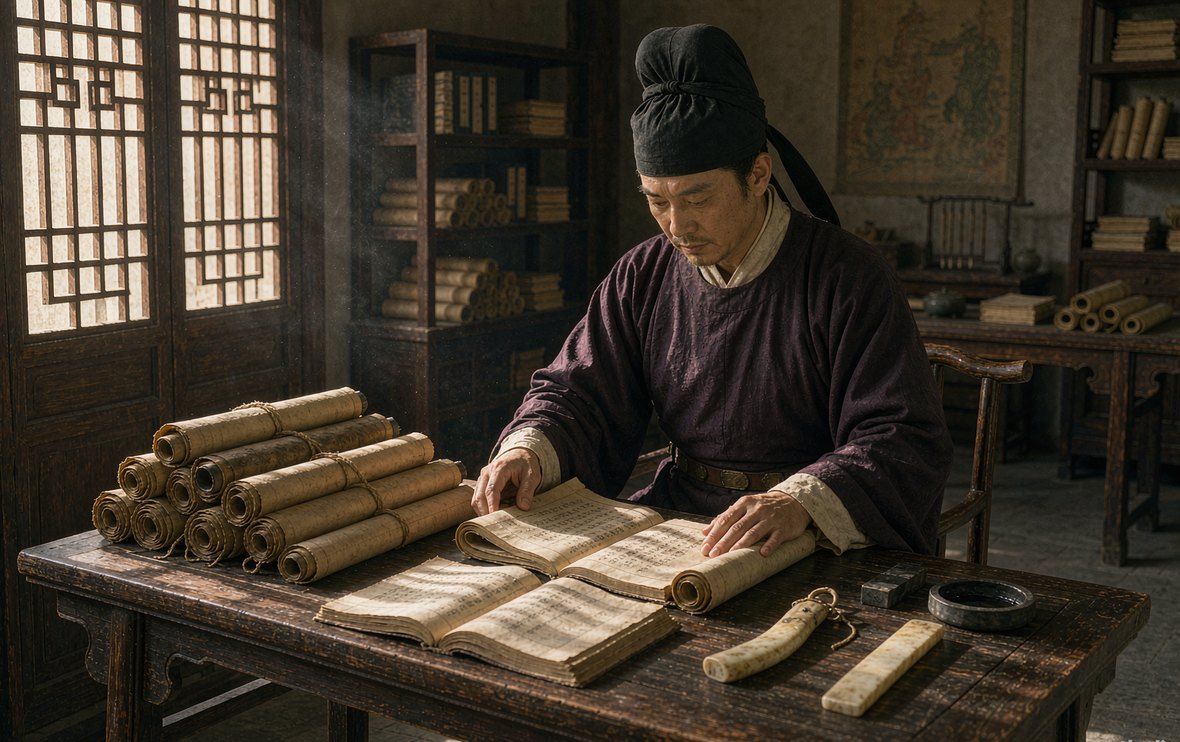
China’s first general history devoted wholly to institutions, written by Du You of the Tang over thirty years: 200 fascicles, some 1.9 million characters. Breaking with annalistic and biographical models, it takes "comprehensiveness" as method: from the legendary Yao and Shun to the end of the Tianbao era (with later touches), it traces each institution through the dynasties in nine sections — finance and food, examinations, offices, rites, music, army, penal law, provinces, and frontier — each subdivided, so that the evolution and revision of every system stands clear at a glance. Completed in 801, it is the "ancestor of books of statecraft," joined by the Tongzhi and Wenxian Tongkao as the "Three Comprehensives." Du You’s historical vision is strikingly modern: he held that the evolution of institutions is the main line for understanding a civilization — "weigh the essentials of antiquity, connect them to present needs" — only by reading institutional history do you read how a state actually runs.
Before Du You, history centered on rulers and events; Du You took another road: the skeleton of politics is institutions, and institutions alone have true continuity. He broke apart and reassembled all materials on revenue, personnel, offices, rites and music, military, law, local government, and frontier across the dynasties, rearranged in a section-and-topic scheme — under each institution, the successive reigns set in order, so changes and reforms show of themselves. Without reading through the Twenty-Four Histories, one book in hand gives the whole institutional past.
This method — "arranged by category, threaded through past and present" — founded the institutional genre: Zheng Qiao’s Tongzhi with its twenty monographs and Ma Duanlin’s Wenxian Tongkao continued the line; sequels followed in every age down to the Qing’s Continued Comprehensive Institutes. Chinese historiography thereby gained a fourth possibility beyond annals, biography, and chronicle — one book opened a school of history a thousand years long.
The ordering of the nine sections is itself an essay: finance and food first, examinations second, offices third... rites and music later. Du You says plainly: "the root of moral transformation lies in filling people’s clothes and bellies" — only when people are fed and clothed can education begin; economy determines the political structure, and the structure determines rites and music. In a historiography that took ritual as foundation, this order verges on heresy — and anticipates the modern insight about the economic base by a thousand years.
The finance section’s materials are equally solid: land systems, taxation, coinage, transport, salt and iron, reign by reign, with statutes and debates side by side. Du You served in fiscal office himself (at the Yangtze-Huai transport and expenditure bureaus), and knew that "grain is the master of men’s lives" — the Comprehensive Institutes is thus no study-chair scholarship but the work of a fiscal statesman who had lived through the practice, every page seasoned with experience.
夫理道之先,在乎行教化;教化之本,在乎足衣食。 — The first principle of governance is moral transformation; the root of moral transformation is filling people’s clothes and bellies.——Du You, preface to the "Food and Goods" section of the Comprehensive Institutes
Each section carries "discussions" — Du You’s own or drawn from rulers and ministers across the ages — set there expressly "to take lessons": the well-field system cannot be revived, hence the merits of Yang Yan’s two-tax reform; the militia system was hollow, hence the necessity of recruited armies. He opposed antiquarianism — "where institutions of former ages arose from momentary needs and cannot all be identical, aim always at what serves the people" — the standard of an institution is its fitness, not its age.
This statecraft historiography, inherited from Liu Zhi’s Zhengdian and carried higher, opened onto Sima Guang’s Zizhi Tongjian, "useful for the way of governance." Du You’s career ran fifty years to the chancellorship; he knew the disease and health of institutions from practice, and fused a lifetime’s observation into this book — the best true record of Tang institutions and first-hand material for comparing institutions across dynasties — desk-required reading for later reformers (such as the Qing statecraft scholars).
The Institutes’ form was expanded endlessly after: Zheng Qiao’s Tongzhi divided knowledge into monographs; Ma Duanlin’s Wenxian Tongkao refined it into twenty-four examinations; the huiyao and huidian (institutions of single dynasties) flourished; in the Qianlong era the court ordered sequels and Qing versions — statecraft books thus stood beside biography and annals as a great branch of history. One may say the systematic knowledge of "how the state is governed" in imperial China is stored chiefly in this tradition.
Its influence reaches beyond historiography: readers of institutional economics will find Du You’s core questions — how fiscal structure decides a regime’s lifespan, how selection systems shape social mobility — still central in modern political science. In an age that took institutions as mere formulas, Du You saw living structures and their evolution — that is why the Comprehensive Institutes, after a thousand years, has not lost its point.