Author
Zhuang Zhou and later school (c. 369–286 BC)
By Zhuang Zhou and his later school, the recei...
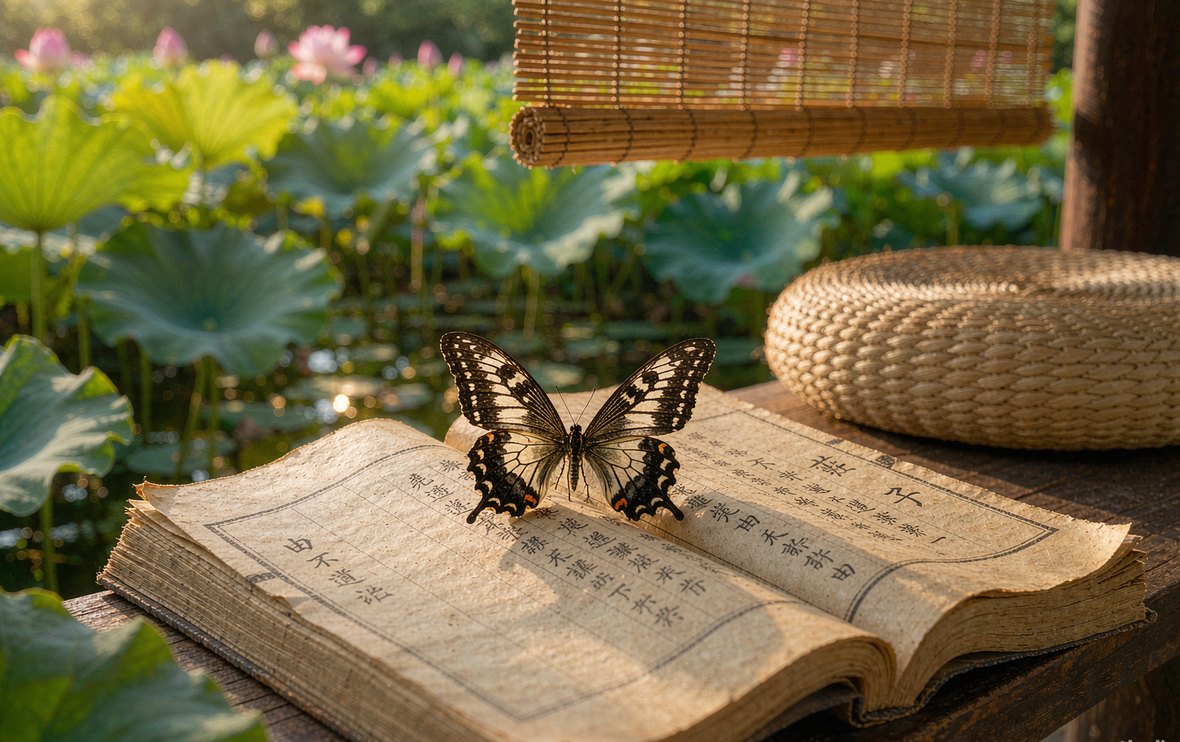
By Zhuang Zhou and his later school, the received text in thirty-three chapters: inner chapters (Zhuangzi’s own), outer, and miscellany. It is the strangest of the masters’ books: no statecraft, no ethics — only one question: how to live free in a world full of harness and toil. Zhuangzi wrote so that "nine parts in ten are allegory": the Kun becomes the Peng and wings ninety thousand li; Cook Ding cuts the ox with spirit rather than eye; Zhuang Zhou dreams a butterfly and cannot tell whether he is a man dreaming a butterfly or a butterfly dreaming a man — philosophy flies in the dress of myth and story; argument becomes literature. Guo Moruo said half the history of Chinese literature since Qin and Han developed under his influence; for the Chinese, Zhuangzi is a spiritual tradition: read him when fortune fails, when hemmed in, when gasping for air — he gave this practical people a pair of flying wings.
The Zhuangzi says of itself: "Nine parts in ten are allegory; seven parts weighty citation; random phrases daily new." The Kun becomes the Peng and journeys to the Southern Deep while cicada and dove laugh — one myth exhausts "small knowledge cannot reach great"; Cook Ding cuts the ox "meeting it with spirit rather than eye, sense halting while spirit moves," his blade fresh after nineteen years — one kitchen scene exhausts the art of "following the natural grain"; Hundun dies when bored gods drill him a hole each day for seven — with the seven openings opened, innocence dies: civilization’s remodeling of nature compressed into one fierce fable.
This manner is itself philosophy: truth cannot be exhausted by argument, only awakened by story. From it Chinese literature gained new possibility — Li Bai’s great Peng, Su Shi’s butterfly dream, Lu Xun’s parody "Resurrection," the opening of Dream of the Red Chamber — all Zhuangzi’s offspring. To awaken truth through beauty, to exhaust meaning through image — half of the Chinese artistic spirit was written by Zhuangzi.
The Qiwulun is the core of Zhuangzi’s philosophy: things seem infinitely different, yet "the Way makes them one." Mao Qiang and Li Ji were beauties to men, yet fish plunge deep at their sight — beauty and ugliness depend on the beholder; Zhuang Zhou dreams a butterfly, and cannot tell whether he is a man dreaming or a butterfly dreaming — the line between self and thing can be lifted; the monkeys cheated at "three in the morning, four at night" rage or rejoice though nothing changed — the absurdity of quarrels over names is plain. Right and wrong, high and low, great and small, life and death — all oppositions are man-made cuts.
This is no relativist game but a liberating gaze: lay down the prefabricated mind, and "heaven and earth were born together with me; the ten thousand things and I are one" — the world suddenly widens. Facing disputes of right and wrong, "the sage harmonizes them and rests in Heaven’s equal" — taking no side, wasting no strength, returning to things themselves. This wisdom of leveling is the Chinese resource for handling disagreement and digesting gain and loss: see things even, and you can let them go.
泉涸,鱼相与处于陆……不如相忘于江湖。 — The spring dries, and fish huddle together on land... better to forget each other in rivers and lakes.——Zhuangzi, "The Great Master"
Free Wandering asks the limit of freedom: the Peng flies ninety thousand li, yet still depends on wind; Liezi rides the wind, yet still depends on his body — true freedom is "depending on nothing": not needing the world’s provision or approval, the spirit a world of its own. Zhuangzi’s recipe: "ride the truth of heaven and earth, harness the changes of the six qi, and wander the infinite" — move with the nature of things, impose not the self on the world nor let the world harness the self.
The other path is "the use of the useless": Huizi scorned the gnarled ailanthus, and Zhuangzi answered, "No ax shall fell it, nothing harms it — how could uselessness ever trouble it?" To be unemployable is the greatest preservation: the worthless tree lives out its years; the deformed Shushu escapes conscription. In a world that uses men as tools, "uselessness" is the earliest resistance to alienation. Zhuangzi thus became the spiritual ally of all who refuse incorporation: to keep a bit of the useless is to keep a plot of free land.
When Zhuangzi’s wife died, Huizi came to condole and found him drumming on a basin and singing — not heartlessness, but "observing her beginning, she had no life": qi gathered and she lived, qi scattered and she died — "a passage through fate." Nearing his own death, his disciples wished a rich burial; he replied, "I take heaven and earth as my coffin and shell, the sun and moon as my jade discs, the stars as my pearls, the ten thousand things as my funeral gifts — what hearse could outdo the universe?" "Fed to the kites above or the ants below — why rob one to give the other? What partiality!"
This view of death is Chinese culture’s most clearsighted vein: no fear of death, no clinging to life, setting the individual back amid the flux to be seen level. Tao Yuanming’s "adrift in the Great Transformation, neither glad nor afraid," Su Shi’s "things and I are both inexhaustible" — all its echoes. A people’s attitude to death measures its spiritual depth — and Zhuangzi’s answer remains the East’s most thorough: life and death as day and night; rest content with the season, accept with the flow, and sorrow and joy cannot enter.