Author
Sun Wu (Sunzi), a man of Qi in the late Spring and Autumn period
The world’s earliest surviving classic of stra...
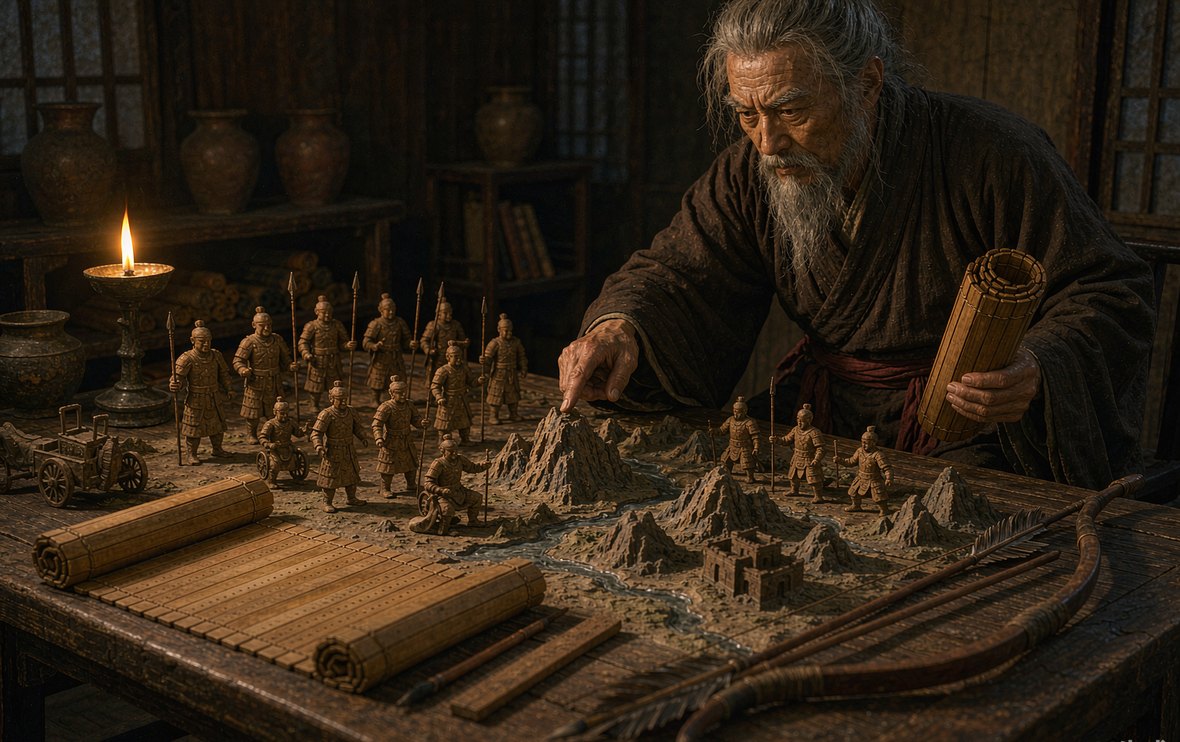
The world’s earliest surviving classic of strategy, written by Sun Wu of Qi in the late Spring and Autumn period: thirteen chapters, about six thousand characters. Born in the wars of the Spring and Autumn era, it transcends war itself: the ultimate ideal of the whole book is not victory in a hundred battles but “subduing the enemy without fighting”; the highest victory is one achieved at the smallest cost. Over twenty-five hundred years it has traveled from the Chinese command tent to the world: Napoleon reportedly carried it, West Point lists it as required reading, every Sengoku warlord in Japan kept a copy, and today it is a general textbook of business strategy, negotiation, and even competitive sport. Six thousand characters lay bare every basic element of competition — force, information, timing, terrain, psychology — so what it teaches was never merely war but the wisdom of every “situation of contest.”
The very first sentence sets the tone of the whole book: “War is a matter of vital importance to the state — the ground of death and life, the road of survival and ruin — it must not be neglected.” Sunzi’s attitude toward war is icy-cold: “A ruler must not raise an army out of anger; a general must not give battle out of resentment”; “move not unless there is gain, use not unless there is success, fight not unless in peril.” Emotion is not grounds for war; interest and survival are. This “rational view of war” was nearly heresy in a hot-blooded ancient world.
On this basis he ranked the heights of warfare: “The best strategy is to attack the enemy’s plans; next, his alliances; next, his army; worst of all, to besiege walled cities” — to subdue the enemy without fighting is the acme of skill. The best victory makes the enemy abandon resistance; next comes isolating him diplomatically; only as a last resort, arms. This idea of “total victory” makes the Art of War an essentially anti-war book on war: it studies war precisely in order to end it.
“When battle has not yet been joined and the temple calculation foretells victory, it is because many conditions are in hand” — Sunzi moved the weight of victory from the battlefield back to the temple: the five factors (Dao, heaven, earth, commander, method) and the seven calculations compared item by item before war reveals most of the outcome. “The skilled fighter first makes himself unconquerable, then waits for the moment the enemy can be conquered”; “the victorious army wins first and then seeks battle; the defeated army fights first and then seeks to win” — those who fight well fight battles already won; those who do not gamble on luck after the fighting starts.
This “winning first” thinking has been widely transplanted in the modern age: business strategy speaks of the moat first, negotiation theory says preparation determines outcome, competitive sport says training wins the game. Its crux is discipline — restraining the urge to open battle in the face of temptation, spending effort where no one sees, amid all the noise. What we call luck is only the modest word of those who had already won.
兵者,国之大事,死生之地,存亡之道,不可不察也。 — War is a matter of vital importance to the state: the ground of death and life, the road of survival and ruin; it must not be neglected.——The Art of War · “Laying Plans” (Shi Ji)
Sunzi’s subtlety lies most of all in his management of uncertainty: “All warfare is deception. Thus, when able, appear unable; when deploying, appear not to.” “The skilled attacker keeps the enemy from knowing what to defend; the skilled defender keeps the enemy from knowing what to attack.” War is at bottom an information game — create false appearances, conceal intent, maneuver the opponent: “seize the initiative rather than be seized” — the initiative stays forever in your own hands; make the opponent move at your tempo.
“In all fighting, engage with the orthodox and win with the unorthodox” — frontal force fixes the enemy; the unexpected decides. “Avoid strength, strike weakness” — do not fight the hard battle; attack the vital point. This dialectic of void and substance runs beyond the military into a universal grammar of Chinese aesthetics and thought: calligraphy speaks of hidden and revealed brush-tips, painting of treating blankness as ink, prose of alternation of density and spareness. To read void and substance is to read half of the Chinese aesthetics of action.
The thirteen chapters are structured as tightly as a modern textbook: Laying Plans, Waging War, Attack by Stratagem, Tactical Dispositions, Energy, Void and Substance, Maneuvering, Variation in Tactics, The Army on the March, Terrain, The Nine Situations, The Attack by Fire, The Use of Spies — from grand strategy to tactics to intelligence, a complete closed loop. Cao Cao annotated it; Emperor Taizong of Tang said, “Of all books on war, none surpasses Sun Wu”; Emperor Shenzong of Song canonized the Seven Military Classics with the Sunzi at their head.
Its global journey is equally legendary: eastward to Japan in the Tang, then learned on the Korean peninsula; first French translation in 1772, and Napoleon reportedly carried it; in the twentieth century it entered American military academies and the halls of business, where “know the enemy and know yourself” became the catchphrase of multinationals. Six thousand characters, unfading after two thousand years, because Sunzi discusses not a particular war but the meta-rules of competition — as long as humans contest and game, this bundle of bamboo slips remains a living book.