Author
Attributed to Zuo Qiuming (Grand Historian of Lu)
Short for the Zuo Commentary on the Spring and...
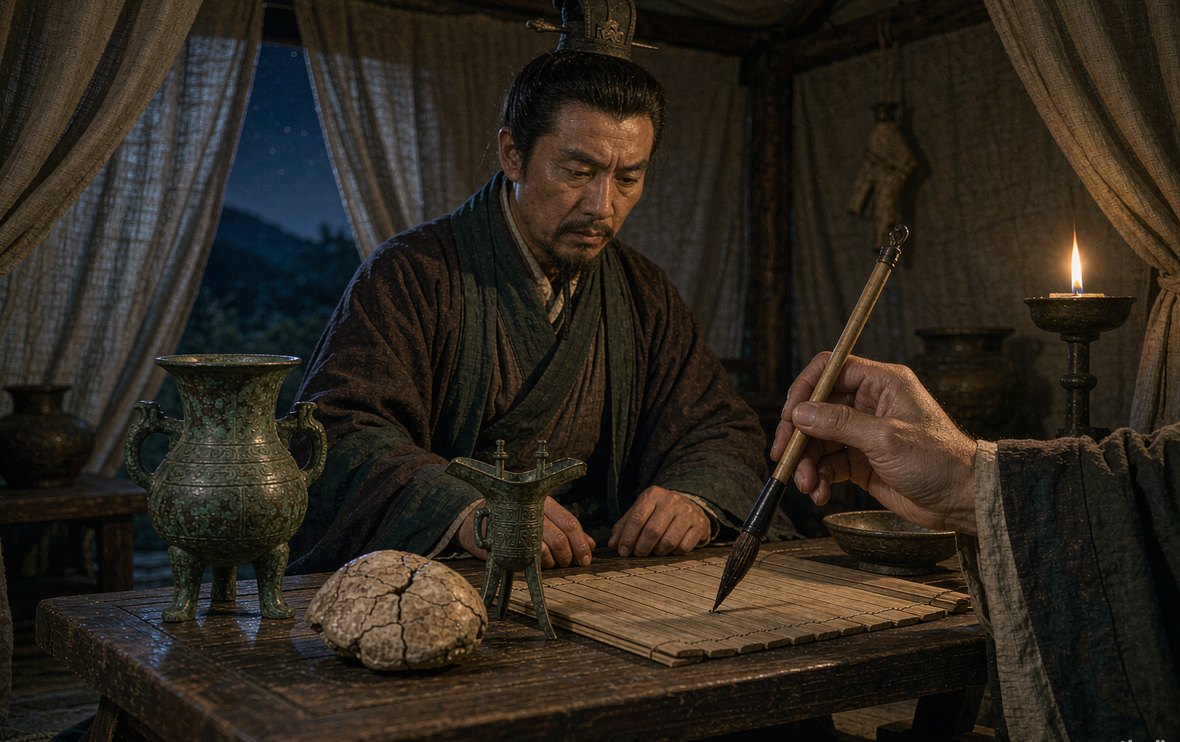
Short for the Zuo Commentary on the Spring and Autumn Annals, attributed to Zuo Qiuming, Grand Historian of Lu — China’s first annalistic history with full narrative, covering 259 years from Duke Yin’s first year to Duke Ai’s twenty-seventh, in 180,000 characters. If the Annals are the bones, the Zuo is the flesh: Duke Zhuang’s defeat of Duan, the hegemonies of Huan of Qi and Wen of Jin, the battles of Chengpu and Xiao, the contest of Jin and Chu — great and small affairs gathered whole, every voice true to life. It is also the summit of pre-Qin prose: narrative cut like fiction, war written like epic, and the "the gentleman says" commentary founding the tradition of historical verdicts. Liu Zhiji praised it as "workmanlike as creation itself, thoughts touching gods and spirits, a rarity among writings, unmatched past and present"; Qian Zhongshu called it "a marvel of prose without precedent." For two thousand years, whoever learned to narrate, to write history, to write at all, began with the Zuo.
The Annals give seventy characters a year; the Zuo unfolds the same years into 180,000 — the surplus is not a ledger but the whole craft of "how to write history": causes (every great event traced to its distant roots, Duke Zhuang’s defeat of Duan first written as the mother’s loathing of the breech-born child), details (mother and son meeting in a tunnel — "within the great tunnel, the joy is warm"), foreshadowing and echo, judgment on values. "He who does many unrighteous deeds will destroy himself; wait and see" — Duke Zhuang’s forbearance is planted at the start, so the victory twenty years on seems inevitable.
This is a maturity rare in world historiography: a keener sense of structure than Herodotus, a fuller cast than chronicle. The narrative technique of all later Chinese history — from the Shiji to the Zizhi Tongjian — is built on the Zuo’s foundations.
The Zuo writes war masterfully, and on a singular principle: full before the battle, spare on the field — victory is decided in council, hearts, and diplomacy, not in slaughter. At Chengpu, first Duke Wen of Jin "withdrawing three stages" to keep faith and the morale-war of "an army with virtue cannot be withstood," then Yu Zi’s obstinacy losing him his men — the battle itself is sketched in a few strokes, the outcome settled. At Xiao, first Shu’s weeping over the army ("Qin’s force will be met at Xiao"), then the Qin troops’ insolence passing Zhou’s north gate — "leaping onto chariots, three hundred of them" — the defeat already written on the road.
"The first drum rouses their spirit; with the second it flags; with the third it is spent" — Cao Gui’s debate on battle, and the sure deployment of detail, made the Zuo’s war-narrative the common model of later military manuals and novels: the Romance of the Three Kingdoms’ Guandu and Red Cliff are written precisely in the Zuo family method of "scheming before the field." To read the Zuo’s battle chapters is to gain not just historical insight but a method — decide the contest where no smoke yet rises.
国之大事,在祀与戎。 — The great affairs of a state are sacrifice and war.——Zuo Commentary, 13th year of Duke Cheng
The Zuo pioneered "the gentleman says": after the narrative, moral judgment introduced by "the gentleman considers" — Duke Zhuang’s failure to teach his brother, Duke Mu of Qin’s repentance, each brought to verdict. It is Spring and Autumn brushwork unfolded: praise and blame no longer hidden in word-choice but argued as historical essay. Thenceforth "the Grand Historian says" in the Shiji, "the eulogy says" in the Han History, "your servant Guang observes" in the Zizhi Tongjian — the verdict-form of two thousand years of official history begins here.
Its judgments also preserve the age’s ripest political wisdom: "The great affairs of a state are sacrifice and war"; "in danger, not forgetting his state — that is loyalty"; "thrift is the companion of virtue; extravagance the chief of evils"; "highest is to establish virtue, next to establish deeds" — countless maxims were fixed here. One may say the Zuo is both history and the collected political ethics of the Spring and Autumn era — many Chinese commonplaces on governing, serving, and being a man were first systematically said here.
The Zuo’s birth is disputed: is it a "commentary" expounding the classic, or an independent history? Han New Text scholars denied it commented on the Annals; Old Text scholars honored it as the true commentary; Liu Xin fought to seat it in the academy, raising Han classical learning’s greatest case; Kang Youwei even suspected it a forgery by Liu Xin — two thousand years of contention. Today’s general view: its core took shape in the early Warring States, its author formed by Lu’s historian tradition, dating events to the Annals while standing as an independent book.
The disputes diminish not its worth but witness it: precisely because it mattered so much, scholars fought over its every word. Du Yu’s Collected Commentary fixed the joint arrangement of classic and commentary; Kong Yingda’s Correct Meaning gathered all before the Tang; from the Anthology of Ancient Prose to school textbooks, "Duke Zhuang defeats Duan at Yan," "Cao Gui’s debate on battle," "Zhu Zhiwu turns back the Qin army" remain the Chinese first lesson in narrative prose. An 180,000-character old book is still teaching the Chinese how to write and how to read hearts.