Chief editor
Sima Guang (1019–1086)
China’s first great general history in annalis...
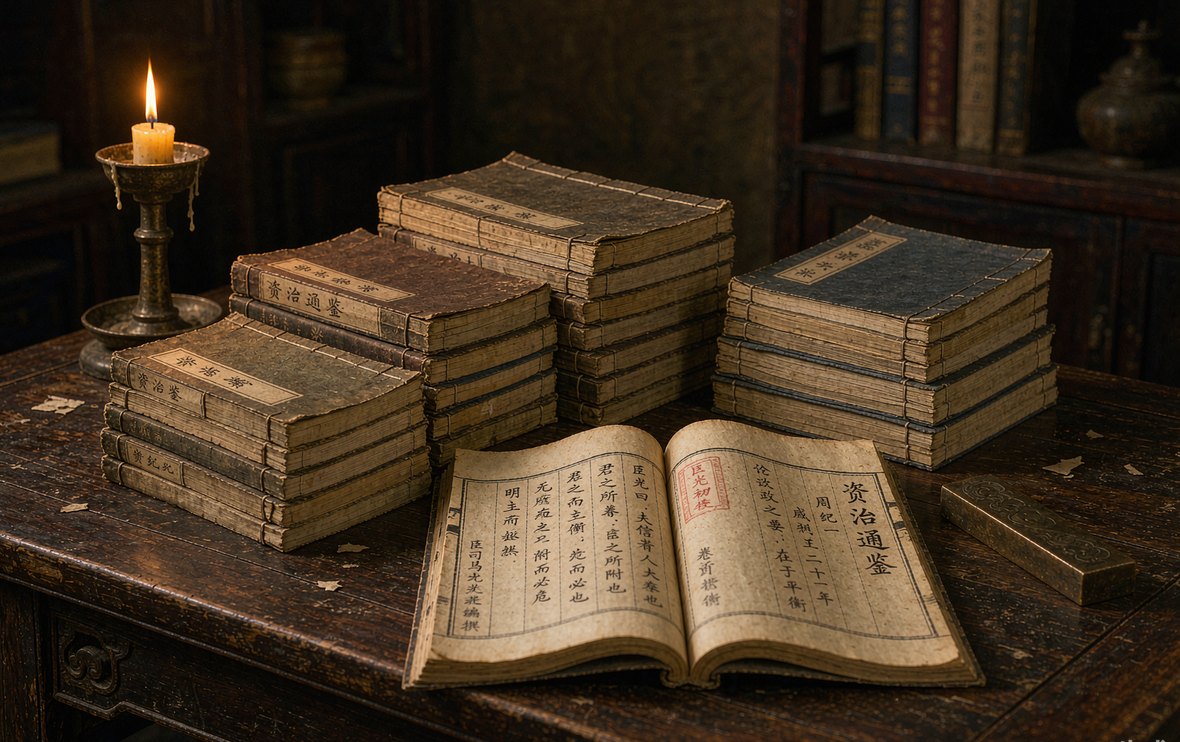
China’s first great general history in annalistic form, chief-edited by Sima Guang over nineteen years: 294 juan, over three million characters, covering 1,362 years from King Weilie of Zhou to Emperor Shizong of Later Zhou. Emperor Shenzong of Song bestowed the title “Zizhi Tongjian” — mirroring past events, that they may aid the way of governance: a history textbook written for rulers, every juan answering the same question — why do some regimes flourish and others perish? Sima Guang’s view of history is plain and cold: “history is that by which one clarifies the way of governing the world.” Time is the warp, events the weft — “events strung to years, persons shown through events” — the order and chaos, rise and fall of 136 reigns compressed into one enormous mirror. It does not seek the literary brilliance of the Records; it seeks precision like statute. Zhu Xi, dissatisfied that its narrative outran its moral argument, wrote his own Zizhi Tongjian Gangmu — itself proof of its weight. Thenceforth on every emperor’s desk the Tongjian stood beside the Records: one speaks of persons and spirit, the other of institutions and consequence.
The Zizhi Tongjian’s aim is explicit: not chronicle for collecting, but a mirror hung expressly for governance. Sima Guang stated his selection: take only what “bears on the rise and fall of states and the welfare of the people — the good that can serve as model, the evil that can serve as warning.” Whatever bore no relation to governing, however beautiful, was excluded; whatever touched rise and fall, however small, was recorded. The opening on the partition of Jin by the three families is already a famous essay: the Zhou Son of Heaven personally endorsed three usurpers — “with this, the ritual of the former kings was finished” — once name and rank break, the world falls apart with them; the book sets its keynote of “ritual order as the framework” from the first page.
Emperor Shenzong bestowed the name “Zizhi Tongjian,” regarding it as “the master ledger of dynastic rise and fall.” Thereafter it was desk-required reading for emperors and ministers: the Kangxi Emperor read it seventeen times; the Qianlong Emperor’s marginalia never ceased; Zeng Guofan called it “the startling book of the ancient sages”; Mao Zedong read it through seventeen times and left more than ten thousand characters of commentary. A single book studied and reread for a thousand years by the holders of supreme power — without parallel in world history. It proves the Chinese fixation on historical experience: everything happening today has happened in history.
The making of the Tongjian is itself a model of scholarly engineering: Sima Guang first drew the Liniantu (Chronological Charts) to fix the frame, then compiled the “congmu” (master inventory) to gather sources, next wrote the “changbian” (extended draft) — “better to err on the side of plenty than of sparseness” — and finally cut and polished the final text. Liu Shu, Liu Ban, and Fan Zuyu drafted sections in parallel, each taking a span, yet the style of the whole is uniform as one hand. An appendix, the Kaoyi (Textual Criticism), in thirty juan, examines and adjudicates every discrepant source item by item — the founding of source criticism in Chinese historiography.
When the book was done, Sima Guang said, “my strength is spent entirely in this book.” Nineteen years in the Garden of Solitary Joy in Luoyang: begun in the third year of Zhiping under Yingzong, completed in the seventh year of Yuanfeng under Shenzong; two years later Sima Guang became chancellor and abolished the New Laws wholesale, dying within the year — a life’s achievement, half in the political arena, half in the study. Reading the Tongjian today, one reads not only history but how one man spent a lifetime answering one question: why does order collapse, and how is it rebuilt?
鉴前世之兴衰,考当今之得失,嘉善矜恶,取是舍非。 — Mirror the rise and fall of past ages, examine the gains and losses of the present; commend the good, pity the wicked, take the right, discard the wrong.——Sima Guang, memorial accompanying the presentation of the Zizhi Tongjian
In writing rise and fall the Tongjian never ascribes them to fate but to human scheming and institutions: Qin perished by extortion that lost the people; Han rose by covenant laws that won hearts; Wang Mang failed through reforms sundered from reality; Tang flourished by accepting remonstrance and equalizing land; the An–Shi rebellion broke out from border power too heavy and the center too light. Behind Sima Guang’s year-by-year arrangement lies a complete political pathology: in which year the lesion was planted, in which year it flared — a case history with every channel clear.
He watched especially for the “beginnings” — the starting points of every collapse: whence did Jin fall? Not on the day of the Rebellion of the Eight Princes, but at the first indulgence of Emperor Wu after the conquest of Wu. Whence did Tang decline? Not at the Huang Chao uprising, but when Xuanzong wearied of governance and Li Linfu monopolized power. “Calamity ever accumulates from the minute and overlooked” — the most dangerous signals appear first where no one looks. This depth of diagnosis made the Tongjian an early-warning manual of governance.
Sima Guang’s historical judgments (over a hundred “Your Servant Guang remarks”) take clear positions: li (ritual) is order’s framework — the core of order is name and rank, and rules; talent is the resource of virtue, virtue the commander of talent — in appointments virtue comes first, as the fall of Zhi Bo showed, talent outgrowing virtue. Which is harder, founding an enterprise or preserving it? When Taizong asked, Fang Xuanling and Wei Zheng each held one end, and he gave a balanced answer through historical events. His judgments do not always fit modern values — a conservative cast made him dismissive of the reformers — but as a self-consistent philosophy of governance, its coherence and rigor command awe.
After the Tongjian, annalistic history became a grand lineage: the Xu Zizhi Tongjian Changbian, the Xu Zizhi Tongjian, the Ming Tongjian, the Qing Tongjian — more than a thousand years of continuation made this book the spine of Chinese general history. Hu Sanxing annotated the Tongjian for thirty years; Wang Fuzhi wrote the Du Tongjian Lun in sixty-four essays; the great Confucians of every age used this book as their training ground of thought. One may say the Tongjian bred a tradition: take history as a mirror — four characters still engraved in the political instinct of the Chinese.