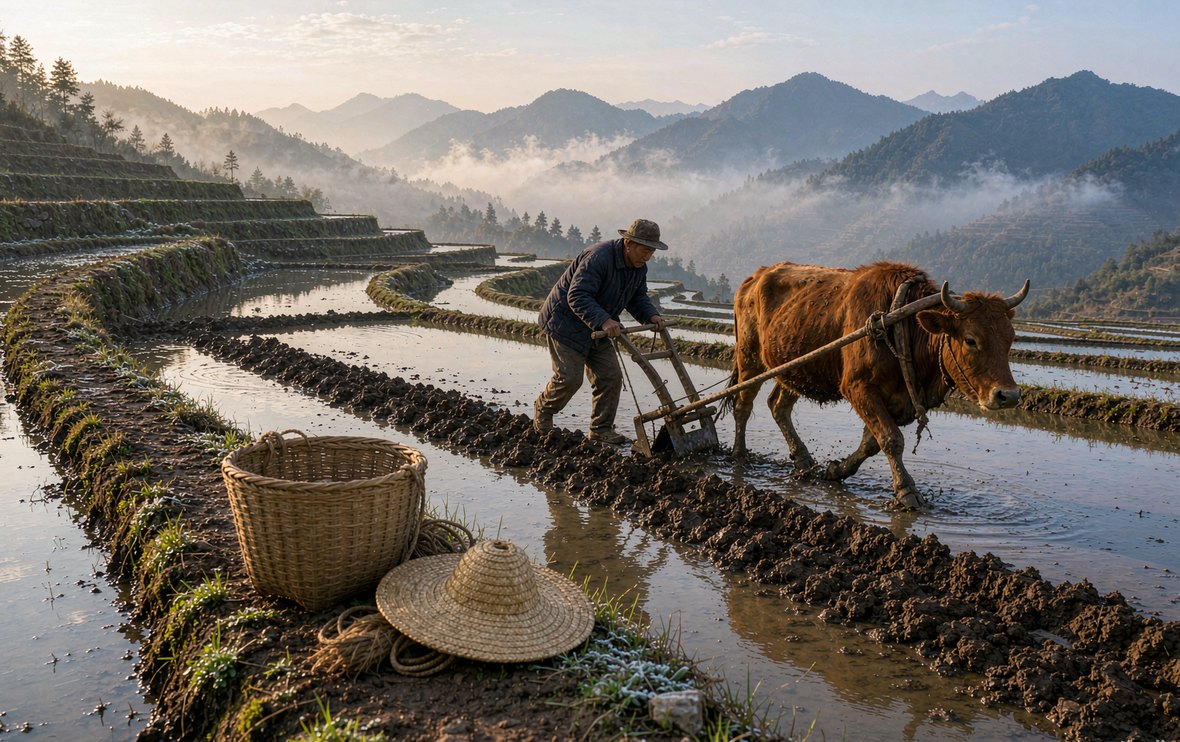
The twenty-four solar terms are a system of time-knowledge the Chinese built by watching the sun's annual circuit: the ecliptic is cut into twenty-four segments, opening with the Beginning of Spring and closing with Major Cold, each carrying its own phenology, farm work and instructions for living. It fixes the calendar by astronomy, answers the seasons by phenology and returns to use through agriculture. Formed in the pre-Qin era and written into the calendar in the Han, for more than two thousand years it has guided farming, food, health and festival life — the most everyday embodiment of the philosophy of tianren heyi (Heaven and humanity as one). In 2016 the terms were inscribed on UNESCO's Representative List of the Intangible Cultural Heritage of Humanity, and the world meteorological community has called them "China's fifth great invention". They are not merely ticks on a dial but a way of perceiving the world: knowing cold and heat, telling north from south, moving with the seasons — a survival wisdom written into the calendar itself.
Astronomy and the Calendar: Cutting the Solar Year into Twenty-Four PartsAstronomy of the Terms
QWhy do the terms hold almost the same date in the Gregorian calendar year after year, yet drift each year in the lunar calendar? — Because the terms follow the sun and the lunar calendar follows the moon: two clocks, each keeping its own time.
At its core the system is solar: the Earth's circuit of the sun is divided into 360 degrees, and every fifteen degrees marks one term — which is why the terms fall on almost fixed dates in the Gregorian calendar, the winter solstice always arriving around 21 December. The four "beginnings" of spring, summer, autumn and winter open the gates of the seasons, while the two equinoxes and two solstices fix the pivots of yin and yang. The framework was already taking shape before the Qin, and the Huainanzi, in its chapter on celestial patterns, records all twenty-four names in full for the first time.
The ancients measured the sun directly with the gnomon: a post eight chi tall was raised, and the day of the shortest noon shadow was the summer solstice, the longest the winter solstice; the span between two solstices was then divided into twenty-four equal parts. With no telescope and no atomic clock, armed only with a pole and the patient records of dozens of generations, they fixed the solar year to within a day — a remarkable achievement in the history of world astronomy.
The system also carries the pentads: three to each term, five days apiece, each marked by a phenomenon such as "wild geese come" or "thunder first sounds". Astronomy and phenology are recorded on two parallel tracks, giving the abstract calendar a natural scale one can feel. It is one of the most precise bodies of solar-calendar knowledge in the ancient world.
✦
斗柄东指,天下皆春 — When the Dipper's handle points east, all under Heaven is in spring
At dusk one watches where the handle of the Big Dipper points: east means the Beginning of Spring, south the summer solstice. The ancients turned the whole sky into an enormous clock whose hands were the turning stars — astronomy thus left the observatory and became public knowledge that anyone could verify by looking up.
❖
The Pentad System: A Natural Clock That Changes Every Five DaysThe 72 Pentads
QWithout thermometers or satellite images, how did the ancients cut the year into seventy-two parts and still keep the error tiny? — Through centuries of unbroken collective observation: phenology is the data nature reports on its own.
Each term spans fifteen days, subdivided into three pentads, seventy-two in all across the year. Take Awakening of Insects: in the first pentad the peach begins to bloom, in the second the orioles sing, in the third hawks turn into doves — a new phenological shot every five days, like a nature documentary edited by the eye. These descriptions rest on thousands of years of continuous observation, the longest ecological record on the East Asian continent.
The beauty of the pentads is that they test the sky against the earth: when the calendar says it should be warm, one checks whether the peach has actually flowered; when astronomy says it should be cold, one looks for the geese flying south. Celestial regularity and terrestrial verification interlock, forming a loop of knowledge that can be checked and handed down. The West built an observation system of comparable scale only with the rise of modern phenology.
✦
花木管时令,鸟鸣报农时 — Flowers keep the seasons, birdsong announces the farming hour
Plants and animals are the most honest calendar: peach blossom means rain is near, swallows mean the spring equinox. The ancients institutionalized this into the seventy-two pentads, so that even a farmer who could not read could "read the sky for his living" without going wrong — science translated into the language of daily life.
The Twenty-Four Terms, One by One: Meaning · Phenology · ScienceALL TERMS · ONE BY ONE
Lichun (Beginning of Spring)Feb 3–5
The first of the seasons; all things set out anew; "biting the spring" welcomes the year
The sun reaches 315° of ecliptic longitude; the East Asian winter monsoon weakens and the soil begins to thaw — the ground turns back toward warmth
Yushui (Rain Water)Feb 18–20
Ice and snow melt, rainfall grows, and moisture nourishes all things in silence
Warm, moist air pushes north and snow turns to rain; its three pentads are "otters pile up fish", "wild geese arrive" and "plants stir"
Jingzhe (Awakening of Insects)Mar 5–7
Spring thunder startles the hundred insects; the dormant awaken
Soil temperature rises to around 10 °C and hibernating animals emerge; it is the warmth of the ground, not the thunder, that wakes the insects
Chunfen (Spring Equinox)Mar 20–22
Day and night are equal, spring is half gone, yin and yang are in balance
The sun stands over the equator and day equals night worldwide; thereafter the northern hemisphere gains daylight and loses night
Qingming (Clear and Bright)Apr 4–6
Sky clear and earth bright; honouring the departed and walking out among the willows
Temperatures climb to 12–14 °C and the air turns crisp and clear; the day is both a solar term and a major festival of ancestral remembrance
Guyu (Grain Rain)Apr 19–21
Rain brings forth the hundred grains; sowing and showers coincide, and the tea harvest is at its best
Rainfall rises markedly, ideal for sowing grain; in the south the "Grain Rain tea" picking follows the pre-Qingming harvest
Lixia (Beginning of Summer)May 5–7
Summer opens its gate; all things grow lush and full
The sun reaches 45° of ecliptic longitude; a steady 22 °C marks the start of summer, and Jiangnan enters its season of deep green shade
Xiaoman (Grain Buds)May 20–22
Grain fills but does not yet ripen — nearly full, not yet overflowing
Winter wheat in the north enters the milky stage; in the south the saying runs "Xiaoman fills the rivers" — abundant rain without flood
Mangzhong (Grain in Ear)Jun 5–7
Awned grain can be sown; wheat to reap and rice to plant — busy at both ends
The busiest "three summers" of the year: harvest, planting and field care all at once, as the plum rains begin
Xiazhi (Summer Solstice)Jun 21–22
The longest day; yang reaches its peak and the first yin is born
The sun stands over the Tropic of Cancer, giving the northern hemisphere its longest day; heat still accumulates, so the hottest days lie ahead
Xiaoshu (Minor Heat)Jul 6–8
Heat first gathers, not yet at its height; crickets take to the walls
Around the end of the plum rains and the start of the dog days, the steamy "steamed above, boiled below" pattern sets in
Dashu (Major Heat)Jul 22–24
The hottest stretch of the year, when damp heat steams to its extreme
The subtropical high is at its strongest and most regions record their yearly temperature peak; cooling herb tea and sun-dried ginger appear on cue
Liqiu (Beginning of Autumn)Aug 7–9
Autumn opens; cool wind arrives on schedule and bodies are fattened for the cold
The sun reaches 135° of ecliptic longitude; heat lingers though cool winds have come — "one dog day after autumn" warns that summer is not over
Chushu (End of Heat)Aug 22–24
"Chu" means to cease: the heat ends here
The subtropical high retreats south and the gap between day and night widens; from now on "each autumn rain brings a little more cold"
Bailu (White Dew)Sep 7–9
Cool nights condense into dew, autumn begins to tint the land, and geese fly south
A wide day-night temperature gap condenses vapour into dew at night; the Book of Songs line "thick grow the reeds, white dew turns to frost" describes this very season
Qiufen (Autumn Equinox)Sep 22–24
Day and night divide again, autumn passes its midpoint, and the harvest is celebrated
The sun returns to the equator; since 2018 the day has been observed as China's Farmers' Harvest Festival
Hanlu (Cold Dew)Oct 8–9
The dew turns cold and verges on frost; chrysanthemums show their yellow blooms
Temperatures fall below those of White Dew and the dew carries a chill; north of the Nanling range, late-autumn phenology takes hold
Shuangjiang (Frost's Descent)Oct 23–24
First frost arrives, the autumn harvest is rounded off, persimmons redden and chrysanthemums fade
Ground temperature drops below freezing and vapour condenses directly into frost; "frost kills the hundred grasses" marks the end of the growing season
Lidong (Beginning of Winter)Nov 7–8
Winter opens; all things store themselves away and the body is nourished for the cold
The sun reaches 225° of ecliptic longitude; crops go into store and animals hide away — in the north this is the phenological marker for the heating season
Xiaoxue (Minor Snow)Nov 22–23
First snow approaches, earth and sky begin to freeze, vegetables are pickled for winter
The first light snows fall along the Yellow River; temperatures hover near freezing and the curing of winter meats begins
Daxue (Major Snow)Dec 6–8
Snow lies heavy and the ground is cold; a timely snow promises a good year
Snowfall and snow cover become far more likely; a thick blanket insulates the soil, holds moisture and kills pests — hence the omen of plenty
Dongzhi (Winter Solstice)Dec 21–23
The shortest day; a single yang returns and the "nine nines" of cold begin
The sun stands over the Tropic of Capricorn, giving the northern hemisphere its shortest day; the sun then turns north again — "the winter solstice is as great as the New Year"
Xiaohan (Minor Cold)Jan 5–7
The cold is called minor, yet this is often where the deepest chill begins
"Minor Cold outdoes Major Cold": ground heat reaches its lowest ebb, and in most regions the year's coldest days fall around this term
Dahan (Major Cold)Jan 20–21
Cold at its utmost, winter storage ends, and all waits quietly for spring
The last term of the year, where cold peaks and turns; "when Major Cold tops out, the days grow warm again" — the annual cycle closes
❖
Farm Work and Daily Life: The Terms as OrdersFarming by the Terms
Q"Around Qingming, plant melons and beans" — why could a ten-character proverb go almost never wrong for two thousand years without a weather forecast?
"Around Qingming, plant melons and beans"; "White Dew is early, Cold Dew is late, the Autumn Equinox is just right for wheat" — farming proverbs use the terms as absolute coordinates, and sowing, reaping and storing all answer to the season's command. The terms order daily life too: tonics at the winter solstice, "biting the spring" at its beginning, herb tea in the dog days. The care of the body follows the sun — the calendar form of the Chinese medical principle of nourishing life in step with the seasons.
Why have these proverbs held good for two thousand years? Because the astronomy behind the terms does not change: the geometry of sun and earth determines light and accumulated heat, light and heat determine phenology, and phenology determines the farming hour. The proverbs are empirical, the terms astronomical, and the two have checked each other for two millennia, producing an astonishingly stable set of instructions. Winter wheat in north China is still sown roughly by the old rule: "sow wheat at the Autumn Equinox".
The modernity of the terms has not faded: agriculture still combines accumulated temperature with the old calendar, wellness practice still regulates the body by the terms, and even city dwellers "put on autumn fat" or eat dumplings at the winter solstice out of seasonal habit. A body of knowledge from the farming age continues to serve life in the post-industrial age — a case with few parallels anywhere in the world.
✦
白露早,寒露迟,秋分种麦正当时 — White Dew too early, Cold Dew too late, the Autumn Equinox just right for wheat
One task, three terms, three answers: sowing at White Dew makes the wheat grow too rank, at Cold Dew the accumulated warmth falls short, at the Autumn Equinox it is exactly right. The proverb compresses the most complex optimum into rhyme, letting knowledge travel mouth to mouth for a thousand years without distortion — a compression algorithm built into the Chinese language.
❖
Terms and Festivals: Flowers Grown on the Skeleton of TimeFestivals Born of Terms
QWhy was the winter solstice once more important than the New Year, with the emperor himself sacrificing at the Temple of Heaven? — Because the solstice is the point where the sun turns back, the cosmic pivot at which "yin reaches its end and yang is born".
Terms and festivals share one root: Qingming rose from a solar term to the great day of ancestral remembrance; the winter solstice, "as great as the New Year", once began the Qin year; the summer solstice and the Dragon Boat Festival are entangled in origin; the spring ox whipping at the start of spring grew into a nationwide welcome to the season. More than four fifths of Chinese festivals have a solar term behind them. The terms are the skeleton of time; the festivals are the flowers that grow on it.
The shifting status of the winter solstice makes the point best. In the Zhou dynasty the month containing the solstice began the year — the solstice was the New Year itself. When the Han moved the year's start to the first lunar month, the solstice was demoted to a "sub-year", yet officials still took leave, the court still offered congratulations and the sacrifice to Heaven was still performed. The Circular Mound Altar in Beijing's Temple of Heaven was built precisely for the emperors of Ming and Qing to sacrifice there each winter solstice. Behind the rise and fall of one term lies the whole political history of the calendar.
✦
冬至大如年 — The winter solstice is as great as the New Year
On this day the daylight is shortest and the night longest; from then on each day grows a little longer. The ancients saw it as "the return of a single yang", the moment the world restarts. To make the turning point of the year the most solemn of festivals is at heart a rite of gratitude to the sun: endure the darkest hour, and the light gains ground every day.
❖
Poetic Time: The Chinese Aesthetics of the Solar TermsPoetics of Time
QWhy do words like Jingzhe and Bailu seem to carry their own images and moods? — Because each name is a frame of nature in close-up: Chinese turned astronomical data into poetry.
The terms seep into language and aesthetics as well: Jingzhe, Bailu, Shuangjiang are among the most beautiful words in Chinese — not abstract numbers but images: spring thunder waking the sleeping insects, the first drop of autumn dew beading on a leaf. Du Fu's "good rain knows its season, and comes when spring is due" was written of Rain Water; "thick grow the reeds, white dew turns to frost" fixed White Dew in the Book of Songs for all time. The terms became the seasonal grammar of poetry.
The naming is itself a miniature natural philosophy: single characters — awakening, clear, full, awn, white, cold, frost, snow — trace the year's rising and falling curve of energy and moisture. Japan still uses the twenty-four names intact, and the traditional calendars of the Korean peninsula and Vietnam follow them too. The terms are a time-aesthetic shared across the Sinographic world.
✦
好雨知时节,当春乃发生 — Good rain knows its season, and comes when spring is due
Du Fu, "Happy Rain on a Spring Night". In the Rain Water term the east wind thaws the ice and plants stir; a night rain is spring's message delivered on time. Du Fu gives this punctuality its life: the good rain understands the calendar and arrives when it should. The terms gave the poet a coordinate system for time; the poet gave it warmth and a heartbeat.
❖
Heritage and Transmission: A New Contract with NatureLiving Heritage Today
QIn the smartphone age, with a clock accurate to the second in every hand, why do we still need the solar terms? — Because the terms do not measure the hour but the relationship between the body and the world.
After the UNESCO inscription in 2016 the culture of the terms enjoyed a revival: documentaries, themed exhibitions, community observances and school courses have multiplied. The Start of Summer festival at Banshan in Hangzhou, the winter-solstice rites at Tingpang in Sanmen, the "speaking of spring" in Shiqian, the Zhuang Frost's Descent festival — localities answer the terms with their own customs, drawing a regional map of "one term, one tradition".
In an age ruled by clocks and phones, the terms offer another view of time: not a homogenous scale but a flow with temperature, with phenology, with bodily feeling. Tea at Grain Rain, autumn fattening at the start of autumn, gathering round the stove at the winter solstice — the terms remind modern people that one may keep an appointment with nature and live by rhythm rather than by an endless schedule. This is the contemporary meaning of the phrase "a knowledge system of time" in the inscription.
✦
顺天时,量地利,则用力少而成功多 — Follow the seasons and measure the land, and less effort brings greater success
The agronomist Jia Sixie, in Essential Techniques for the Common People, stated the whole principle fifteen hundred years ago: work with the pattern of things and you spend least and gain most. The line long ago outgrew farming. It is the underlying algorithm by which Chinese culture handles the relation between people and nature, and the core legacy the twenty-four terms leave to the future.