Duration
From the 23rd of the twelfth lunar month to the 15th of the first
The Spring Festival is the grandest node in th...
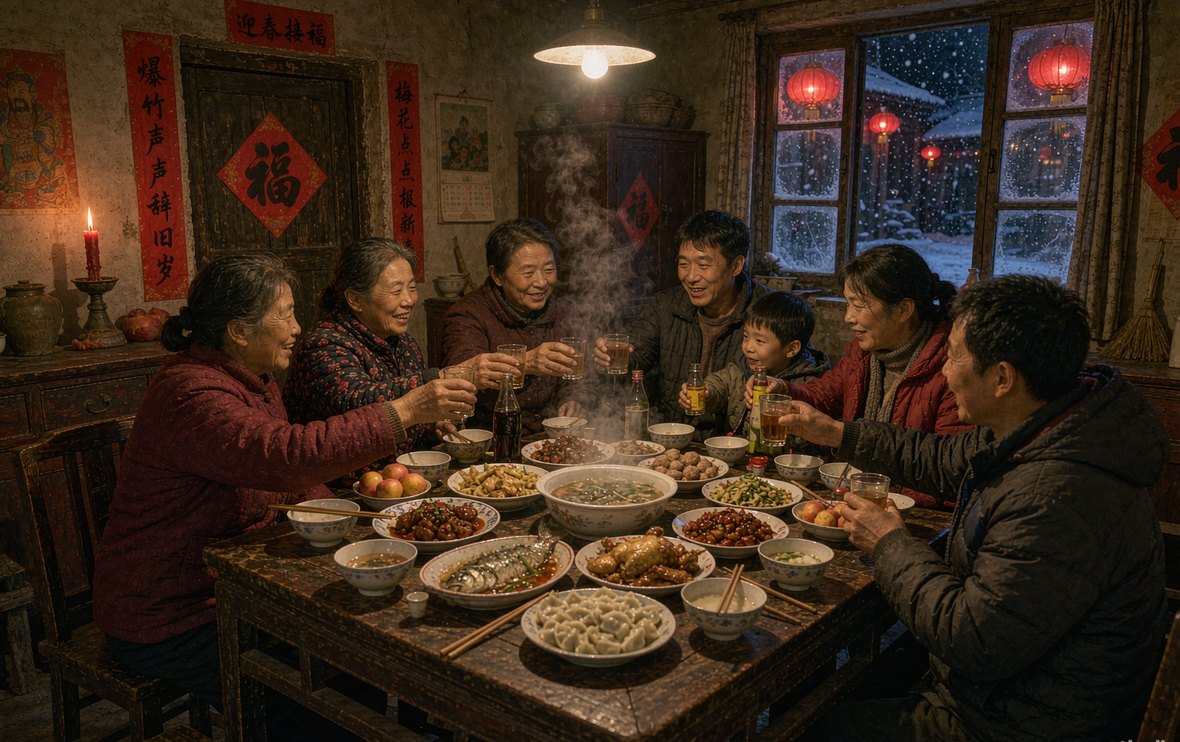
The Spring Festival is the grandest node in the Chinese year and the most widely observed annual ritual on earth. It opens with the kitchen god's send-off on the twenty-third of the twelfth lunar month, then runs through sweeping the house, laying in provisions, pasting spring couplets, the reunion dinner, the New Year vigil, New Year calls and the welcome of the wealth god, closing with the Lantern Festival on the fifteenth of the first month — a chain of some forty days that amounts to the yearly dress rehearsal of Chinese family ethics. The word nian first meant the ripening of grain, and its story is woven with the farming cycle and the legend of the nian beast; its core is farewell to the old, gratitude to the ancestors and the gathering of kin. In 2024 "Spring Festival, social practices of the Chinese people in celebration of the traditional new year" was inscribed on UNESCO's Representative List. As the Chinese New Year becomes a festival of the world, roughly one fifth of humanity takes part in this reunion in one form or another. A pair of chopsticks laid at the table, a lamp burning through New Year's Eve — these carry the whole of the Chinese imagination of home.
The original sense of nian is the cycle of ripening grain; the Shuowen dictionary glosses it simply as "the year: grain ripened". The New Year began as the zha sacrifice, a harvest thanksgiving offered to the ancestors and the hundred spirits. The start of the year moved repeatedly — the Xia began it in the first month, the Shang in the twelfth, the Zhou in the eleventh — until Emperor Wu of Han's Taichu calendar fixed it at the first day of the first month, where it stayed for more than two thousand years. The legend of the nian beast is a latecomer, yet it gives the firecrackers a vivid rationale: folk narrative always finds a way to fit a story's heart into an old custom.
The festival was once called Yuandan or Yuanri, "the first dawn". When the Gregorian calendar was adopted in 1912 the name was ceded to 1 January, and the lunar new year became the "Spring Festival" — a migration of names that records a delicate negotiation between tradition and modernity.
The festival is a play in forty days. The curtain rises at Laba: "once Laba is past, the New Year is here." On the twenty-third the kitchen god is sent off, his mouth sealed with sticky sugar; on the twenty-fourth the house is swept, for chen (dust) puns on chen (the old), and the old must be swept out; on the twenty-eighth come the paper cuttings. New Year's Eve brings the ancestral offerings and the reunion dinner, with the fish left head and tail intact for "surplus year after year"; then the vigil, lamps kept burning and no one sleeping; then the lucky money that "presses down" evil. The first day is for New Year calls, the second for a daughter's return to her parents, the fifth for welcoming the wealth god and breaking the taboo, the fifteenth for the Lantern Festival that ends it all. Every day has its name, its rules, its emotional direction.
Beneath the sequence lies an annual reset of order: debts settled, vows repaid, quarrels reconciled, families gathered — human relations are sorted and put back in place at the turn of the year. This is why the festival has been called the Chinese rehearsal of social ethics: filial piety, brotherly respect, deference and neighbourliness all appear on the schedule.
The regional variety of the festival is a living cultural map. The north keeps the vigil with jiaozi, whose name puns on the "crossing of the year" at midnight; the south eats nian gao and tangyuan for "rising higher year by year" and "reunion". Guangdong walks the flower streets, Fujian parades its gods, the northeast has frozen pears and bean-paste buns, Jiangnan sets out the clay pot and eight-treasure rice. In Minnan families gather round the stove; in Sichuan and Chongqing, tangyuan in fermented rice wine. One New Year table is half a geography of Chinese custom.
The migrant society of today has produced new forms — "reverse migration" to the children's cities, holidays spent travelling — yet the reunion dinner and its meaning have never shifted. The form changes, the core holds: the Spring Festival is the smallest common denominator of feeling in the Chinese-speaking world.
By the time the festival was inscribed in 2024, nearly twenty countries had made it a public holiday. New Year celebrations in San Francisco, London and Sydney have become signatures of those cities, and Disney and the NBA alike bring out Spring Festival themes — the Chinese New Year is now a global cultural event. In 2023 the United Nations General Assembly adopted a resolution making the lunar new year a UN holiday.
Its spread rests on a century of Chinese migration and on China's opening and rise. What travels is not only a festival but a grammar of values — reunion, gratitude, leaving the old behind — which happens to be a structure of feeling common to all humanity. How deeply the world keeps the Spring Festival has become a thermometer for the warmth of Chinese culture.